
Mission4Million: Axis Bank Foundation's Initiative To Transform 4 Million Rural Lives By 2030
For millions of rural families, economic security remains a distant goal. Through Mission4Million, Axis Bank Foundation hopes to change that by creating sustainable livelihood opportunities.
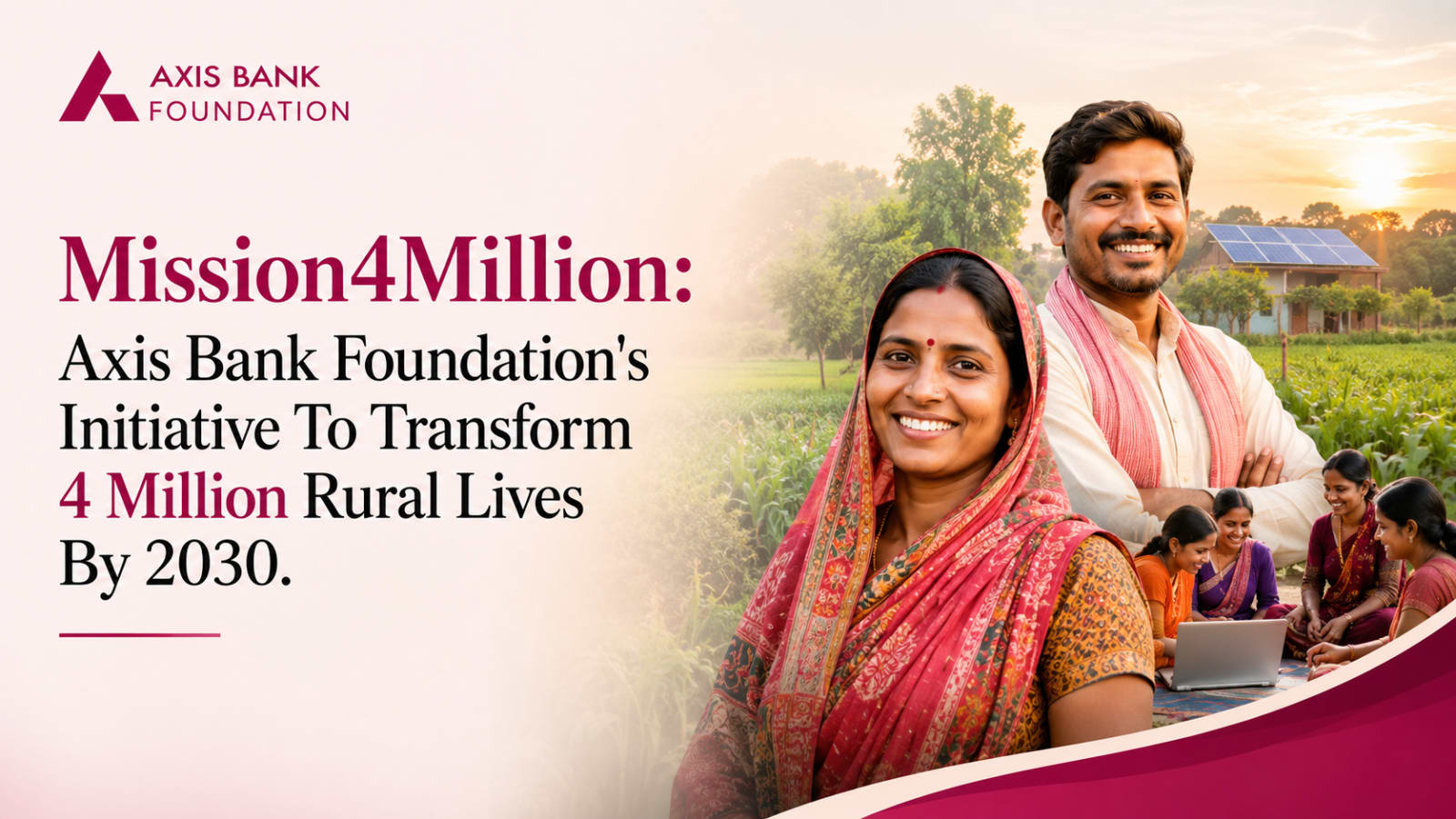
India may be one of the world’s fastest-growing major economies. Still, millions of rural households continue to face fragile livelihoods shaped by climate uncertainty, limited access to markets, inadequate financial services, and restricted income opportunities.
To bridge this gap, Axis Bank Foundation rolled out its programme called Mission4Million. Under this, the bank aims to enable 4 million vulnerable households to achieve sustainable and resilient livelihoods by 2030.
Mission4Million is the next phase of the bank’s long-standing livelihood development efforts. Announced in 2025 following the completion of Mission2Million, the initiative seeks to expand the foundation’s reach and empower 4 million households cumulatively by 2030-31.
Mission4Million primarily targets vulnerable and underserved rural households. These include small and marginal farmers, landless labourers, women from economically weaker backgrounds, rural youth, and communities that are particularly vulnerable to climate-related risks.
It works across multiple areas including agriculture and allied livelihoods, micro-enterprise development, skill training, women’s economic participation, access to financial services, climate-resilient farming practices, etc. The objective is to equip families with the resources, knowledge, and market linkages required to improve their earning potential and withstand economic or environmental shocks.
According to the latest estimates cited by the Axis Bank Foundation, more than 2.05 million families across 23,000+ villages in 32 states and union territories have already been supported as of March 2025.
The programme is highly significant because even today, rural livelihoods are influenced by multiple interconnected factors, ranging from changing weather patterns and declining farm productivity to limited access to formal credit, skills, and markets. As a result, improving household incomes often requires more than a single intervention. Sustainable progress depends on addressing these barriers to enable the families to build resilience against future uncertainties.
What Success Looked Like The First Time
The programme is implemented through partnerships with grassroots organisations and local communities across rural India. By combining livelihood opportunities with financial inclusion, capacity building, and climate resilience, Mission4Million aims to create self-sustaining ecosystems where families can move beyond subsistence and build long-term economic security.
Though the success of the initiative is yet to be determined, the first instalment, Mission2Million, was reported to be successful. According to Axis data, the programme supported more than 1.55 million families in kharif cultivation and 1.01 million families in rabi cultivation. It also helped strengthen over 120,000 self-help groups with 1.24 million members. Nearly 90,000 young people received vocational training, while enterprise development initiatives enabled rural women and entrepreneurs to access markets, credit, and new income opportunities.
Built on this success, the Axis Bank Foundation plans to take its cumulative outreach to four million households and reinforce its vision of creating resilient, self-reliant communities across the country.
Redefining Financial Inclusion
A key feature of the programme is the focus on creating measurable livelihood outcomes rather than plain and simple welfare initiatives. Farmers have been introduced to improved agricultural practices and market linkages, women have been encouraged to participate in income-generating activities, and young people have received vocational training designed to enhance employability.
The long-term relevance of Mission4Million lies in its recognition that financial inclusion alone cannot solve rural poverty. Access to banking services is undoubtedly important, but meaningful transformation requires a broader ecosystem that supports livelihoods, skills, entrepreneurship, and resilience.
As India continues its journey towards becoming a developed economy, ensuring that growth reaches vulnerable communities will remain a key challenge. Programmes such as Mission4Million seek to address this challenge by focusing on the people who are often left behind in the growth story.
While the success of the initiative will ultimately be measured by the lives it transforms over the coming years, its foundation rests on the achievements of Mission2Million and decades of community-based development work. If successful, Mission4Million could become one of the country's largest private-sector-led livelihood initiatives, helping millions of households move closer to economic security, self-reliance, and sustainable prosperity.
Read Next
More stories

Have a person, achievement or story our editors should know about?
Submit a Story
Stories worth telling, in your inbox.
Get the latest People Who Matter features delivered weekly.
Subscribe NowDiscussion
No comments yet. Be the first to share your thoughts.