
Gaur Gopal Das: The Monk Who Redefined How India Consumes Wisdom
Gaur Gopal Das’s rise signals a cultural shift where spiritual storytelling intersects with corporate wellness, offering emotional tools for navigating high-pressure professional life.
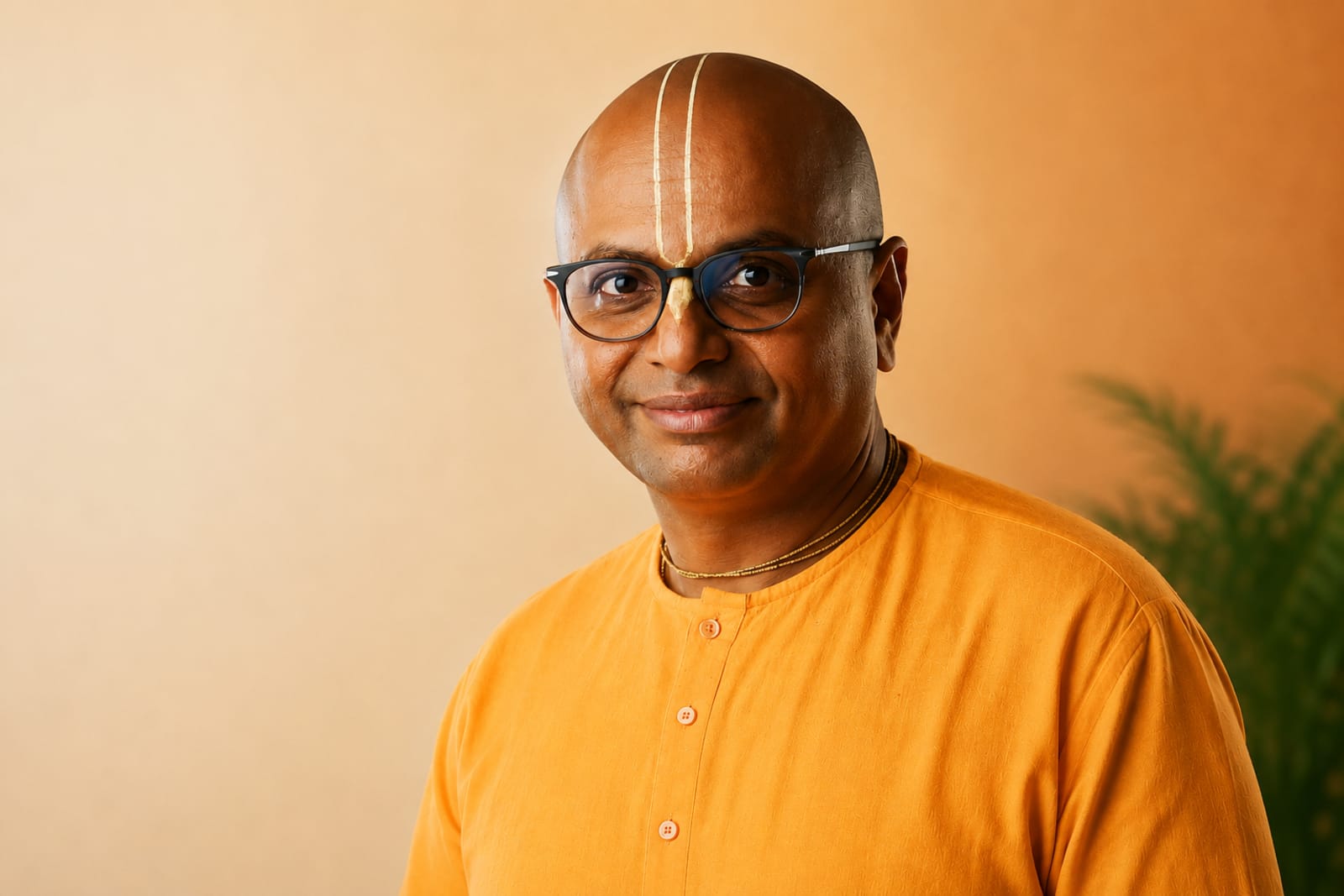
An Indian mind is naturally tuned to spirituality through storytelling, symbolism, community practice, and everyday philosophy woven into life. But Gaur Gopal Das didn’t just change that perspective, but also changed the format.
In TED-style talks, reels, and packed auditorium sessions, he turned spiritual discourse into performance. His expressive body language, humour that disarms rather than preaches, and a tone that makes younger audiences feel this to be trendy set him and his work apart.
In an environment where users scroll past heavy ideas within seconds, Gaur Gopal Das’s format lowers resistance. What makes it effective is not dilution of wisdom, but its packaging for a distracted audience that still wants meaning, just not in traditional form.
What makes Gaur Gopal Das significant is not the content of his messages alone, but the role he now plays in public emotional life. He sits in a rare category of speakers who operate at the intersection of spirituality, corporate leadership, and self-help culture. He addresses stress, burnout, and decision fatigue in a language that feels accessible to urban India.
Addressing the India 2030 Leadership 2026, he said, “We are not letting down our mental load about deadlines, toxic relationships, etc. The longer we hold onto them, the worse our mental health will be. It’s important to let these go for a while. Also, it is important to seek support because when two hands share a weight, the pain reduces.”
His history of such sessions consistently suggests that his talks are regularly invited at universities, corporate summits, and leadership forums, where the focus is less on religion and more on mental clarity, emotional regulation, and workplace resilience. That’s how he has reshaped the idea of spiritualism in India.
Corporate Spiritual Responsibility (CSR)
Born in Maharashtra, he pursued engineering studies at Cusrow Wadia Institute of Technology in Pune, later continuing at the College of Engineering, Pune. Before joining ISKCON in 1996, he briefly worked at Hewlett-Packard as an electrical engineer. At ISKCON, he stayed for twenty-two years, learning ancient philosophy and contemporary psychology, to become a life coach.
On life and wellness, he has written multiple books, including Life's Amazing Secrets, The Way of the Monk, You Can Have It All, and others. He is also the holder of an honorary doctorate from Kalinga Institute of Industrial Technology (KIIT).
What makes this transition significant is not the shift from corporate to spiritual life, but the way he later re-entered the corporate world in a completely different form. He is not positioned as a traditional monk speaking within religious boundaries, but as a communication bridge between inner well-being and external performance systems.
In modern India’s corporate and educational circuits, this role has become increasingly important. As burnout, performance anxiety, and constant digital stimulation become structural challenges, organisations are no longer only looking for productivity frameworks.
They are actively seeking narratives that help individuals regulate emotion, attention, and purpose. This is where speakers like him are frequently placed, not as religious voices, but as well-being interpreters in high-performance environments.
According to his profile, he has been serving as a life coach for 22 years. Other than corporate events and ISKCON, he has delivered speeches at the British Parliament and the UN. He is a monk whose stories and talks are now viral, reaching over 2.5 billion people.
At the UN, he spoke about Yoga as a mode of achieving the UN’s Sustainable Development Goals. At the British Parliament,
The rise of speakers like Gaur Gopal Das also reflects how corporate India has internalised wellness as part of organisational design. Leadership forums, HR conferences, and corporate training ecosystems now regularly include sessions on emotional regulation, focus, and purpose.
About India’s global leadership position by 2030, he said, “By 2030, we don’t need to be a global power. We need to be a global example. An example of trying to grow powerfully yet being deeply human. That’s what India is all about. Speed is necessary. But the wrong direction is not leadership. Leadership is about speed in the right direction.”
Within this evolving landscape, his relevance is also shaped by how he engages with younger audiences, particularly Gen Z. Often characterised as digitally native yet emotionally overwhelmed, this generation navigates constant information overload, career uncertainty, and fragmented attention spans. In this context, his commentary on youth is frequently framed not as instruction, but as an attempt to interpret the emotional and psychological patterns of a generation growing up in accelerated digital environments.
What His Rise Really Signals About Modern India
Ultimately, Gaur Gopal Das represents more than a popular spiritual speaker in modern India. His significance lies in what his rise reveals about the changing grammar of influence itself.
In that sense, he is not just responding to a demand for spirituality, but to a deeper cultural condition. His work centres on individuals who are constantly seeking meaning within systems designed for speed, pressure, and distraction.
His relevance lies in the fact that he speaks to a generation living through constant stimulation, emotional fatigue, and performance pressure, but does so without sounding clinical, preachy, or inaccessible.
At a time when younger audiences are increasingly distancing themselves from rigid religious structures while still searching for clarity, balance, and emotional reassurance, Gaur Gopal Das occupies the space in between. He translates spirituality into a language that fits modern life, which is fast, relatable, emotionally aware, and easy to absorb.
That is what makes him more than just a motivational speaker or monk. He reflects a broader cultural shift in which people are no longer looking for distant Gurus but for interpreters who can help make sense of modern anxiety in a language they already understand.
Read Next
More stories


Have a person, achievement or story our editors should know about?
Submit a Story
Stories worth telling, in your inbox.
Get the latest People Who Matter features delivered weekly.
Subscribe NowDiscussion
No comments yet. Be the first to share your thoughts.