
Sudha Murty: A Legacy Built On Compassion & Conviction
She questioned gender bias when few dared to. She helped shape one of India’s most influential technology companies, transformed corporate philanthropy, and inspired millions through her writing. Sudha Murty’s journey is a testament to the power of purpose-driven leadership.
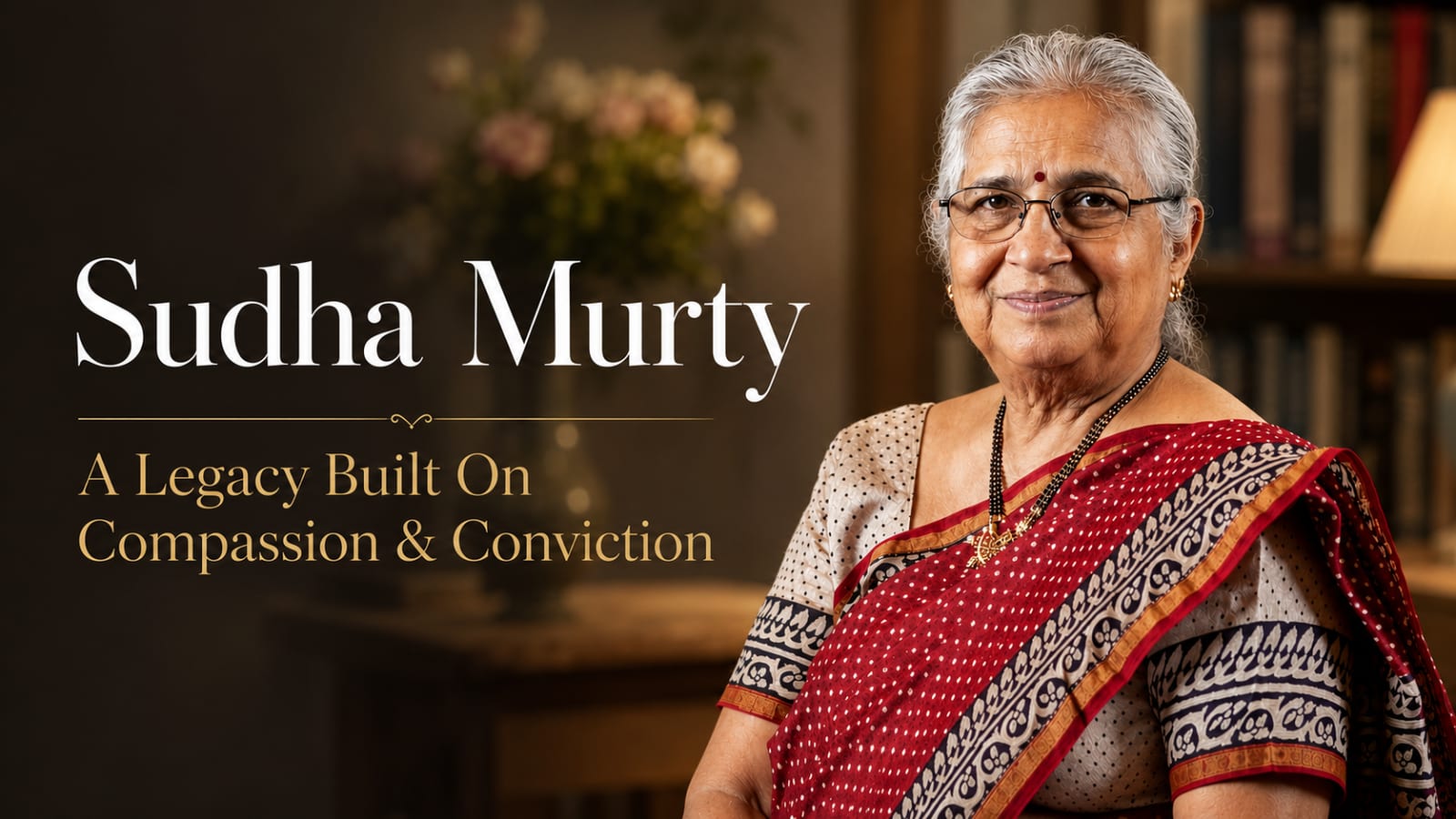
Long before she became the face of the Infosys Foundation, Sudha Murty was simply a young woman who refused to accept rejection, simply due to gender bias.
When engineering classrooms in India were overwhelmingly male-dominated, she was the only woman in her batch at B.V.B. College of Engineering in Hubli. Every lecture, every laboratory session and every workshop was a reminder that she had entered a world that wasn’t traditionally designed for women.
That experience probably shaped a lifelong habit of questioning inequality. In an interview, she shared her experience as a woman in the male-dominated sector. She said that one day she came across a recruitment advertisement from TELCO (now Tata Motors) asking female candidates not to apply. But having competed against men throughout her academic life, she chose to flag this as a bias.
She did something which young students would hardly dare to. She wrote directly to the then-chairman of the company, J.R.D. Tata. In the letter, she asked why one of India’s most respected industrial houses believed women did not belong on the manufacturing floor.
She wrote, “Sir, JRD Tata, when the country was not independent at that time your group started chemicals, locomotives, and the iron and steel industry. You are always ahead of time. In this society, there are 50–50% men and women. If women don’t get an education and job opportunities, then society or a country never rises, and this is one mistake of your company (for not allowing women students to apply for the job at TELCO, Pune).”
Upon receiving the letter, J.R.D. Tata invited her for an interview, and that’s how Sudha Murty became TELCO's first woman engineer, opening a door that had remained firmly shut for generations.
It was more than a career breakthrough. It was the first public demonstration of a leadership style she carries even today. This was a quiet conviction backed by action.
That same conviction later defined every chapter of her work. From helping Narayana Murthy build one of India’s biggest IT companies to transforming the Infosys Foundation, her conviction has shaped her achievements.
The Making Of A Trailblazer
The courage to question discrimination did not emerge overnight. It was rooted in the values she grew up with.
Born in 1950 in Shiggaon, Karnataka, Sudha Murty was raised by her parents, Dr. R. H. Kulkarni, a surgeon, and Vimala Kulkarni, a schoolteacher. Growing up in an academically inclined household, she developed an early fascination for books, storytelling and education. Later, these interests defined both her literary, entrepreneurial and philanthropic journeys.
At a time when engineering was overwhelmingly considered a man’s profession, Sudha Murty chose to pursue Electrical and Electronics Engineering. She graduated with first rank and received a gold medal for her academic performance.
Determined to deepen her technical expertise, she went on to earn a Master’s degree in Computer Science from the Indian Institute of Science (IISc), Bengaluru. By then, she had already established herself as one of the brightest engineering graduates of her generation, despite studying in an environment where women were rare.
From Engineer To Institution Builder
Her appointment at TELCO was much more than a personal milestone. By challenging the company’s discriminatory recruitment advertisement, she not only became the company's first woman engineer but also made a statement that there is no gender defined role.
She met N. R. Narayana Murthy during her engineering career. The two married in 1978. According to Sudha Murty, during the formation of Infosys in 1981, she contributed Rs. 10,000 from her savings.
As Infosys evolved into one of India’s most influential technology companies, she increasingly chose to devote her energy to public service rather than corporate leadership. That commitment took institutional shape in 1996, when she founded the Infosys Foundation.
Working across education, healthcare, rural development, women’s empowerment, arts and culture, disaster relief and public hygiene, the Foundation has supported projects across the country through long-term community partnerships.
As a philanthropist, one of her key accomplishments is the rehabilitation of the Devadasi community. Her initiative helped more than three thousand Devadasis with a substitute livelihood and economic independence.
But beyond philanthropy and Infosys, she has one more identity. She is also recognised for her literary work. Writing in both Kannada and English, she has authored more than 40 books across genres including novels, short stories, travelogues, memoirs, non-fiction and children’s literature.
Her journey as an author began in 1978 with the Kannada travelogue Atlanticadacheyinda, while her first English title, Wise and Otherwise, was published in 2002. Drawing inspiration from her travels, interactions with people, and lived experiences, her stories are rooted in everyday life and explore themes such as compassion, integrity, resilience and the importance of education.
She received the Bal Sahitya Puraskar in 2023 for contributing to children’s literature, which strengthened her image as an author.
National Recognition
Decades of service eventually earned Sudha Murty recognition at the highest national level. In 2006, she was conferred the Padma Shri for her contributions to social work, followed by the Padma Bhushan in 2023. The latter was awarded for her distinguished service in literature and education.
In 2024, President Droupadi Murmu nominated her to the Rajya Sabha, recognising her exceptional contributions to literature and social service. The nomination was not merely an acknowledgement of her achievements, but also of a lifetime spent advancing education, philanthropy and nation-building through quiet, consistent leadership.
Few could have predicted that the young woman who challenged one of India’s biggest industrial houses would one day become one of the country’s most respected voices on compassion, education and social responsibility. Yet, looking back, the thread is unmistakable. Every defining chapter of Sudha Murty’s life has been driven by questioning exclusion and creating opportunity where none existed.
Great leaders are often remembered for the institutions they build. But ideas come first. For Sudha Murty, the defining idea has always been simple. It is that talent should never be limited by gender, geography or circumstance.
Read Next
More stories


Have a person, achievement or story our editors should know about?
Submit a Story
Stories worth telling, in your inbox.
Get the latest People Who Matter features delivered weekly.
Subscribe NowDiscussion
No comments yet. Be the first to share your thoughts.