
From A Single Terrace To Global Kitchens: Lijjat Papad Legacy Lives On
Having begun with a Rs. 80 loan in 1959, today the monthly global export target of Lijjat Papad stands close to Rs.10 Cr. From empowering women to offering scholarships to their children, Lijjat, as a cooperative, seems louder than boardroom discussions on inclusion.
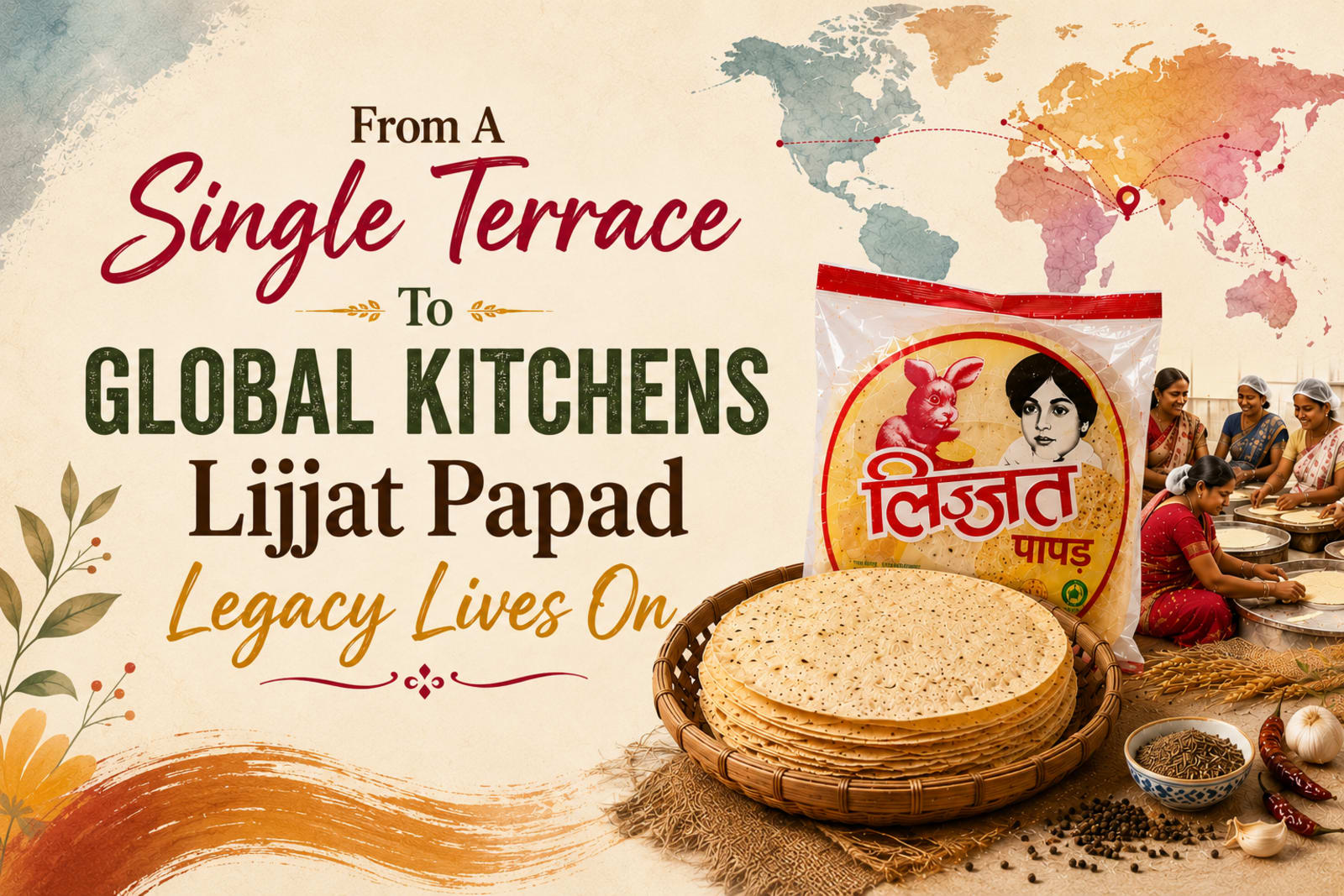
Long before India celebrated women founders on magazine covers, 7 women from Girgaum in Mumbai started creating history. But they were probably not aware that what began as a small venture would make a permanent place on the Indian dining tables.
On 15th March, 1959, these women started making papad with a borrowed amount of Rs. 80. The idea was simply to have financial independence and to support their families. But eventually it turned into a cooperative movement, giving birth to the legendary Lijjat Papad (also known as Shri Mahila Griha Udyog Lijjat Papad).
From Community Initiative To Structured Operations
Though Lijjat Papad, as an initiative, started in 1959, the real turning point came in 1966. It was in this year that the brand got registered under the Bombay Public Trusts Act, 1950 and Societies Registration Act, 1860. In this very year, it also received recognition from the Khadi & Village Industries Commission as a part of the rural industry.
It is important to recognise the contribution of Lijjat in ‘women empowerment’ at a time when financial independence for women was still a distant conversation. At such a time, Lijjat introduced an alternative model of entrepreneurship.
Members were regarded as equal participants in the brand’s growth, with profits distributed collectively instead of flowing to a single owner or promoter. The model challenged traditional assumptions around employment. It proved that large-scale enterprise could coexist with decentralised production and community ownership.
Eventually, every woman associated with the organisation became a stakeholder in its growth, and not merely a worker. The women were referred to as ‘sisters’, profits were collectively shared, and the focus remained as much on dignity as on income. And the outcome? The idea spread beyond the borders of Maharashtra to reach the rest of India.
Currently, Lijjat has 83 branches and 27 divisions across 16 states of the country and employs about 45,000 sister members all over India. While some branches support manufacturing, some offer raw materials to women to make papads at their homes.
According to National Geographic India, Lijjat today produces more than 1.3 crore papads per day. It means that if spread for drying in the open, it could cover about 44 football grounds.
Every unit is headed by a Sanchalika who manages the production. Lijjat has a Central Managing Committee, which consists of 21 members. Six of them are elected Office Bearers, i.e., one President, one Vice-President, two Secretaries, and two Treasurers.
Notably, Lijjat also offers pick and drop service to these members. According to Lijjat, any woman capable of performing physical labour can become a member. It shows that self-reliance and support for women continue to be the core idea despite the need for mass production to meet the growing demand.
That small terrace operation evolved into one of India’s largest women-led cooperative enterprises, creating livelihoods for thousands across the country while gaining extraordinary trust inside Indian homes.
Today, the cooperative offers scholarships to the children of the sister members once they complete the 10th and 12th final examinations. The idea is to encourage children’s education. And, most importantly, Lijjat Papad, as a cooperative, takes pride in not accepting charity ever.
These developments were significant not just from the administrative point of view but also because the women had transformed Lijjat from a community initiative into a structured socio-economic institution.
Registration under formal legal frameworks gave the organisation legitimacy at a time when women-led enterprises rarely received institutional recognition in India.
Plus, the recognition from the Khadi and Village Industries Commission positioned Lijjat within the larger narrative of rural employment and self-reliance that post-Independence India was attempting to build.
Lijjat means tasty. And by the amount of trust the papad has acquired across Indian households, it is safe to say that it lives up to the name. Unlike many modern brands driven by aggressive marketing, Lijjat grew through familiarity, consistency, and a deeply human story that consumers felt connected to.
Global Expansion
The presence of Lijjat isn’t confined to the Indian dining tables. What started as a hyperlocal initiative from a rooftop slowly introduced the rest of the world to Indian flavours.
The products are exported to countries such as the U.S.A., the U.K., France, Germany, Italy, Thailand, Singapore, Hong Kong, the Netherlands, Japan, Canada, Australia, South Africa, and more. As per National Geographic’s two-year-old documentary, the monthly export target was Rs. 7 Cr.
The cooperative has also ventured into other product categories, which are spices, flour, chapatis, appalam, detergent powder, laundry soap and liquid soap.
In today’s competitive world, scale is often associated with automation, venture capital, and centralised operations. But Lijjat still follows a radically different path. Its production relies completely on human participation rather than replacing it, ensuring that growth translates into livelihood generation instead of workforce reduction.
This is perhaps why the brand continues to remain relevant even decades later, not just as a food product, but as a case study in inclusive entrepreneurship.
Recognitions
While big corporate giants spend a lot of time on discussions to boost the participation of women in the workforce, Lijjat Papad shows that meaningful inclusion is not always built inside the glass doors or corporate diversity reports.
Decades before boardrooms began discussing women-led growth, the cooperative had already created a sustainable economic model where thousands of women could earn with dignity, participate in decision-making, and contribute directly to their households and local economies.
This certainly caught the attention of many, leading to a chain of recognitions for the company.
Some of the key awards and recognitions received by Lijjat are:
- Economic Times Award of "Businesswomen of the Year 2001-02 for Corporate Excellence"
- ‘Best Village Industries' awarded by former Prime Minister Atal Behari Vajpayee
- ‘Brand Equity Award' presented by former President of India, Dr. A.P.J. Abdul Kalam
- ‘Best Village Industries Institution’ for 2012-13
- 'Mahila Vikas Award 2016-17’ given by Prime Minister Narendra Modi
- 'Global Economic Award' for outstanding contribution to women empowerment and self-reliance
The Legacy Lives On
Over time, Lijjat Papad became more than a grocery product. Its distinct packaging, familiar taste, and memorable advertising campaigns created a sense of familiarity across generations.
Much like Amul Butter, Tata Salt, Parle-G, Lux, etc, Lijjat Papad slowly became part of everyday Indian life. It is trusted because it feels deeply familiar.
More than six decades later, the cooperative continues to stand as proof that entrepreneurship can be inclusive, community-driven, and deeply human, and yet be transformative.
Read Next
More stories

Have a person, achievement or story our editors should know about?
Submit a Story
Stories worth telling, in your inbox.
Get the latest People Who Matter features delivered weekly.
Subscribe NowDiscussion
No comments yet. Be the first to share your thoughts.