
How Lenskart Changed The Way India Buys Eyewear
What started as a risky ecommerce idea evolved into one of India’s biggest consumer-tech success stories. Lenskart not only modernised eyewear retail but also changed how India perceived spectacles.
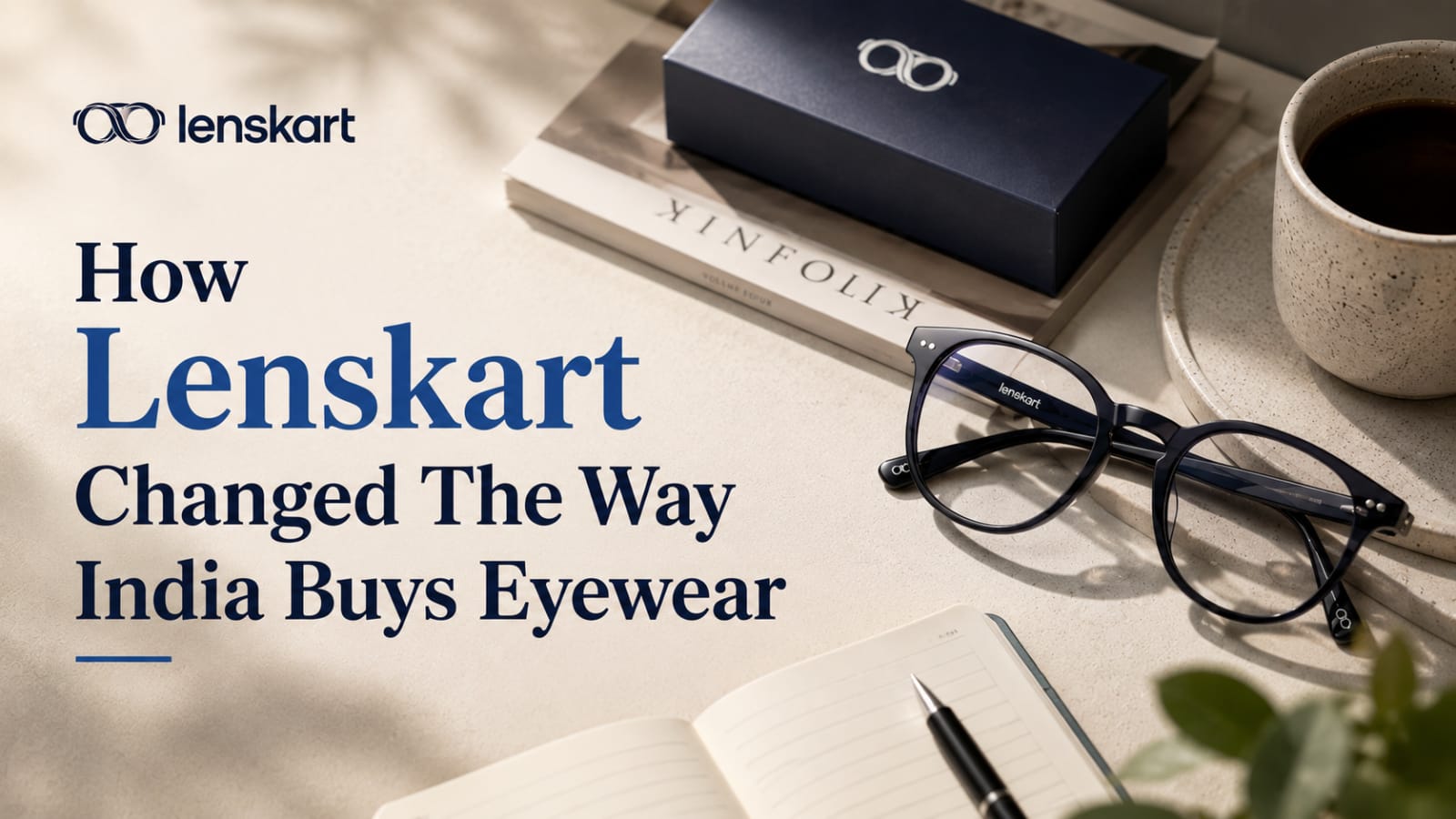
Who would have thought that people would be ordering eye checkups and getting their hands on a variety of designs right from the comfort of their homes? Peyush Bansal and his team saw this gap and showed the courage to open a new horizon in the ecommerce space in India by launching Lenskart in 2010.
At a time when online shopping itself was still evolving in India, betting on the D2C eyewear market seemed risky. After all, eyewear was considered a product people would only buy after physically trying it on.
Though business schools teach that products and services should be made and sold according to demand, Lenskart swam against the stream and reshaped Indian consumerism towards eyewear. But according to Peyush Bansal, the company was launched with a bigger mission.
On Shark Tank, he said, “50% of Indians need spectacles. But only 1/4th of them have specs, which means about 40 crore Indians don’t have spectacles… A worker in India can increase his productivity by 30% and his income by 25% just through vision correction. For the global economy, the loss of productivity due to lack of vision correction incurs an annual loss of $227 Bn… To revolutionise vision correction, we have launched Lenskart. We wanted to be the Maruti of eyewear in India.”
Reflecting on this, the company wants its Eyewear for All objective to impact the underserved communities in India. Through the Lenskart Foundation, it carries out preventive eye healthcare. It aims to create awareness, enhance accessibility, and advocate for the inclusion of vision correction in the national healthcare agenda.
Under one of its campaigns, the brand also introduced Reframe India collection boxes at selected stores across the country, encouraging customers to donate old spectacles that are still in usable condition. After undergoing quality checks, the frames are fitted with fresh prescription lenses and distributed to people in need through the company’s child eye care centres.
Addressing the Gaps
According to Peyush Bansal, the primary issues with the eyewear industry in India were a lack of awareness, accessibility, and affordability. Eye testing isn’t included in the health insurance policies. Plus, when Lenskart was launched, there were merely 40,000 specs shops in India, making accessibility a huge challenge. The overall ecosystem was very closely knit.
Lenskart almost broke this barrier overnight by democratising organised eyewear retail. By scaling both online and offline operations, it helped make prescription eyewear and eye checkups more mainstream and accessible to a wider consumer base.
Earlier, spectacles were often associated with discomfort, ageing, or lack of style, especially among young consumers. Also, consumers usually owned a single pair and replaced it only when absolutely needed. The eyewear giant helped change that perception by positioning eyewear as an extension of personality and fashion.
From medical necessity to fashion accessory, Lenskart painted a new perception of the young crowd towards eyewear. Affordable collections, celebrity-led campaigns, and digitally driven marketing made glasses more aspirational for younger consumers.
However, unlike other fashion accessories, eyewear could affect health negatively if not worn correctly. Thus, gaining trust was a necessity for growth.
Making Online Specs Purchase Mainstream
The brand entered the market at a crucial time. India’s eyewear market was also entering a transition phase during the early 2010s. Rising screen time, increasing awareness around eye health, growing disposable incomes, and the rapid adoption of smartphones were slowly changing consumer habits.
However, the industry itself had not evolved at the same pace. This created the perfect opportunity for organised players like Lenskart to bridge the gap between traditional optical retail and technology-driven convenience.
The company broke through the market with the idea of going omnichannel. The company knew that though the young consumer base could be cracked through ecommerce, to expand the customer base across all ages, physical outlets were important for this industry. So the company started offering home-based eye checkups for free. This created a sense of trust among the older generation. Eventually, Lenskart also started expanding aggressively through offline stores while continuing to strengthen its digital ecosystem.
It blended technology with physical retail at a time when most ecommerce companies were focused only on online expansion. While consumers were becoming comfortable ordering clothes and electronics online, purchasing spectacles still required a high level of confidence.
Beyond convenience, the brand also introduced a level of standardisation that was largely missing in the fragmented eyewear industry. From pricing transparency to organised customer service, Lenskart brought structure to a sector that had long depended on small independent optical stores.
What began as an attempt to solve accessibility and trust issues in the eyewear market soon evolved into something much larger. As consumer acceptance towards organised eyewear retail grew, the company rapidly expanded its footprint across the country and positioned itself among the leading players in India’s eyewear industry.
From One Store To Global Expansion
Though the company launched the ecommerce store in 2010, it was originally conceived in 2008 as Valyoo Technologies. Apart from Peyush Bansal, Neha Bansal, Amit Chaudhary and Sumeet Kapahi were also a part of it.
From opening its first physical store in 2013 to expanding across Japan, Southeast Asia, and the Middle East, Lenskart has proven that no idea is irrelevant if executed right.
In 2017, the company set up its manufacturing unit in Gurugram (then Gurgaon), and it went global through the website and one physical store in Singapore. Eventually, it acquired a majority stake in Japan-headquartered eyewear business OWNDAYS, while crossing the milestone of 2000 stores in India.
According to an Inc42 report, ahead of the IPO in November 2025, the eyewear retailer turned profitable, making a net profit of INR 297.3 Cr in FY25, as against a net loss of INR 10.1 Cr in FY24.
Beyond changing consumer behaviour and modernising eyewear retail, Lenskart also emerged as one of India’s biggest startup success stories in the consumer-tech space. Over the years, the company’s rapid expansion reflected how strongly Indian consumers responded to organised, technology-driven retail models.
Changing Perception Toward Eyewear Forever
India’s startup ecosystem has produced several successful ecommerce companies over the last decade. However, only a handful managed to fundamentally change consumer habits. Moreover, in a sector where trust could only be built around physical stores, ecommerce was a crazy idea. Lenskart did not simply respond to changing consumer behaviour. It actively shaped it.
Its success also reflected a larger shift taking place in urban and semi-urban India. The growing willingness of consumers to trust technology-led convenience in deeply personal categories is a testament. From trying frames virtually to booking eye tests from home, the brand helped bridge the gap between healthcare, fashion, and ecommerce.
Even today, the company continues to remain relevant because, despite competition from the likes of Titan Eye+, GKB Opticals, Fastrack, and more, Lenskart has managed to position itself as a dominant market leader. At a time when consumers increasingly expect convenience-led and personalised experiences, the company’s omnichannel model reflects the future of Indian retail itself.
Today, the impact of Lenskart extends beyond eyewear retail. It stands as an example of how Indian startups are increasingly attempting to organise fragmented industries, create new consumer habits, and scale services that were once considered difficult to digitise.
Read Next
More stories

Have a person, achievement or story our editors should know about?
Submit a Story
Stories worth telling, in your inbox.
Get the latest People Who Matter features delivered weekly.
Subscribe NowDiscussion
No comments yet. Be the first to share your thoughts.