Mysore Sandal: From Karnataka’s Hidden Forest Treasure To A Heritage Soap Brand
Born out of a crisis during World War I, Mysore Sandal evolved from a regional industrial experiment into a Rs. 2,000 Cr heritage brand. The soap not only shaped Karnataka’s sandalwood economy but also became an emotional part of Indian households across generations.
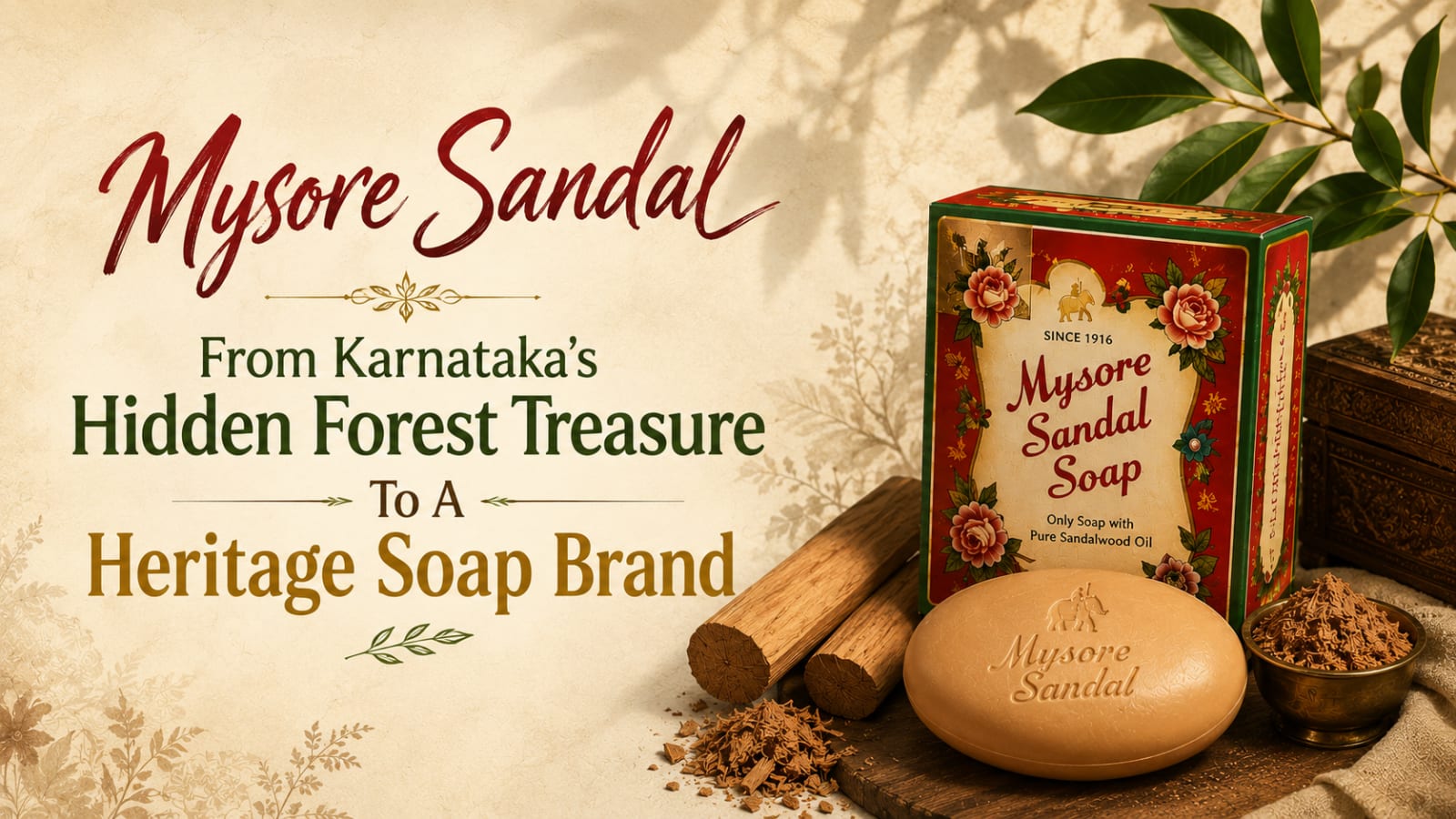
While buying a bathing soap, what most people look for is the fragrance. This is where Mysore Sandal stands out in the category. It announces itself through the scent, carrying with it the heritage of Karnataka and the legacy of one of the earliest indigenous luxury brands of India.
Long before the country opened up to premium personal care, Mysore Sandal had already built an identity rooted in pure sandalwood oil, regional pride, and self-reliant manufacturing.
Launched in 1918, the soap tells the story of Karnataka’s sandalwood forests. It transformed Karnataka’s sandalwood economy from raw-material trade into indigenous value creation, generating employment for the locals and tribal communities.
Mysore Sandal helped build local expertise in sandalwood oil extraction, perfumery, and indigenous manufacturing while supporting generations of livelihoods linked to forestry and fragrance production. Over the decades, the brand evolved into a Rs. 1,785 Cr legacy, establishing itself as one of India’s oldest and most trusted premium personal care brands.
From Royal Experiment To Cultural Icon
At a time when luxury personal care products largely came from Europe, Mysore Sandal quietly introduced the idea of an Indian premium self-care brand rooted in indigenous resources.
According to an NDTV report, sandalwood exports from Karnataka to Europe halted after World War I. This disrupted the forest-based economy and left the state with a surplus of sandalwood. But the Mysore administration took this opportunity to create a premium self-care brand for India.
Per a document published by the Karnataka Government, primarily, the Maharaja of Mysore was determined to position the Mysore State on the global map through “the world's best natural sandalwood oil” indigenous to this region’s forests. He wanted to make Mysore the ‘fragrance ambassador of India’.
Further, the document states that the first experiment for the oil extraction was successfully conducted at the Indian Institute of Science, Bengaluru, under the leadership of Prof. Suddourough and Prof. Watson. The high-quality sandalwood oil, as mentioned in the British Pharmacopoeia, was introduced to the world by the Government Soap Factory, Mysore.
This was after the factory started using the oil to make soaps.
Since then, the company hasn’t just produced one of the most purchased soaps in India, but also boosted the local economy. Over generations, Mysore Sandal created an ecosystem of factory workers, chemists, perfumers, transport workers, distributors, and forest-linked livelihoods across Karnataka. For many families in Mysuru and Bengaluru, employment linked to the company represented economic stability and social prestige.
NDTV reported that the government has expanded sandalwood cultivation, currently employing 700 farmers across 3,800 acres of land.
Only a few Indian FMCG brands have embedded themselves into domestic culture the way Mysore Sandal has. For generations, the soap has been associated with weddings, festive gifting, temple-town nostalgia, and middle-class South Indian households.
Mysore Sandal grew not merely through advertising, but through emotional trust built across generations, with families often storing unused soap bars inside wardrobes and suitcases for the lingering fragrance.
People of Karnataka are highly emotional about this soap, even decades later. In 2025, the appointment of actress Tamannaah Bhatia as the brand ambassador triggered criticism as the locals could not relate the product to a non-Kannada-speaking actress.
From India To Abroad
As per the latest media reports, Karnataka Soaps and Detergent Ltd., the manufacturing company of Mysore Sandal, has achieved an all-time high turnover of Rs. 2,016 Cr, with a net profit of Rs. 507 Cr in FY2025-26. Production also grew to a whopping 47,494 metric tonnes, with 57 new products launched and exports expanding. The official website of KSDL states that currently the company exports products to the Middle East, some European countries, the US, Canada, etc.
Further, it is pertinent to note that out of the profit, Rs. 5 Cr will be contributed to the Chief Minister's Relief Fund.
By 2028, the company aims to achieve a turnover of Rs. 3,000 Cr, while targeting Rs. 5,000 Cr by 2030. To support this, the government is in talks to set up a new manufacturing unit across 50 acres of land in Vijayapura, for which Rs. 229 Cr has already been sanctioned.
The Scent Of Karnataka
Not many Indian brands have managed to retain their identity over the decades. But Mysore Sandal is certainly one which has. From simple packaging to low-key marketing, the soap reflects that trust plays a bigger role than any other factor in building a brand image.
Over the years, various soap brands such as Lux, Dettol, Medimix, Santoor, etc., have entered the Indian FMCG market. But almost every brand came with a huge marketing budget and attractive campaigns. Yet in this competitive market, Mysore Sandal managed to keep its feet steady. It was only during early 2026 that the Karnataka government relaunched the product to give the legacy a modern touch and push it across the North Indian belt.
What began in 1918 as an effort to revive Karnataka’s sandalwood economy eventually evolved into one of India’s oldest premium personal care brands. From generating livelihoods linked to forestry and manufacturing to becoming an emotional part of South Indian households, Mysore Sandal built a legacy.
Even today, the fragrance of Mysore Sandal carries the story of the sandalwood forests of South India and the craftsmanship rooted in the region. It also reflects the generations of people who helped transform a local resource into a globally recognised Indian brand.
Read Next
More stories

Have a person, achievement or story our editors should know about?
Submit a Story
Stories worth telling, in your inbox.
Get the latest People Who Matter features delivered weekly.
Subscribe NowDiscussion
No comments yet. Be the first to share your thoughts.