Khadi India: Inspired By Swadeshi Movement, Embraced By Youth, Livelihood For Many
From the Swadeshi movement to ecommerce platforms, the journey of Khadi India reflects how rural employment, sustainability, and indigenous craftsmanship became central to modern consumerism.
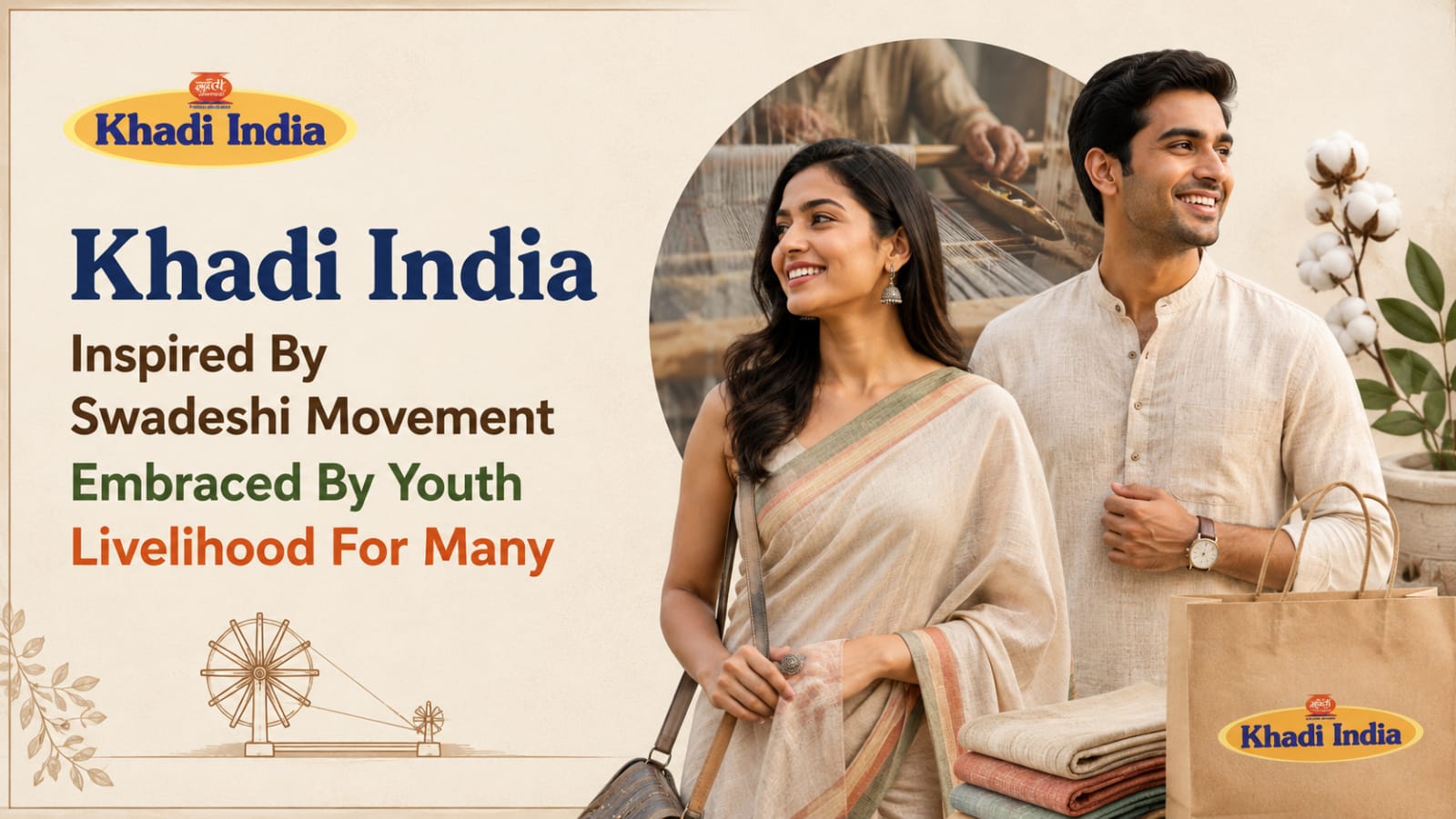
Mention of Khadi India immediately takes one back to the history of the Indian freedom struggle. Though the Khadi and Village Industries Commission (KVIC), which manages ‘Khadi India’, was formally established in April 1957, it is inspired by Mahatma Gandhi’s Khadi Movement launched in 1918.
Though the movement was part of the Swadeshi Andolan to promote Indian goods, it also generated rural employment in India. Gandhi described the charkha as a tool of economic decentralisation because it enabled rural households to produce cloth at home rather than relying entirely on seasonal farming. The brand Khadi India was also formed on this principle.
In 2018, KVIC launched a campaign in the Sundarbans to generate employment for the women whose husbands died of tiger attacks. Known as ‘tiger widows’, as of 2022, more than 100 such women were spinning the Khadi charkha.
In 2024, KVIC, in a joint announcement with the Ministry of MSMEs and the Government of India, said that the cumulative employment through such moves reached 1.87 Cr in FY2023-24, up from 1.30 Cr in FY2013-14. Meanwhile, 10.17 Lakh jobs were created in FY24, up from 5.62 Lakh in FY14. In addition, 4.98 lakh rural Khadi artisans (spinners and weavers) and workers are also employed in manufacturing Khadi fabrics.
What differentiates Khadi India from a conventional textile brand is its economic structure. Unlike industrial manufacturing concentrated in urban centres, Khadi India promotes decentralised production.
It allows rural households to participate in income generation without migrating to cities. It functions as an early model of localised and community-driven enterprise. This happened long before sustainable production and decentralised economies entered mainstream business discussions.
From Swadeshi Movement To Ecommerce
Over the decades, Khadi India evolved beyond being a symbol of nationalism. From fabric and fashion, it has moved on to other segments, too. Now it has entered the mainstream retail and lifestyle market through self-care products, wellness products, honey, leather products, etc.
It has become a government-backed rural economic ecosystem supporting artisans, weavers, potters, beekeepers, and village entrepreneurs across the country.
The transformation changed the way Indians look at the brand. For decades, the brand has been closely associated with political imagery and traditional clothing. Its expansion into lifestyle and wellness categories helped reposition Khadi India for younger and urban consumers who may not have connected with its historical identity in the same way.
Last year, KVIC chairman Manoj Kumar highlighted that the launch of Honey Mission in 2017-18 led to the distribution of over 2,29,409 bee boxes across the country. It resulted in the production of approximately 20,000 metric tonnes of honey, generating an income of Rs. 325 Cr for beekeepers.
Further, to artists across Tamil Nadu, a wide range of 556 machineries and 620 toolkits were distributed by KVIC under the Gramodyog Vikas Yojana (GVY). This included 220 electrical pottery wheels, 220 sewing machines, 4 sets of tamarind processing machines, and 16 sets of oil extraction machinery. In a statement, KVIC stated that over 2,985 khadi institutions across the state engage 5 lakh artisans, of which 80% are women.
The numbers indicate that the relevance of Khadi India today extends beyond nostalgia associated with the freedom struggle. Its scale now resembles a rural economic network that combines traditional craftsmanship with organised market access.
The brand underwent a commercial transformation after the Indian government’s Vocal for Local and Make in India push. PM Narendra Modi is of the view that the surging numbers show that the trust of Indians in indigenous products has increased.
The credit partially goes to the consumers who started recognising the talent of the local artisans and the need for sustainable products. The global shift towards sustainability worked out well for Khadi India. It found relevance beyond political symbolism. Also, the decentralised manufacturing model aligned with conversations around ethical consumption and sustainability.
From being inspired by the Swadeshi Movement to reaching people through ecommerce, Khadi India has evolved. It seems that the brand is an example of how brands should understand the changing pulse of consumerism and transform accordingly.
As conversations around sustainability, handmade products, and local craftsmanship gained momentum, Khadi found relevance among the younger generation in India. Collaborations with designers, government-backed campaigns, and digital platforms further helped the brand move beyond its conventional image.
However, the core principle remains boosting the rural economy and Indian products.
The Larger Idea Behind Nationalism
The relevance of Khadi India is not confined to nationalism anymore. By expanding beyond traditional fabrics into lifestyle, wellness, and rural enterprise ecosystems, the brand managed to remain commercially relevant across youth. However, it also managed to retain authenticity and social purpose. In many ways, Khadi India represents a rare example of a brand where commerce and community development continue to intersect.
Livelihood, craftsmanship, and sustainability remain at the heart of Khadi India. What began as Gandhi’s political statement against colonial rule gradually evolved into a decentralised rural economic ecosystem.
Read Next
More stories

Have a person, achievement or story our editors should know about?
Submit a Story
Stories worth telling, in your inbox.
Get the latest People Who Matter features delivered weekly.
Subscribe NowDiscussion
No comments yet. Be the first to share your thoughts.