
Infosys & India’s IT Boom: The Company That Defined An Industry
As India’s IT industry expanded, Infosys stood at the centre of the transformation, bridging global demand with Indian talent and reshaping how the country works and earns.
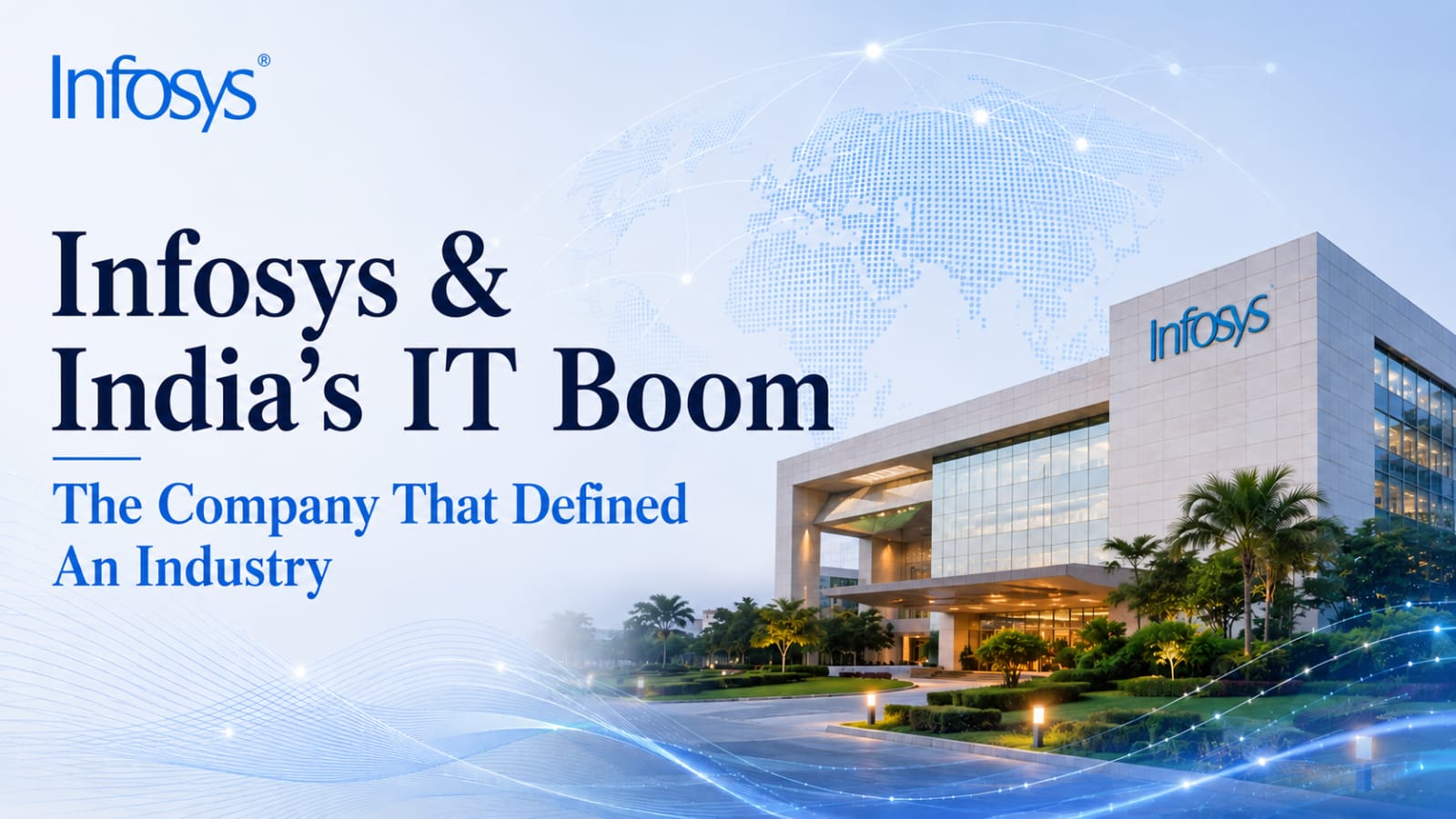
India’s IT boom wasn’t just an economic phase. It was a structural rewiring of how the country earned, worked, and presented itself to the world. Since the early 1980s, some software services quietly became one of India’s most powerful exports. It turned engineering graduates into global client-facing professionals and cities like Bengaluru into digital command centres.
At the centre of this transformation stood a handful of companies that didn’t ride the wave, but actually shaped its direction. Infosys, founded in 1981, was one of those. Years before India fully opened its new economy, seven engineers, including Narayana Murthy, started the firm from a small apartment in Pune.
When liberalisation arrived in 1991, it validated the model Infosys had already been quietly building. It was exporting Indian IT talent to solve global technology problems.
The company’s early journey mirrors India’s IT story almost step-by-step from scarcity and scepticism in the 1980s, to global outsourcing credibility in the 1990s, and finally to enterprise-scale digital transformation in the 2000s and beyond. In many ways, Infosys is almost synonymous with India’s IT boom. It is one of the earliest structures that made that boom possible.
Opening Of The New Economy
The IT boom allowed Indian firms to engage more directly with international clients and scale export-oriented services.
Infosys, which had already been working on offshore delivery models, suddenly found itself aligned with global demand. Companies abroad were looking for cost-efficient software development and maintenance partners, and India emerged as a natural destination due to its large pool of emerging engineering talent.
Infosys, according to its corporate history, was among the early firms positioned to benefit from this structural shift. In 1993, it went public, becoming one of the early Indian IT companies to list on domestic stock exchanges. According to records, the IPO initially saw limited enthusiasm, reflecting uncertainty around India’s software export potential at the time.
However, the listing became an important turning point. It introduced transparency, public accountability, and investor scrutiny into a new sector. More importantly, it signalled that Indian software companies were no longer experimental ventures. Rather, they were formal and investable businesses.
For Infosys, this phase showed that it was transitioning from a founder-led setup to a structured corporate institution, capable of operating at scale.
Going Global
With time, the company became part of a wave that absorbed large numbers of engineering graduates into the services economy. Interestingly, its hiring model helped shape a new career pathway in India, where graduates from small towns could enter global roles without leaving the country.
IITs and private engineering colleges boomed across the country. Tier-2 and Tier-3 cities began producing IT professionals at scale. Household incomes in many middle-class families shifted upward due to stable IT employment.
This further drove urban migration, but not towards factories or government jobs. Towards tech parks and software campuses. Cities like Bengaluru, Hyderabad, Pune, and Chennai became long-term employment hubs rather than just administrative centres.
This industrial shift scaled Infosys too. It is pertinent to note that in 1999, Infosys became one of the first Indian companies to be listed on NASDAQ, a milestone documented in its corporate history and widely recognised in global financial records.
This was more than a financial event. It positioned Indian IT firms within global capital markets and reinforced confidence in offshore delivery models. The industry moved from being cost-driven outsourcing to becoming a structured global service ecosystem.
During this period, employment at Infosys and similar firms expanded significantly, contributing to what many economists describe as India’s ‘services-led growth phase’.
But the impact was much more than employment. The change reshaped social mobility in ways that were not immediately visible in macroeconomic data. Regular salaries, global exposure, and structured career progression created financial predictability.
It also changed aspirations. Engineering shifted from being a purely technical qualification to a gateway into global careers. In many households, especially in smaller cities, IT jobs became associated with long-term security, home ownership, and education opportunities for the next generation.
At the same time, this growth was not without limitations. The model was heavily dependent on global demand cycles, and the nature of work often remained service-driven rather than product-led innovation.
Becoming Future-Ready
Filings suggest that today, Infosys operates across more than 50 countries and serves thousands of global clients. It continues to operate under Salil Parekh, who serves as CEO and MD.
Its scale reflects not just corporate growth, but the maturity attained by India’s IT services industry as a whole. The IT giant currently employs over 3 lakh people globally.
But this didn’t come frictionless. From employee dissatisfaction discussions in public forums, to concerns around wage growth stagnation, to recurring scrutiny over workplace practices and corporate governance norms, the company has seen it all. These debates have become more visible as India’s IT industry transitions from rapid expansion to efficiency-led growth.
At the same time, the company is increasingly positioning itself around AI. Media reports indicate that large-scale enterprise AI deployments are already underway across clients and internal systems.
What makes this shift more significant is that it is not just about adding a new service line, but about rethinking how IT services themselves are delivered. But it also raises an uncomfortable yet necessary question about the model that once created mass employment. Can it continue in the same form when intelligence systems begin to replace parts of that workforce? Probably the future has the answer, or probably not.
From pulling hyperlocal talent to creating a new form of upward mobility that was salary-driven, stable, and globally linked, Infosys has been one of the key drivers of modern India.
The story of Infosys is often told as a case study, but its deeper impact is social and structural. It helped normalise the idea that Indian talent could serve global systems at scale. It created employment pathways that reshaped middle-class life. And it became part of the foundation on which India’s IT boom was built.
Read Next
More stories

Have a person, achievement or story our editors should know about?
Submit a Story
Stories worth telling, in your inbox.
Get the latest People Who Matter features delivered weekly.
Subscribe NowDiscussion
No comments yet. Be the first to share your thoughts.