
Bajaj Auto: How A Company Put The Middle Class In The Driving Seat
From enabling affordable mobility for millions to building one of India’s strongest automotive export businesses, Bajaj Auto has played a defining role in the country’s growth story. Today, it stands at the intersection of legacy, automation, and the transformation of electric mobility.
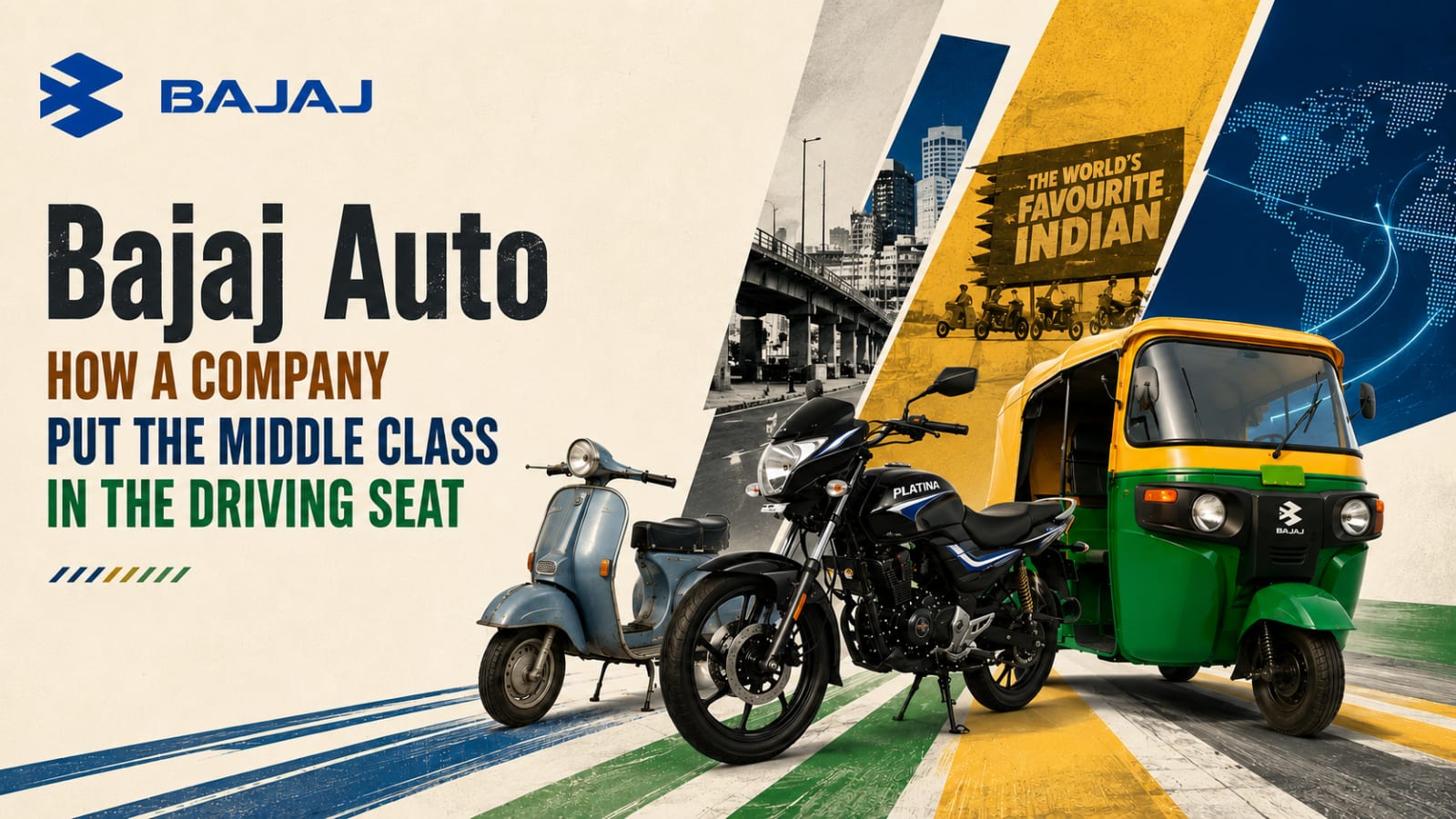
Around the years of India’s independence, economic self-reliance was viewed as an essential part of nation-building. The country needed strong indigenous enterprises which could create opportunities for Indians. Like many other companies, the Bajaj Group also emerged out of this principle. Led by the family of freedom fighter and industrialist Jamnalal Bajaj, it was built on the theory of self-reliance and nation-building.
Initially incorporated as Bachraj Trading Corporation Private Limited, Bajaj Auto was founded on November 29, 1945. Though during the initial years, the company sold imported vehicles, it transitioned from trader to manufacturer in 1959.
According to Bajaj Auto, following this, it started making two-wheelers domestically. It collaborated with Italian manufacturer Piaggio to start producing the Vespa 150. The milestone was significant not only for the company but also for a young nation seeking to build its industrial capabilities.
Over the following years, this shift from import-led trade to domestic manufacturing began to align with a deeper change unfolding in India’s economy itself. As industrial capacity slowly expanded and consumer aspirations grew, the need for affordable and accessible mobility became basic. Against this backdrop, Bajaj Auto’s early manufacturing base began to scale, setting the stage for its first major volume milestone at the turn of the decade.
From Bajaj Auto To ‘Humara Bajaj’
In a country where owning a vehicle looked like a luxury, Bajaj Auto’s scooters soon became ‘Humara Bajaj’ as it aggressively started dominating the market.
This shift reflected an industrial expansion into the everyday structure of work and life in India. As the company scaled manufacturing, it became part of a larger ecosystem where employment offered a rare form of financial continuity for workers and their families in a developing economy.
But its deeper influence unfolded outside the factory gates. Mobility stopped being just a product category and started functioning as an economic enabler. According to the company, it manufactured its 100,000th vehicle in 1970, a milestone that highlighted the increasing acceptance of two-wheelers as a practical mobility solution for Indian families.
The early 1970s marked another turning point. Company records show that Bajaj’s technical collaboration with Piaggio ended in 1971, allowing it to manufacture vehicles under its own brand name.
This was the turning point for not just Bajaj but also the Indian scooter industry. India got its very own Chetak, which continued to rule the market for years to come. Chetak eventually became one of the most recognisable symbols of middle-class India. For many families, owning a Chetak represented economic progress. It was often the family's first personal vehicle and became associated with reliability, affordability and aspiration.
Driving Aspirations
However, Bajaj Auto’s impact was never limited to family transportation. In 1971, the company introduced its first three-wheeler goods carrier. The move helped create an entirely new ecosystem. Across cities, towns and villages, Bajaj three-wheelers enabled countless drivers, traders and small business owners to earn a livelihood.
But the launch of Pulsar was a significant step. It didn’t just change how Bajaj was perceived but also helped create India's performance motorcycle segment. With this, the company started fulfilling its global aspirations. Bajaj’s started exporting massively to countries across Asia, Africa and Latin America. Its partnerships with international brands such as KTM and Triumph further strengthened its global footprint while showcasing India's manufacturing capabilities on the world stage.
Miles To Go…
Today, Bajaj Auto competes with the likes of Royal Enfield, Hero Motocorp, Honda, TVS, etc, in the market which was almost created by the company itself. With time, competition has only intensified. Its competition is not just with brands but also with modernised vehicles. As e-scooters started taking the market over, it had to turn to its signature Chetak.
Plus, Bajaj needed to go with the need of the hour, which is technology. Today it operates in an environment which is increasingly defined by automation, robotics, and lean production systems.
Factories that once symbolised mass employment are now far more efficient but employ fewer people. This reflects a shift from labour-intensive growth to capital and technology-driven production. While this has strengthened global competitiveness, it has also reduced direct employment. According to several reports, the company, which had about 10,000 employees in FY21, was left with almost half of its workforce by FY25.
The story of Bajaj Auto is often told through its scooters, motorcycles and three-wheelers. Yet its larger contribution lies elsewhere. For more than seven decades, the company has shaped how mobility is perceived in India.
It has enabled families to travel farther, entrepreneurs to earn livelihoods and young consumers to embrace new aspirations. From the era of self-reliance to the age of electric mobility, Bajaj Auto's journey mirrors the journey of a nation constantly on the move.
Read Next
More stories
Have a person, achievement or story our editors should know about?
Submit a Story
Stories worth telling, in your inbox.
Get the latest People Who Matter features delivered weekly.
Subscribe NowDiscussion
No comments yet. Be the first to share your thoughts.