
Maruti: How A Government Experiment Continued To Lead The Market
From a modest 1981 government venture to 42% market share today, Maruti's journey mirrors India's own story of growth and aspiration.
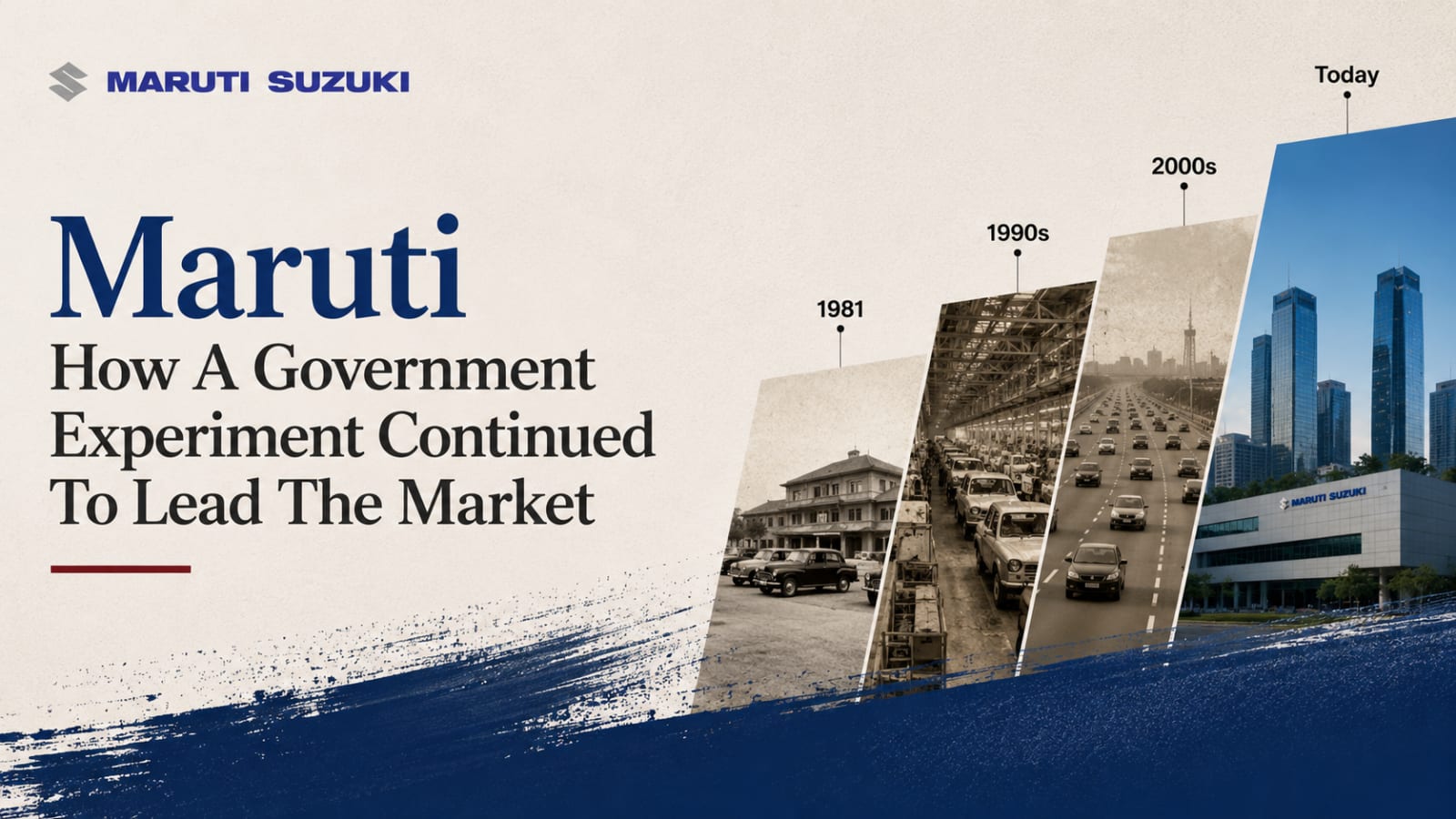
There was a time when four-wheelers were beyond the reach of the common middle-class people in India. For most families, a car was less a mode of transport and more a distant aspiration. Mobility existed, but accessibility did not.
Then came Maruti, and the market changed. It put the Indian middle class in the driving seat.
Established in 1981 as Maruti Udyog Limited and later partnered with Japan’s Suzuki Motor Corporation in 1982. The partnership would go on to reshape India's automotive landscape. The following year, the company rolled out the Maruti Suzuki 800, a compact hatchback that would become synonymous with first-time car ownership for many.
Over the following four decades, Maruti Suzuki evolved into India's largest passenger vehicle company. According to the filings, in FY2024-25, it recorded its highest-ever annual sales of 2,234,266 vehicles, including 332,585 exported units, while accounting for nearly 43% of India's passenger vehicle exports.
When the government-backed car maker was launched, India had little experience in modern passenger car manufacturing. The company itself was entering largely uncharted territory. While the ambition to create an affordable people’s car existed, the technical expertise, production systems and supplier ecosystem required to achieve it were still developing.
This is where Suzuki was significant. Its entry into the venture brought not only technology but also manufacturing practices that would influence the broader automotive sector for decades to come.
The impact extended well beyond the factory floor. Maruti’s manufacturing operations in Gurugram and later Manesar attracted component manufacturers, logistics providers and supporting industries to the region.
Over time, this industrial ecosystem played a major role in transforming Gurugram (then Gurgaon) from a relatively modest town into one of India's most important business and manufacturing centres. The growth of the automotive sector also accelerated infrastructure development, employment generation and urban expansion across large parts of Haryana.
What makes this origin story matter, decades later, is not just that a car company was born. It’s about a government-run experiment which ended up reshaping personal mobility for an entire country.
Beyond Gurugram
But employment, for Maruti, was not limited to its manufacturing ecosystem. As part of CSR, it partnered with Gujarat’s Ministry of Tribal Development. It launched the Maruti Suzuki’s All Gujarat Institute of Driving, Technical Training and Research (AGIDTTR). Under that, it trained young tribal men and women, many of whom were landless farm labourers or unskilled construction workers. The institute focused not only on professional driving skills but also on employability, offering training in personality development, hygiene, courtesy and communication alongside driving instruction.
Maruti tried to formalise this further. According to the company, it set up the Automobile Skill Enhancement Centres across government-run Industrial Training Institutes and established the Japan-India Institute for Manufacturing to upskill the Indian youth. It also runs a volunteering programme called e-Parivartan, in addition to operating two schools through a non-profit education trust.
The Scars And The ‘Way Of Life’
No institution this large grows without friction, and Maruti’s journey has not been without its darker chapters.
In 2012, the Manesar plant became the site of one of India’s most serious industrial unrests. A worker protest escalated into violence that resulted in the demise of a manager and injuries to several others, as documented by media reports. The aftermath saw mass dismissals, long legal battles, and renewed scrutiny of how the company treated its contract workforce versus its permanent employees.
This left a deep scar on Maruti’s history, which seems to be painful even today. But as the company’s tagline suggests, it’s probably the ‘way of life’.
The tagline is, in many ways, an apt summary. For four decades, Maruti has not just been a company that sells cars. It has been the first car for countless Indian families, the first job for countless engineers and dealership staff, the first steady income for tribal youth trained to drive, and the anchor around which an entire ecosystem of component makers, mechanics and driving instructors built their livelihoods.
The Journey Ahead…
A government-backed experimental venture ended up gifting many middle-class Indians their first cars. Not a luxury. Not a status symbol for the few. But something an ordinary clerk, a school teacher, a small shopkeeper could one day call their own.
Of course, the story isn’t without its scars. The events of 2012 are a reminder that no institution, however transformative, is free of its own contradictions. Progress and pain have often travelled the same road.
What is remarkable, though, is how little this dominance has slipped, even as the market it once had to itself has become one of the most competitive in the world. Some of Maruti’s earliest competitors like Hindustan Motors only exist in nostalgia today. Ambassador and Premier's Padmini are vintage now. Today, the competition is with the likes of Hyundai, Tata Motors, Mahindra, Toyota, etc. And yet, Maruti continues to cover the largest space in the market.
Not that Maruti was always perfect, but it became inseparable from the everyday lives of millions, decade after decade, even as the world around it changed entirely.
Read Next
More stories


Have a person, achievement or story our editors should know about?
Submit a Story
Stories worth telling, in your inbox.
Get the latest People Who Matter features delivered weekly.
Subscribe NowDiscussion
No comments yet. Be the first to share your thoughts.