
Anup Bagchi Is Leaving ICICI Life to Lead HDFC Bank. Why India’s Biggest Bank Chose an Outsider
Anup Bagchi will become HDFC Bank’s first outsider CEO. His appointment from the ICICI ecosystem reveals what India’s largest private sector bank may be looking for after merger, scrutiny and a difficult transition.
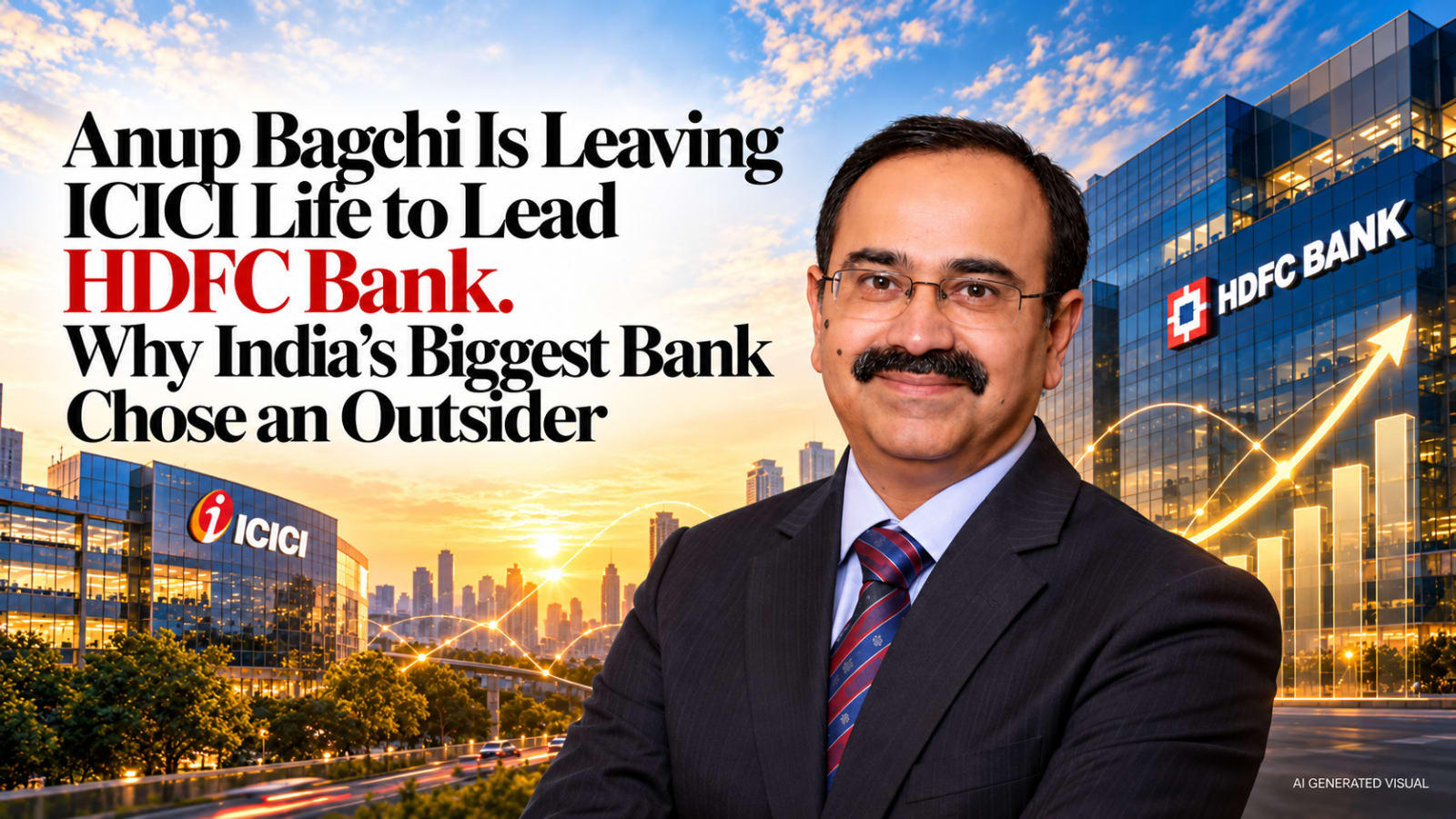
HDFC Bank has selected ICICI veteran Anup Bagchi as its next managing director and chief executive. The appointment is historic for a bank that has traditionally grown its leaders from within, but the more revealing story is why an institution built on continuity has decided that this moment calls for an outside perspective.
Some appointments matter because of the person chosen. Others matter because an institution has decided to break one of its own habits. Anup Bagchi’s appointment at HDFC Bank is both.
HDFC Bank describes Bagchi as a financial services leader with more than three decades of experience across banking, capital markets, wealth management and insurance. He joined the ICICI Group in 1992 and has led businesses ranging from ICICI Securities to retail and wholesale banking at ICICI Bank and, most recently, ICICI Prudential Life Insurance.
Reuters reported that Bagchi will take charge for a three year term from October 27, following Reserve Bank of India approval. More unusually, he will become the first external candidate to lead HDFC Bank.
That last fact is what turns a senior banking appointment into a larger leadership story.
HDFC Bank has historically trusted continuity
The modern identity of HDFC Bank was built around institutional continuity. Aditya Puri led the bank from its early years until 2020. His successor, Sashidhar Jagdishan, was not imported from a rival. He had joined HDFC Bank in 1996 and spent decades inside the institution before taking the top job.
HDFC Bank’s profile of Jagdishan records that internal journey from finance to chief financial officer, group leadership and eventually managing director and chief executive.
Bagchi represents the opposite succession logic. He knows Indian banking deeply, but he did not grow up inside HDFC Bank. Much of his career was spent inside the ICICI ecosystem, historically one of HDFC Bank’s most important private sector competitors.
For a bank famous for producing its own leadership bench, choosing an outsider is therefore not a routine change of name. It is a decision about what kind of perspective the institution believes it now needs.
Bagchi brings breadth rather than one narrow banking identity
His career is unusually broad. HDFC Bank says he has worked across treasury, retail banking, wholesale banking, investment banking, digital financial services, capital markets, wealth and insurance. He served as executive director at ICICI Bank from 2017 to 2023 and had responsibility at different points for retail, business and rural banking, and later wholesale banking.
The bank also credits him with helping strengthen ICICI’s retail franchise and with experience in technology led financial services. Before that, he led ICICI Securities, giving him exposure to capital markets and digital investing as well as conventional banking.
That range matters because the job he is entering is no longer simply about running a large lender. HDFC Bank today is a much larger and more complex institution after its 2023 merger with HDFC Ltd.
The outsider arrives after an unusually complicated chapter
HDFC Bank remains one of India’s most important financial institutions, but its recent period has included the operational complexity of absorbing a giant housing finance business, pressure on margins and deposits, and heightened attention to governance.
Reuters Breakingviews noted that the bank’s net interest margin declined from its pre merger level and that the institution is also navigating governance scrutiny. The analysis argues that Bagchi arrives with a mandate shaped by both financial performance and institutional confidence.
Those challenges should not be converted into a prediction about what Bagchi will achieve. They do, however, help explain why the selection of an external leader is consequential.
When an organisation chooses continuity, it is usually saying that its existing culture contains the answers it needs. When it chooses an outsider, it creates the possibility that some assumptions are ready to be challenged.
There is symbolism in choosing someone from the ICICI system
Indian private banking has long been shaped by the parallel rise of HDFC Bank and ICICI Bank. Their models, cultures and strengths have differed, but they have competed for customers, deposits, talent and investor attention for decades.
Bagchi crossing that institutional boundary is therefore more interesting than a normal executive move. He brings experience from a rival system into an organisation with its own deeply established way of doing things.
That does not mean HDFC Bank is trying to become ICICI Bank. It means the bank has chosen a leader whose professional assumptions were formed somewhere else.
The appointment is also a test of what an outsider can change without breaking
External leadership can bring distance from internal habits, but large institutions also depend on accumulated culture, systems and people. The useful outsider is not the person who arrives determined to prove everything before them was wrong. It is the person who can identify what should be preserved and what needs to move.
Bagchi’s first challenge will therefore be cultural as much as financial. He inherits a bank with enormous scale, a powerful franchise and thousands of employees who understand the institution from the inside. He also arrives precisely because the board was willing to look beyond that internal system for its next chief executive.
The most revealing thing about Anup Bagchi’s appointment may ultimately be that HDFC Bank, an institution built on continuity, has decided that continuity alone is no longer the only qualification for its top job
Tags
Read Next
More stories
AJIO Chose Ahaan Panday. Is Bollywood’s New Generation Becoming More Valuable Than Its Biggest Stars?
Oct 5, 2026

Why Air India Chose 15-Year-Old Vaibhav Sooryavanshi to Tell Its New India Story
Sep 23, 2026

Mission4Million: Axis Bank Foundation's Initiative To Transform 4 Million Rural Lives By 2030
Aug 7, 2026
Have a person, achievement or story our editors should know about?
Submit a Story
Stories worth telling, in your inbox.
Get the latest People Who Matter features delivered weekly.
Subscribe NowDiscussion
No comments yet. Be the first to share your thoughts.