
Mumbai Dabbawalas: India’s ‘OG’ Food Delivery Network
Long before food delivery apps transformed urban convenience, the Mumbai Dabbawala built a human-powered network that carried home-cooked meals, livelihoods and trust across the city. More than a delivery system, they became a symbol of discipline, dignity and Mumbai’s relentless spirit.
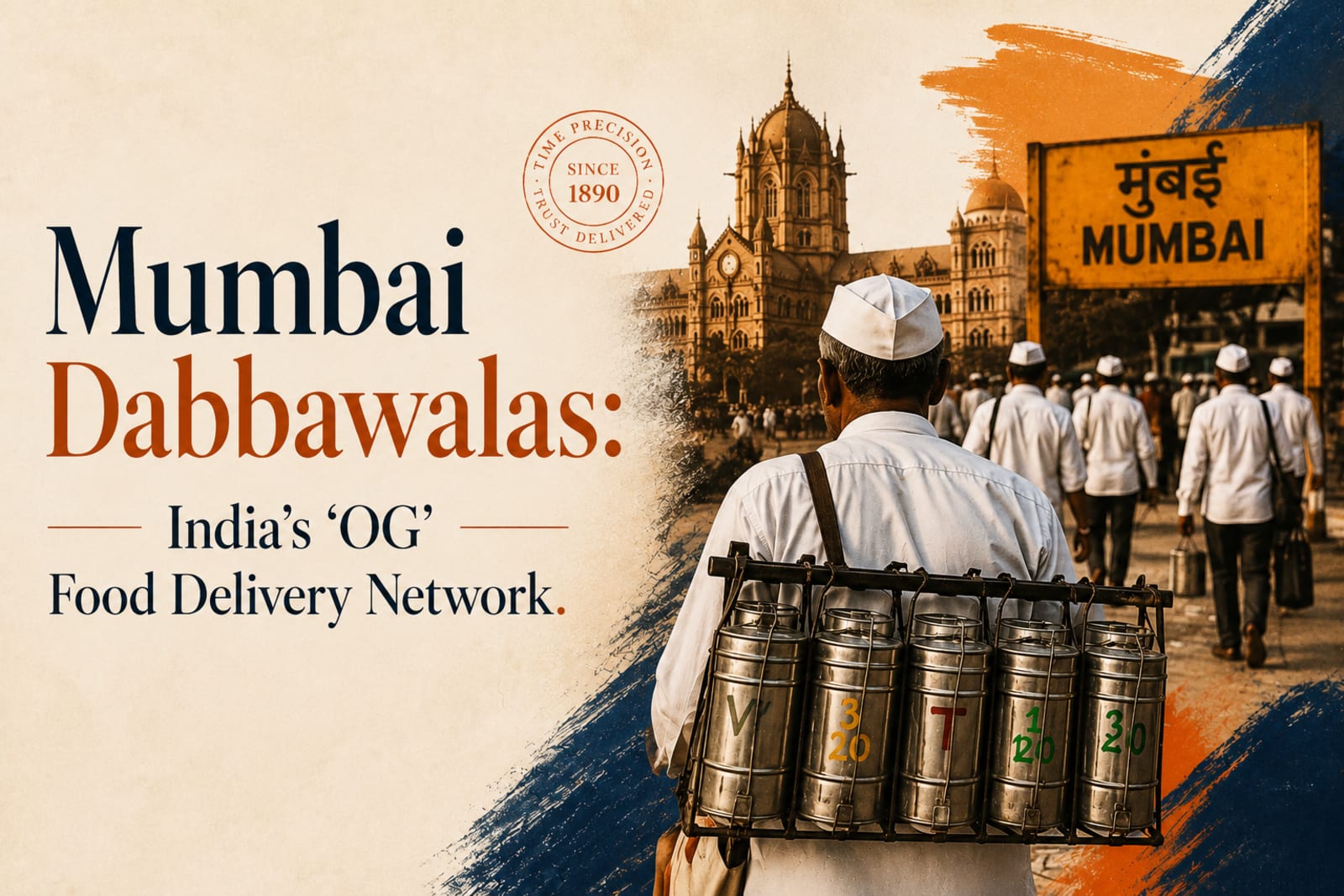
Decades before people could imagine ordering food with a tap on a small palm-sized screen, Mumbai was enjoying its food delivery network. With no GPS, no internet, and no phones to call and ask directions, the Dabbawalas of Mumbai had been delivering fresh food during the British Raj.
The century-old legacy began in 1890, as an experiment when a Parsi banker wanted home-cooked food in the office and entrusted this responsibility to the first-ever Dabbawala. On seeing this, others around him started demanding such service, and that’s how the iconic concept took shape.
As a visionary, Mahadeo Havaji Bachche saw this as having immense potential. He launched it as a full-time service with 100 Dabbawalas. According to reports, the founder started a cooperative model, which later came to be known as Nutan Mumbai Tiffin Box Suppliers Association (NMTBSA).
The dabbawalas did not simply transport food across the city. They created employment, community ownership and a model of dignified labour that survived for over a century. Today, their relevance extends far beyond logistics.
In an economy increasingly driven by temporary gig work and algorithmic management, the dabbawala system stands as a rare example of human-centred employment built on trust, shared responsibility and collective growth. A carefully designed coding system made up of colours, numbers, symbols and locality markings helps workers identify routes, train lines and final delivery points with remarkable accuracy.
The Busy Days Of The Financial Capital
The city’s fast-paced work culture, long commutes, and dependence on local trains created a daily routine in which millions left home early and returned late. But back during those days, without air conditioners and fridges, access to fresh food would be a constraint for the commuters. The Dabbawalas filled this gap.
The service first began in Gaondevi, Girgaon, and quickly gained popularity because of its affordable pricing and reliable delivery system. At a time when Mumbai was witnessing rapid population growth and expanding beyond its older neighbourhoods, the demand for timely home-cooked meals also increased. In many ways, the rise of the dabbawalas closely mirrored the city’s own transformation into a fast-moving urban centre.
Starting more than a century ago, as a solution to fresh food access, today the organisation has emerged as the soul of the city. Today, multiple initiatives such as graduate hiring, training, certification and startup support are part of its transformational framework.
Subhash Talekar, who is currently the president of the Mumbai Dabbawala Association, is also the founder of Roti Bank and Kapda Bank. While the Roti Bank collects leftover food, the Kapda Bank collects used clothes waiting to be discarded. Food is collected from big parties, gatherings, wedding ceremonies, etc to distribute to people in the slum areas of Mumbai. The clothes are distributed to needy people around Adiwadi village.
These initiatives reflect how the dabbawala network gradually evolved beyond its traditional role of carrying lunchboxes across Mumbai. Over the years, the organisation expanded its identity from a delivery system into a community-driven support structure focused on social welfare, sustainability and collective responsibility.
Thus, despite technological disruption and changing food habits, the dabbawala network continues to remain deeply relevant to Mumbai’s social fabric.
But keeping the changing needs of the city in mind, the association has also come up with another delivery service called Papers and Parcels. The food delivery is normally done within three hours. For the rest of the day, the association delivers parcels across the city, within a day.
Over time, the network evolved into a system that serves Mumbai round the clock. But it is pertinent to note that extraordinary coordination is what drew global attention.
Relevance In The Age Of Smartphones
Even in the age of Zomato, Swiggy, Bistro and more such apps, Mumbai Dabbawala holds strong relevance as the identity of the city. As of today, the organisation is operated by more than 5,000 dabbawalas, fulfilling the hunger of almost 200,000 Mumbaikars with home-cooked food.
But the relevance of this legacy extends far beyond logistics or operational efficiency. Their story represents a version of urban India built on trust, discipline and collective responsibility long before technology became central to modern logistics.
For over a century, the network created livelihoods for thousands of workers while quietly building one of the country’s most respected community-driven labour models.
At a time when conversations around gig work, automation and algorithm-driven employment continue to reshape cities, the dabbawalas remain a reminder that human coordination can still power large-scale systems with remarkable consistency.
In many ways, the Mumbai Dabbawala solved more than a food delivery problem. They built an ecosystem where work carried dignity, community and long-term belonging. Thus, even after decades of technological disruption, the white Gandhi caps moving through Mumbai’s crowd continue to symbolise the soul of the city of dreams.
Read Next
More stories
Gig Work, Food Delivery, Q-Commerce, Ambulance: How Zomato Built An Ecosystem
Aug 7, 2026

CMF Is Becoming an Indian Smartphone Brand. Can India Finally Build a Global Phone Brand?
Sep 25, 2026

From Dholera to the World: Tata’s Chip Ambition Just Found an Important Global Customer
Sep 19, 2026
Have a person, achievement or story our editors should know about?
Submit a Story
Stories worth telling, in your inbox.
Get the latest People Who Matter features delivered weekly.
Subscribe NowDiscussion
No comments yet. Be the first to share your thoughts.