
Tata Steel: The Company That Turned Industrialisation Into Social Change
From supporting India’s industrial self-reliance movement to building communities around workers, Tata Steel evolved into far more than a business enterprise. It teaches how industrial growth and social welfare can work well, decades before independence.
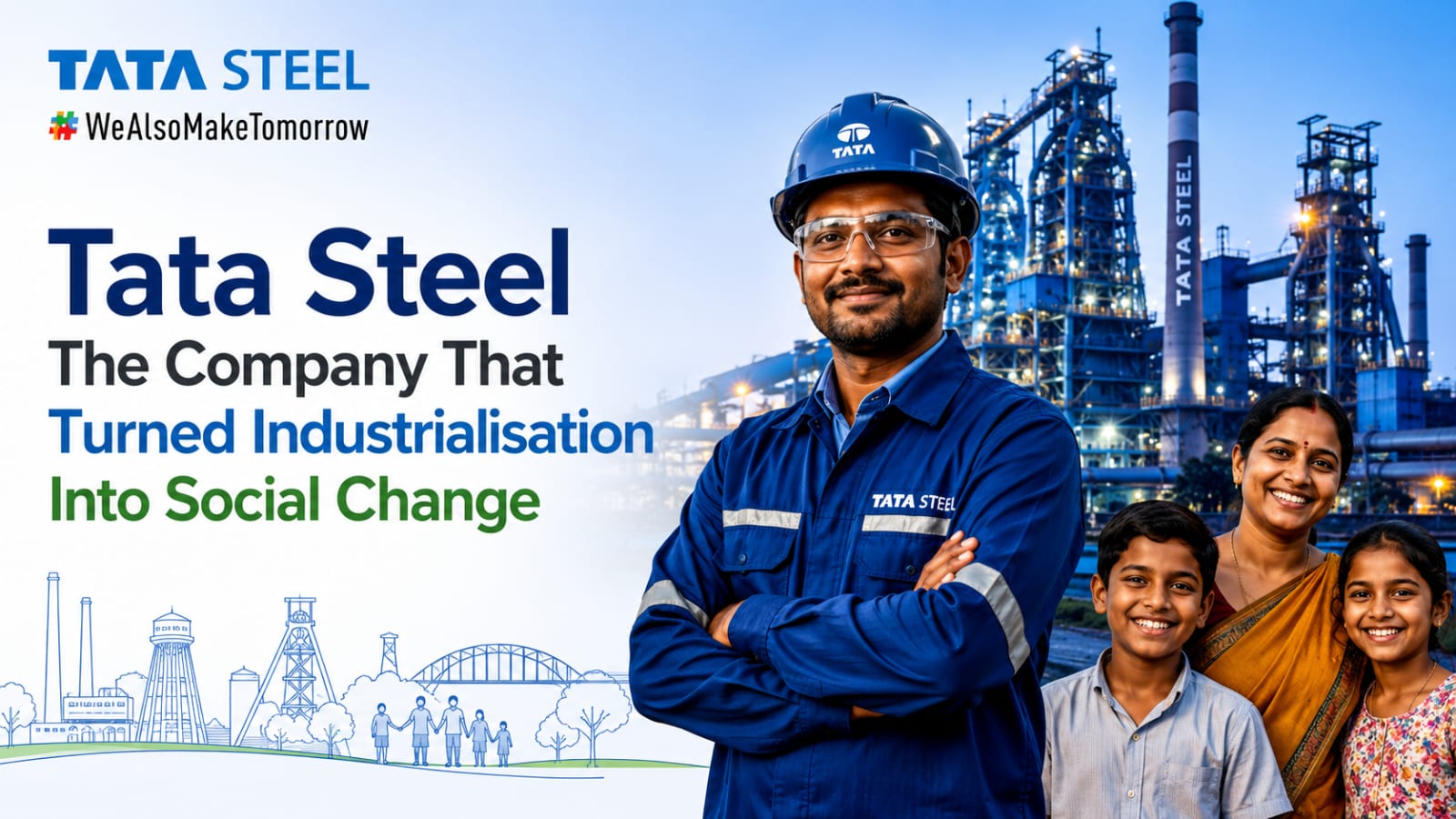
Not the entire freedom struggle of India was fought by patriots shedding their blood. Some did it economically to build a self-reliant country. Tata Steel is one such name. It isn’t just another company manufacturing and supplying steel. It whispers the history of the Swadeshi movement.
But when Jamsetji Tata and his son Dorabji Tata dreamt about Tata Steel, their vision wasn’t just to limit the company’s objective to revenue generation. He aimed for holistic socio-economic development. He realised that the primary step was to create an ecosystem where workers could flourish as much as the company.
Thus, long before corporate social responsibility became boardroom vocabulary, Tata Steel started building worker housing, healthcare systems, sanitation networks and an industrial township, Jamshedpur, that challenged the very idea of how labourers should live and work in colonial India.
The Company Is Your Extended Family
Today, business leaders and managers are often heard saying, “Treat the company as your extended family.” But Tata Steel probably never had to say this. All it did was to extend the necessary support to the workers with a perfectly healthy and balanced work culture.
To start with, way before an eight-hour shift became a mandate by law, Tata Steel made it a policy. In 1912, at a time when industrial workers normally endured exhausting 10 to 12-hour shifts, the company introduced the eight-hour workday at its plant in Jamshedpur.
The move was considered remarkably progressive for colonial India, where labour welfare protections were still minimal and industrial workers were often viewed primarily as units of production. Tata Steel’s decision reflected a broader philosophy that industrial growth could not be separated from worker wellbeing.
Over the following decades, the company continued to introduce several employee welfare measures long before they became legal requirements in India. These included free medical aid in 1915, provident fund schemes and accident compensation in 1920, maternity benefits in 1928, and leave-with-pay policies, etc.
Around the steel plant itself, worker housing, sanitation systems, schools, hospitals, parks and sports facilities gradually transformed Jamshedpur into one of India’s earliest examples of a planned industrial township.
Though Jamsetji Tata did not live to see his dream project, Jamshedpur, he expressed his thoughts in a letter to his son even before the factory started operating. He wrote, “Be sure to lay wide streets planted with shady trees, every other of a quick-growing variety… Be sure that there is plenty of space for lawns and gardens. Reserve large areas for football, hockey and parks. Earmark areas for Hindu temples, Mohammedan mosques and Christian churches.”
The excerpts from the letter reflect that the city seems to have been rightly named after him.
These initiatives were not merely employee benefits in the modern corporate sense. In colonial India, they represented a fundamentally different philosophy of industrialisation. At Tata Steel, labour was viewed as part of a long-term community rather than just a workforce.
In many ways, Tata Steel was experimenting with a form of industrial capitalism that differed sharply from the extractive labour systems common during the colonial era. The company appeared to recognise early that industrial stability could not be achieved merely through production targets or wages.
A worker who had access to healthcare, housing, education and recreation was more likely to develop a sense of belonging towards the institution itself. What modern management theories describe as employee engagement and organisational culture, Tata Steel had already begun practising the elements of it in the early 1900s.
Even today, Tata Steel claims to be following the footsteps of Jamsetji Tata, offering several employee welfare benefits such as flexibility to work from home, child adoption assistance, paid family care leave other than parental leave, allowance of Rs. 70,000 for child adoption if it involves travelling, etc.
Other Social Commitments
When Tata Steel was planned, the idea was not just to create a business. According to Tata Steel, the primary focus of the Tata family was to create a developed ecosystem where people could feel safe and happy. Jamshedpur is the name of that ecosystem, not just because the steel plant was constructed here, but also because the township fosters a pool of other things that attract people from across the world even today.
A primary example of this development is the Tata Main Hospital. Though it was built as a part of the Tata Steel ecosystem, the hospital served both the employees and the local communities in the area.
But years later, the social outreach of Tata Steel expanded to places outside Jamshedpur. As the company expanded its operations across mineral-rich belts of eastern India, particularly in Jharkhand and Odisha, it also became increasingly involved in rural and tribal development programmes around these regions.
Even today, in these areas, the company continues such initiatives. According to the company, it aims to preserve and promote tribal culture and heritage through various initiatives. The initiatives include the tribal leadership programme, Samvaad tribal conclave, tribal language centres, curated tribal literature programmes, etc.
Further, it claims to be partnering with governments and independent organisations worldwide to improve the healthcare facilities in the mining-affected areas. Recently, the company partnered with IIM Raipur to work together in the areas of social impact, public policy, sustainability, and inclusive development.
The community outreach of Tata Steel is too vast to understand at one go. But what is crucial is that the core focus on welfare and social development through industrialisation lived on.
Several mining and industrial belts in eastern India historically witnessed a paradox where places close to mines continued to struggle with healthcare gaps, low literacy and economic underdevelopment. In that context, Tata Steel’s community programmes increasingly positioned the company not merely as an industrial operator, but also as a stakeholder in regional development.
As a conglomerate, the Tata Group has adopted this across its companies. But the interesting fact is that even with such investments in welfare, the company continued to grow to declare a consolidated turnover of approximately Rs. 2.18 lakh crore as of FY25.
Global Expansion
Tata Steel started with the idea of an ‘Atmanirbhar Bharat’ decades before even the country got independence. With Jamsetji Tata’s aim to position India as a leading steel producer of the world, today the company operates not just across India, but also in the Netherlands, the UK, and Thailand with an annual capacity of 35 million tonnes of crude steel.
But the global legacy has existed since the first few decades of the company’s growth. At the time of World War I, a shortage of materials in Europe was observed. This thrust India to the forefront. To construct railways to transport troops and supplies, steel was needed in large quantities. At that point, Tata Steel stepped up.
Following this, on a visit to the plant in Jamshedpur, the then Viceroy of India, Lord Chelmsford, said, “I can hardly imagine what we would have done if the Tata Company had not given us steel for Mesopotamia, Egypt, Palestine, and East Africa.”
Currently, Tata Steel employs over 1.15 lakh people globally as of 2025. As of this day, some key Indian projects that have procured materials from Tata Steel are Rabindra Setu (Howrah Bridge), Bandra–Worli Sea Link, Delhi Metro, Kalinganagar Industrial Complex and more.
Since 1907 To Forever…
More than a century later, Tata Steel’s legacy cannot be measured merely through the product. Its larger contribution perhaps lies in attempting to redefine what Indian industrialisation could look like, if at all economic ambition coexisted with labour dignity, social welfare and community development.
About Tata Steel, Mahatma Gandhi once said, “... throughout my public service of 35 years, though I have been obliged to range myself seemingly against capital, capitalists have in the end regarded me as their true friend. And in all humility, I may say that I have come here also as a friend of the capitalists - a friend of the Tatas.”
The story of Tata Steel is, in many ways, the story of modern India itself, as the country tries to balance ambition with responsibility. Perhaps that is why Tata Steel’s story continues to stand apart even today.
It was never only about furnaces, factories or production numbers. It was about building an ecosystem where workers could live the life they planned when they entered the workforce, whether organised or unorganised.
Read Next
More stories
Have a person, achievement or story our editors should know about?
Submit a Story
Stories worth telling, in your inbox.
Get the latest People Who Matter features delivered weekly.
Subscribe NowDiscussion
No comments yet. Be the first to share your thoughts.