
Why Air India Chose 15-Year-Old Vaibhav Sooryavanshi to Tell Its New India Story
Air India could have chosen an established sporting icon. Instead it chose 15 year old Vaibhav Sooryavanshi. The decision reveals how the airline wants its own transformation to be seen alongside a younger, more ambitious India.
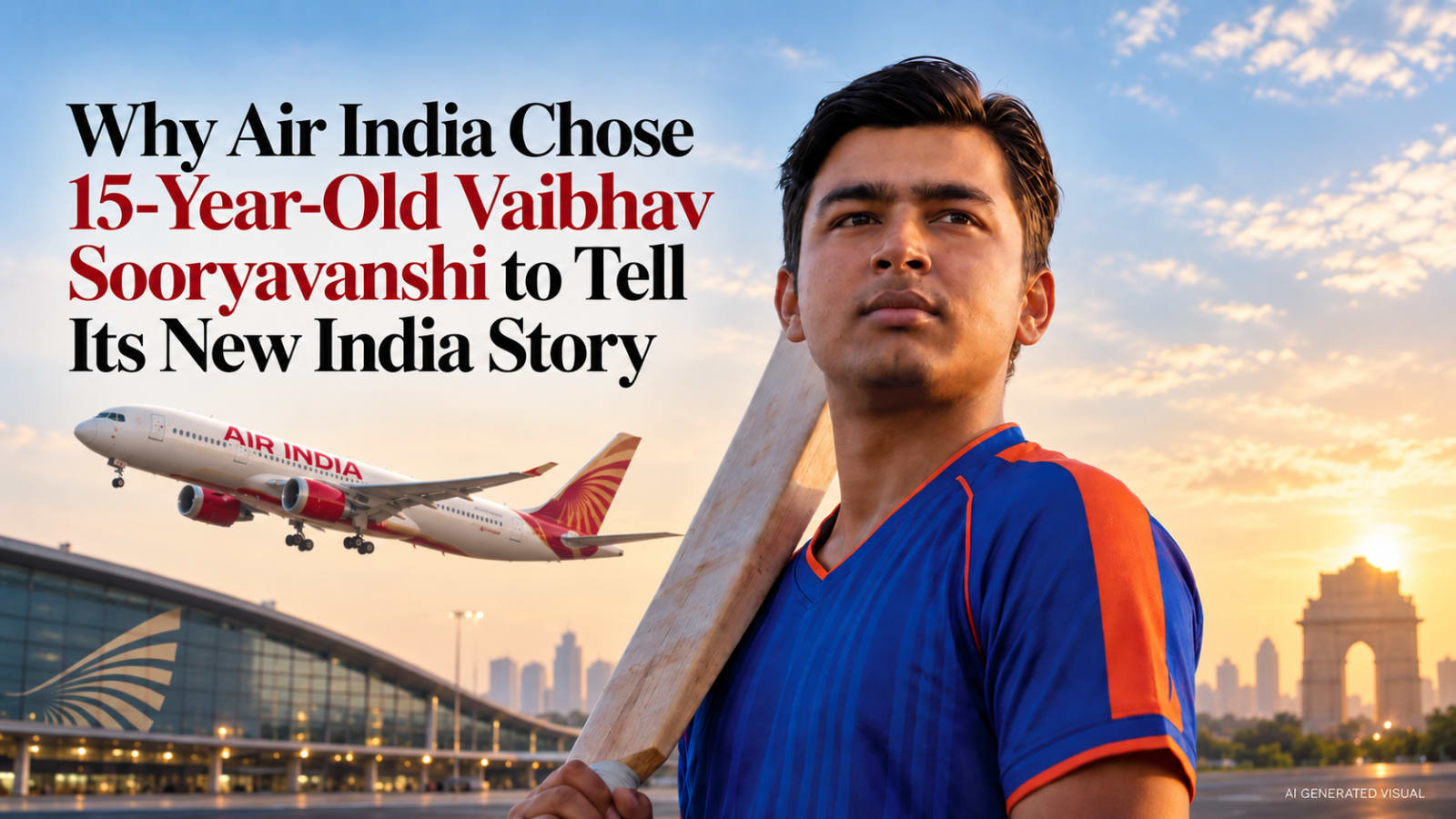
Air India's latest ‘There is an Air About India’ campaign puts teenage cricketer Vaibhav Sooryavanshi at its centre. The interesting part is not another celebrity campaign. It is why a national airline in the middle of reinventing itself chose potential over established fame to represent the India it wants to fly with.
The safest celebrity choice for a national airline is usually obvious. Pick somebody already famous enough to need no introduction. A cricket captain. An Olympic medallist. A film star. Someone whose achievements are complete enough to be converted neatly into a campaign line.
Air India has done something more interesting.
For the latest chapter of its ‘There is an Air About India’ platform, the airline has put 15 year old cricketer Vaibhav Sooryavanshi at the centre of the film. Air India says the campaign, released ahead of the Asian Games, is built around the families, coaches, teammates, mentors and supporters behind Indian achievement. The refrain is ‘Together We Fly.’
But the person chosen to carry that idea matters just as much as the line.
Sooryavanshi is not being used as proof of a finished legacy. He is being used as a symbol of possibility. And for an airline trying to convince India that its own transformation is still unfolding, that is a revealing choice.
Brands usually borrow achievement. Air India is borrowing potential.
Celebrity advertising traditionally works backwards. A person achieves something extraordinary, becomes famous, and a brand then borrows some of that accumulated meaning. The medal, the career, the box office record or the captaincy has already done the cultural work.
Sooryavanshi represents something less settled. His story is still being written. He has already attracted enormous attention as a teenage cricket prodigy, but the interesting thing about him for a brand is precisely that nobody yet knows the final shape of his career.
That makes the association feel less like a trophy cabinet and more like a bet on what comes next.
There is also a useful tension here. Reuters reported this month that India coach Gautam Gambhir urged patience around the teenager, noting the competition for places and the importance of development. That context makes Air India's choice more interesting, not less. The brand is attaching itself to promise rather than pretending promise is the same thing as guaranteed greatness.
Air India is also asking India to believe in a journey that is unfinished
The airline itself is in an awkward but potentially powerful brand position. Since returning to the Tata group in 2022, Air India has been trying to rebuild almost every part of the experience at once: aircraft, cabins, technology, service, training, operations and brand identity.
Its official update says it has ordered 600 new aircraft, is carrying out a US$400 million retrofit programme for legacy aircraft, has completed the retrofit of its narrowbody fleet and is building new training, flying and maintenance infrastructure. Air India newsroom continues to document that transformation as it unfolds.
The difficulty is that airline transformations are experienced in public. A passenger does not consume a five year strategy. They consume the aircraft and crew they happen to get that day. New cabins can exist alongside older ones. Ambition can coexist with inconsistency. The future arrives fleet by fleet rather than all at once.
That makes the metaphor of a young athlete unusually useful. Both stories are about potential that has become visible before the finished result has arrived.
The campaign is really about the people behind the visible person
Air India could easily have made Sooryavanshi the entire story. Instead, the campaign deliberately widens the frame. Parents, coaches, mentors, teammates and supporters become part of the achievement.
That is culturally smart. India has always celebrated individual stars, but Indian success stories are rarely as individual as the mythology around them suggests. A teenage athlete makes that especially obvious. Someone drove them to practice. Someone paid for equipment. Someone coached them before anybody was watching. Someone made decisions on their behalf when they were too young to make them alone.
The campaign therefore shifts the emotional proposition from ‘look at this extraordinary person’ to ‘look at the ecosystem that allowed this person to become extraordinary.’
For People Who Matter, that is the more interesting idea. The person who matters is not always the person holding the trophy.
Why a 15 year old fits the new India brands want to sell
There is another reason Sooryavanshi works. Indian brands increasingly want to speak about the country in the future tense.
For decades, national brand advertising often leaned heavily on heritage, unity, nostalgia and achievement already earned. Those themes remain powerful. But a younger vocabulary has entered the room: ambition, momentum, global confidence, technology, creators, athletes, founders and the belief that India's most important achievements may still be ahead.
Air India's original ‘There is an Air About India’ platform, launched in 2025, explicitly framed the country through confidence, joy and momentum. Air India described the campaign as a celebration of a bold and vibrant India on the rise. The new film makes that broad national idea more personal.
A teenager is almost the purest expression of that future tense. There is more ahead of him than behind him.
There is risk in choosing potential
A young athlete is not a finished brand asset. Form changes. Careers take unexpected turns. Public attention can become pressure. The same youth that makes a person symbolically powerful also makes their future impossible to predict.
Brands therefore have a responsibility not to turn young talent into a prophecy. Sooryavanshi does not need to become the next anybody for the campaign to make sense. The better reading is that Air India has chosen someone whose story captures what support can make possible, without requiring us to know where that story ultimately ends.
That distinction matters especially when the person involved is still a minor. Admiration should not become expectation disguised as marketing.
The most interesting brand ambassadors may be the ones who represent direction, not status
Air India is among the first major Indian brands to partner with Sooryavanshi, according to the airline. That gives the choice a different texture from signing a star whose commercial identity has already been defined by dozens of endorsements.
The airline is effectively saying that relevance can come from trajectory rather than seniority. A person can represent a brand not because they have already become an institution, but because their story points in the same direction the brand wants to travel.
That direction is the real connection between Air India and Vaibhav Sooryavanshi. One is a teenager at the beginning of a sporting life. The other is an old airline trying to convince the world that it can begin again.
Neither story is complete.
Perhaps that is exactly the point.
Tags
Read Next
More stories

Have a person, achievement or story our editors should know about?
Submit a Story
Stories worth telling, in your inbox.
Get the latest People Who Matter features delivered weekly.
Subscribe NowDiscussion
No comments yet. Be the first to share your thoughts.