
Sabyasachi Used Bollywood to Build Fame. Now He Wants Indian Luxury to Outgrow It.
Sabyasachi Mukherjee is returning to New York Fashion Week while pushing back against celebrity customisation and overexposure. The contradiction reveals his larger ambition for Indian luxury.
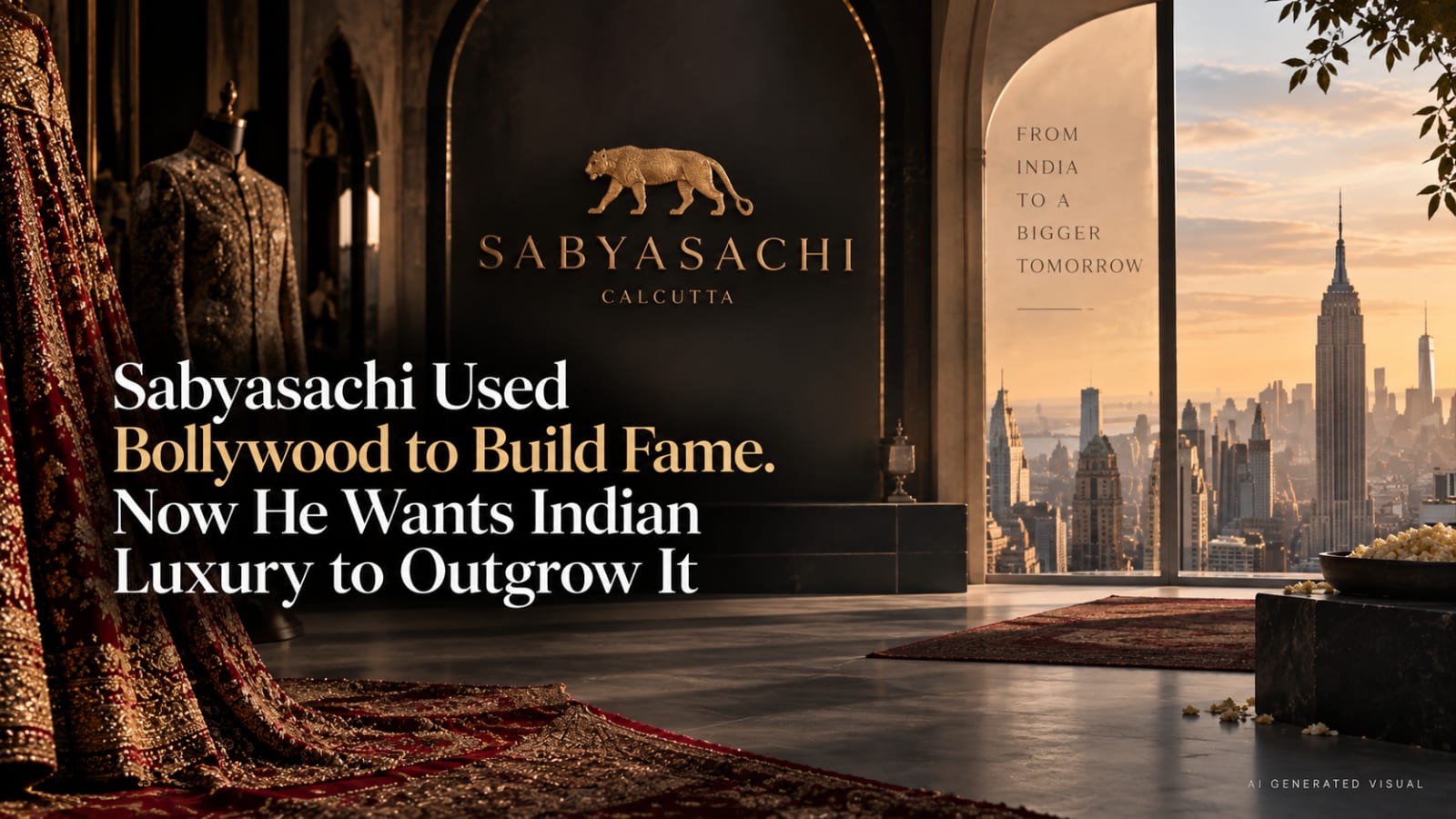
Sabyasachi Mukherjee is returning to New York Fashion Week after two decades while openly questioning celebrity customisation, red carpet overexposure and the machinery that once helped make his name ubiquitous. It sounds contradictory. It may actually reveal the clearest version yet of his ambition: to build an Indian luxury house whose authority comes from culture, craft and conviction rather than celebrity approval.
There is a delicious contradiction at the centre of Sabyasachi Mukherjee's career right now. Few Indian designers have benefited more visibly from celebrity culture. His saris, lehengas and jewellery have appeared at some of the country's most watched weddings. Bollywood helped turn the Sabyasachi name from fashion insider knowledge into cultural shorthand for Indian luxury.
And yet Sabyasachi now sounds increasingly determined not to let celebrity culture define what he has built.
In a recent interview reported by The Indian Express, Mukherjee explained why he avoids making custom clothes for Bollywood stars simply to satisfy red carpet demands. He argued that excessive celebrity visibility can become a disservice to luxury and that constant customisation risks handing creative authority from the designer to stylists and celebrities.
Coming from the man whose name has become inseparable from Bollywood weddings, that could sound like biting the hand that fed the brand. It is more interesting to read it as something else: a designer who understands exactly what celebrity gave him, and who now believes the next stage of Indian luxury requires the confidence to live without depending on it.
Bollywood was not an accident. It was part of the strategy.
Sabyasachi's relationship with celebrity has never been as simple as dressing famous people. His own brand history openly describes Bollywood as a platform for luxury and a way to create visibility for the brand while creating image value for the celebrity. The company credits those years with helping make India felt on global stages through figures including Vidya Balan, Deepika Padukone and others. The Sabyasachi archive makes clear that celebrity was not merely decoration around the business. It was part of how the business learned to communicate.
Mukherjee has also been unusually candid about why he once embraced that ecosystem. In an earlier Vogue interview, he recalled being advised to return to India and win the domestic market before trying to conquer the world. Bollywood and bridal were obvious places to build scale because the attention around them was enormous.
It worked. Sabyasachi did not simply become a successful designer. He became part of the visual grammar of the modern Indian wedding. For a generation of consumers, a Sabyasachi bride became an instantly recognisable cultural image. The red, the gold, the handwork, the jewellery, the styling and the photography formed a universe that could be recognised before the logo was visible.
Celebrity accelerated that recognition. But acceleration and destination are not the same thing.
The designer is now trying to reclaim the authority of the designer
Mukherjee's resistance to celebrity customisation is ultimately an argument about authorship. Luxury fashion has always depended on a certain imbalance of power. The customer may be wealthy, famous or influential, but the house is supposed to possess an aesthetic authority of its own. You buy into Chanel, Hermès or Armani because the brand already knows what it believes.
The contemporary celebrity ecosystem can reverse that relationship. Stylists request alterations. Stars want exclusivity. Red carpet moments are engineered for immediate attention. Design can become content, and content has a brutally short shelf life.
Sabyasachi appears increasingly uncomfortable with that trade. His position is not that celebrities should never wear his clothes. They clearly will. It is that fame should not be allowed to rewrite the house every time a famous client enters the room.
That distinction is important because global luxury is built on recognisable codes. If every product is endlessly modified around whoever happens to be photographed in it, the celebrity becomes the author and the brand becomes the supplier.
Sabyasachi wants the opposite. He wants the person wearing the clothes to enter his world.
And now he is taking that world back to New York
The timing makes his argument much bigger than a comment about Bollywood. Sabyasachi is returning to the official New York Fashion Week calendar after roughly two decades. The Council of Fashion Designers of America listed Sabyasachi by Sabyasachi Mukherjee on the September 2026 schedule, placing the Indian house inside one of fashion's most visible international weeks.
Vogue has framed the return around an even larger question: could Sabyasachi become India's first global luxury house? The profile notes that the company now stretches well beyond bridal fashion into high jewellery, handbags, eyewear and home, operates a growing network of flagships including New York, and reported FY2026 revenue of about 68.2 million dollars.
The new collection, Bengal Byzantine Broadway, is a useful description of the ambition itself. Bengal is not being erased to make the brand internationally legible. It is being placed in conversation with Byzantine references and Broadway, with Indian craftsmanship acting not as anonymous labour behind Western luxury but as visible authorship.
That is a very different globalisation strategy from trying to make an Indian brand look vaguely European enough to be accepted abroad.
He does not want Indian luxury to become less Indian in order to become more global
For decades, India occupied an awkward position inside the global luxury system. The country possessed extraordinary textile traditions, embroidery skills, gemstones, artisans and manufacturing knowledge. Yet much of that value could sit invisibly behind brands whose names, storytelling and margins belonged elsewhere.
Sabyasachi's project has increasingly been to reverse that hierarchy. The craft can remain Indian. The visual language can remain Indian. The maximalism can remain Indian. The name on the door can be Indian too.
That confidence runs through the company's own description of itself. Aditya Birla's profile of the brand describes Sabyasachi as a luxury house rooted in heritage, quality and craftsmanship, with the aim of creating modern heirlooms. It also records the 2021 acquisition of a 51 percent stake by Aditya Birla Fashion and Retail for Rs 398 crore, a partnership explicitly intended to support the journey towards a global luxury house out of India.
The financial backing matters, but Mukherjee's cultural proposition may matter more. Capital can open stores. It cannot automatically create mythology.
Sabyasachi is building mythology on purpose
Walk into a Sabyasachi flagship and the commercial logic is almost deliberately obscured. The stores do not behave like efficient retail boxes. They behave like worlds.
The new Delhi flagship spans about 26,000 square feet and is filled with chandeliers, antique carpets, paintings, textiles and objects. The brand's stated belief, quoted by The Indian Express, is that a luxury store should inspire curiosity, preserve culture and create memory. Commerce may bring people through the door, Mukherjee has said, but culture is what makes them return.
That sentence explains more about his strategy than almost any product launch could. He is not trying to maximise the number of times a tiger logo appears in a feed. He is trying to increase the amount of meaning attached to it.
This is also why overexposure worries him. Luxury depends on desire, but desire is difficult to sustain when something becomes visually unavoidable. The algorithm rewards repetition. Luxury often requires the discipline to resist it.
The paradox is that Sabyasachi is famous because he understood mass culture
It would be easy to romanticise all of this and pretend Sabyasachi somehow exists outside commerce. He does not. In fact, one of the reasons he is so interesting is that he has repeatedly shown a sharp understanding of it.
He has collaborated with global companies including H&M, Estée Lauder, Christian Louboutin, Pottery Barn and Starbucks. His official collaborations archive says the H&M collection sold out online in under seven minutes. He has used television, Bollywood, weddings, beauty, accessories, jewellery and international retail to widen the cultural footprint of the name.
This is not a designer retreating from popularity. It is a designer trying to control the terms on which popularity enters the house.
That is a far more sophisticated position than simply declaring celebrity culture beneath luxury. Sabyasachi knows attention has commercial value because he used it brilliantly. He also appears to know that a luxury house cannot spend forever chasing the same attention that helped create it.
The real ambition is not to be India's most famous designer
There is a point at which a designer brand has to decide whether it wants to remain centred on the designer's fame or become an institution capable of outliving him.
Sabyasachi increasingly behaves like someone thinking about the second possibility. Clothing has expanded into jewellery, accessories, beauty and interiors. Flagships are built like cultural spaces. Collaborations are chosen to extend a recognisable universe. The brand is backed by institutional capital. New York is not simply a foreign market. It is part of an attempt to place an Indian house inside the permanent geography of global luxury.
A recent Forbes analysis makes a similar point through Sabyasachi's relationship with The Metropolitan Museum of Art: the opportunity is not merely another collaboration, but the orchestration of culture, craft, institutions, retail and global attention around one coherent idea.
That is how luxury houses become larger than collections. They build a world that consumers, museums, collaborators, celebrities and cities all want to enter.
Bollywood may have made Sabyasachi unavoidable. Global luxury requires him to become irreplaceable.
The distinction sounds small, but it is enormous.
Being unavoidable is about visibility. Being irreplaceable is about identity. A famous bride can create a billion impressions. A recognisable design language can create decades of brand equity.
Sabyasachi's current stance suggests he understands that the next stage cannot simply be more weddings, more celebrities, more red carpets and more content. At some point, an Indian luxury house seeking global permanence has to prove that people want the product because of the house itself.
That does not mean Bollywood disappears. It means Bollywood stops being the source of authority. The celebrity wears Sabyasachi because Sabyasachi matters, rather than Sabyasachi mattering because the celebrity wore it.
For an industry that has spent years measuring relevance through famous faces, that is a quietly radical reversal.
He may be trying to change what the world thinks Indian luxury looks like
The biggest ambition here is not personal. If Sabyasachi succeeds internationally on his own aesthetic terms, the consequence extends beyond one designer.
India has long supplied luxury with craft. It increasingly supplies luxury with consumers. The next step is supplying the world with luxury houses whose cultural authority originates here.
Mukherjee seems unwilling to achieve that by sanding away the parts of India that make his work distinctive. His stores are excessive. His references are historical. His clothes celebrate craft. His visual language can be nostalgic, opulent and deeply specific. Even when the brand travels, Calcutta keeps travelling with it.
That may ultimately be the most important part of his New York return. Sabyasachi is not asking the global fashion establishment whether Indian luxury can belong. He is increasingly behaving as though the question has already been settled.
Bollywood helped make him famous. Now Sabyasachi Mukherjee appears to be chasing something much harder to manufacture: authority.
If he gets it right, the lasting story will not be that an Indian designer conquered global luxury. It will be that he helped make Indian luxury a global category of its own
Tags
Read Next
More stories

Have a person, achievement or story our editors should know about?
Submit a Story
Stories worth telling, in your inbox.
Get the latest People Who Matter features delivered weekly.
Subscribe NowDiscussion
No comments yet. Be the first to share your thoughts.