Vijay Deverakonda Is Building Unhype. Why Are Celebrities Becoming Founders Instead of Endorsers?
Unhype is the latest example of a bigger shift in Indian celebrity culture. Stars are no longer satisfied with renting their fame to brands. Increasingly, they want equity, creative influence and a place on the cap table.
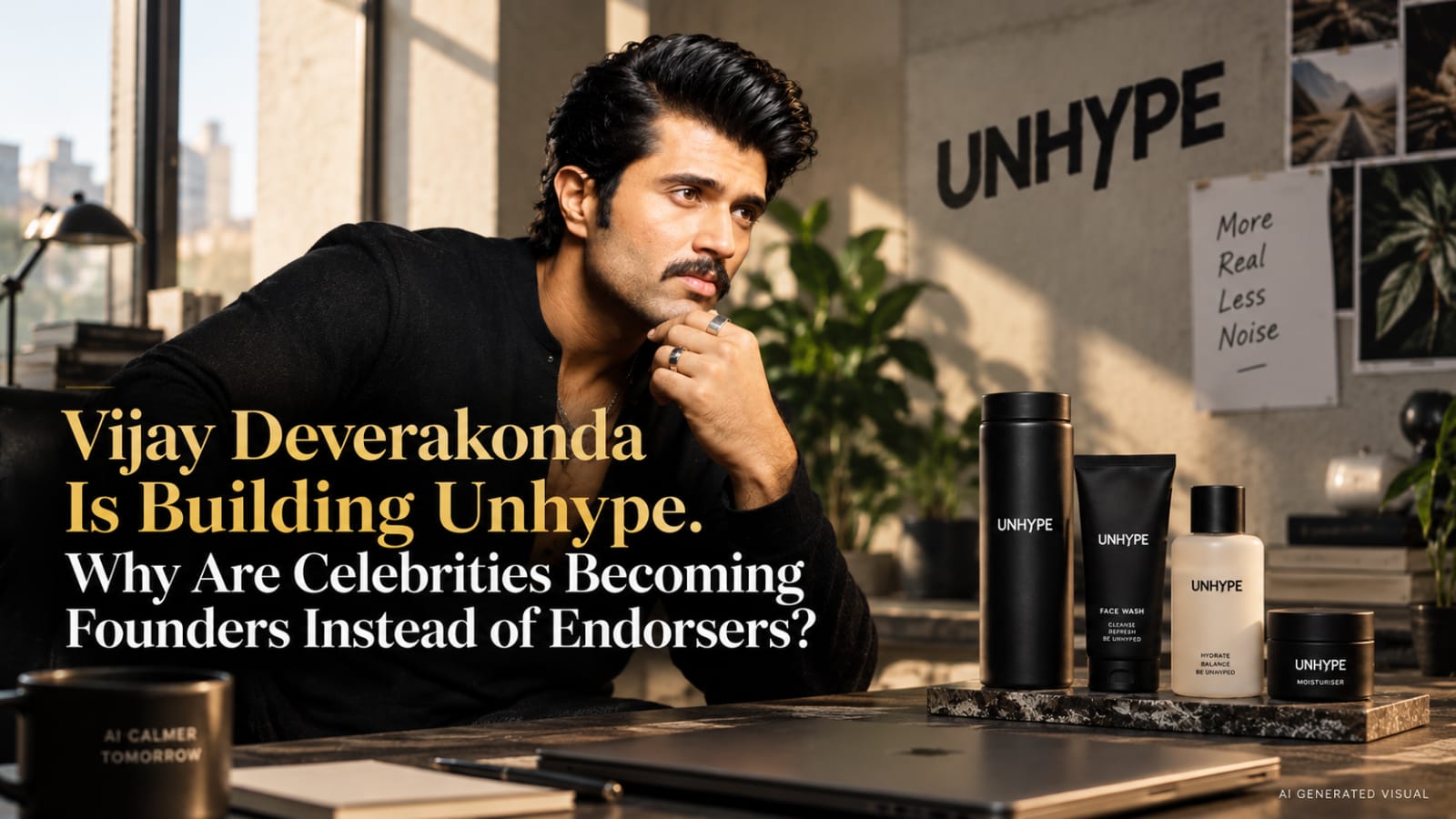
Vijay Deverakonda's new skincare label Unhype presents him as a co-founder who spent nine months testing formulations, not a celebrity hired after the product was finished. He is part of a wider shift in Indian stardom: famous people are increasingly trading endorsement cheques for equity, influence and ownership.
For decades, celebrity commerce followed a beautifully simple arrangement. A company built the product. An agency built the campaign. A famous person arrived near the end, smiled beside the product, collected a fee and lent the brand a little of their fame.
Vijay Deverakonda's new skincare company is trying very hard to tell you that this is not what happened here.
Unhype describes Deverakonda as a co-founder and co-builder. Its own website says he spent nine months testing successive versions of the products on his skin and uses the deliberately provocative phrase ‘No VD tax’ to argue that money has gone into the formula rather than simply paying for his endorsement. Unhype positions the brand around simple routines, named actives and products designed for Indian conditions.
Whether consumers ultimately believe that proposition will depend on the products, not the copy. But the positioning captures a much bigger change in the business of fame.
Indian celebrities increasingly do not want to be paid only for attention. They want to own part of what that attention creates.
The endorsement cheque has a problem: it ends
Traditional endorsements are attractive because they are simple. The celebrity gets paid regardless of whether the brand becomes a billion rupee business. The company gets reach without giving away ownership. Everyone knows their role.
The weakness is equally obvious. If a celebrity genuinely helps create enormous enterprise value, the upside belongs mostly to somebody else.
Equity changes that equation. Instead of renting fame for a campaign, a company can turn the celebrity into an investor, co-founder or co-creator. The star accepts more risk, but also gets exposure to the value of the business itself. The company gets something potentially more valuable than a shoot day: longer term alignment.
The shift is now visible in the data. Business Standard reported, citing Tracxn, that India's top ten celebrity investors participated in 49 disclosed funding rounds across 34 startups between 2021 and 2026 year to date, with the combined value of those rounds at about US$460 million.
Unhype is designed to make Vijay look like a builder, not a billboard
The language around Unhype is unusually deliberate. Deverakonda says he was interested because the team wanted him involved in building the brand rather than merely becoming its face. Entrepreneur India reported that the brand targets consumers aged 18 to 30 and launches with two three step routines built around face wash, moisturiser and sunscreen.
The products are positioned around Indian heat, humidity, sweat, sun exposure, pollution and hard water. The brand says formulations underwent independent third party testing and real user trials. Those are company claims and should ultimately be judged against consumer experience and credible product evidence, but they reveal the strategic intention: establish product seriousness before celebrity glamour.
That is important because celebrity brands carry an immediate credibility problem. Consumers know fame can buy distribution, attention and launch day headlines. It cannot automatically produce a good moisturiser.
The more aggressively a celebrity founder insists they were involved in the product, the more the product eventually has to prove them right.
Celebrity capital is not just money
A conventional investor can bring cash, networks and strategic advice. A famous investor brings something else: a distribution system built into their identity.
Millions of followers can be reached without first paying a platform to find them. Retailers recognise the name. Media notices the launch. Consumers may try a product simply because they are curious about the person behind it. That can lower one of the most painful costs for a young consumer brand: getting noticed in the first place.
This is why equity can make sense even when the celebrity is not writing large cheques. Their attention, credibility and cultural reach can function as capital.
Business Standard's reporting offers a useful example. Shraddha Kapoor holds a 21 percent stake in demi fine jewellery brand Palmonas, whose founder said Kapoor's association expanded discovery and credibility and helped the company scale customer acquisition. The same article describes celebrities increasingly participating in product conversations, creative direction and brand storytelling rather than remaining outside the business.
The best celebrity brands solve the fame problem quickly
Fame is incredibly useful at launch and potentially dangerous after it.
A celebrity brand that never becomes more interesting than the celebrity has a ceiling. Consumers may try the first product because of the founder. They buy the fifth because the product works, the price makes sense and the brand has earned an identity of its own.
That is why the strongest celebrity businesses eventually have to become ordinary businesses. They need repeat purchase, margins, supply chains, customer service, product development and a reason to exist when the founder is not trending.
India already offers different versions of this transition. Katrina Kaif's Kay Beauty, Hrithik Roshan's HRX, Alia Bhatt's Ed-a-Mamma and other celebrity linked ventures have shown that the relationship between fame and enterprise can extend far beyond a campaign contract. The models differ, and not every famous founder is equally involved, but the direction is clear: celebrity is increasingly being treated as an asset that can be converted into ownership.
Why founders want celebrities on the cap table
For a startup, the attraction is obvious. Consumer brands are expensive to build. Digital advertising costs money. Influencers cost money. Retail placement costs money. Public relations is crowded. A celebrity can compress the journey from unknown to noticed.
But the cap table also creates incentives that an endorsement contract cannot. If the company becomes more valuable, both sides benefit. If the celebrity damages the brand or stops caring, both sides have something to lose.
That does not eliminate the risks. Equity can become expensive if the company succeeds spectacularly. A celebrity can overshadow the actual founders. Personal controversies can travel directly into the business. And a large social following does not guarantee product market fit.
The model works best when there is believable alignment between person, product and audience. Deverakonda entering skincare is therefore not automatically interesting because he is famous. It becomes interesting if consumers believe his involvement changed the product or the way the company was built.
The new celebrity question is no longer ‘What do you endorse?’
For the previous generation of stars, the commercial scorecard was often the number and prestige of endorsement deals. A bank, a soft drink, a car, a watch, a telecom company and perhaps a luxury label could turn fame into a formidable annual income stream.
The newer question is more ambitious: what do you own?
Ownership changes the relationship between celebrity and commerce. It asks the star to stay after the campaign ends. It asks them to attach their name to customer complaints as well as launch photographs. It gives them the possibility of creating wealth that is not directly tied to the next film, match or appearance.
Vijay Deverakonda's Unhype arrives at exactly that moment. The skincare market is crowded, the consumer is sceptical and celebrity founders are no longer unusual. His fame can make people look. It cannot make them reorder.
That may be the most useful difference between an endorsement and ownership.
An endorsement asks whether a celebrity can sell a product once. A founder has to build something people want to buy again.
Tags
Read Next
More stories

Have a person, achievement or story our editors should know about?
Submit a Story
Stories worth telling, in your inbox.
Get the latest People Who Matter features delivered weekly.
Subscribe NowDiscussion
No comments yet. Be the first to share your thoughts.