
India’s Beauty Market Is Booming. So Why Did SUGAR’s Valuation Crash?
SUGAR Cosmetics has raised fresh capital at a sharply lower valuation even as India’s beauty market races ahead. The reset shows how investor expectations around India’s beauty brands have changed.
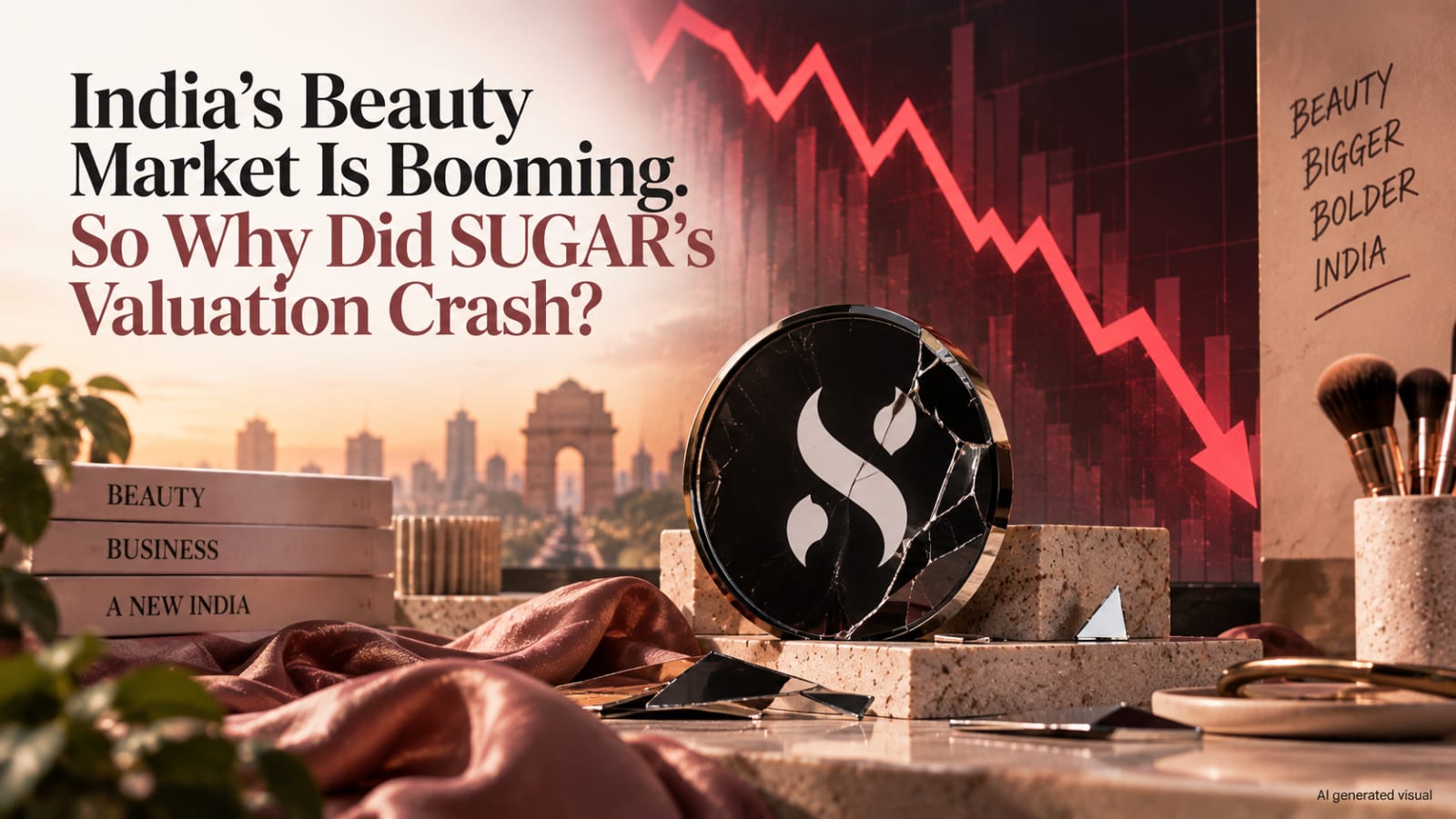
SUGAR Cosmetics has raised fresh money at a fraction of its peak valuation even as India’s beauty market races towards $40 billion. That contradiction says a great deal about how India’s beauty business is changing.
A few years ago, building a hot Indian beauty brand followed an appealing script.
Find an underserved consumer. Build a personality on Instagram. Make packaging people want on their bathroom shelf. Sell directly online. Spend aggressively on digital marketing. Raise money. Open stores. Expand distribution. Raise more money at a higher valuation.
For a while, the formula looked almost unstoppable.
SUGAR Cosmetics was one of its most recognisable success stories. Founded by Vineeta Singh and Kaushik Mukherjee, the brand built itself around bold colour cosmetics, digital first distribution and a younger Indian consumer who did not necessarily see herself in the beauty advertising she had grown up with.
Then came September 2026.
SUGAR raised approximately Rs 144.5 crore from existing investor A91 Partners. Fresh capital should normally be good news. The uncomfortable part was the price attached to it. Moneycontrol reported an implied post-money valuation of about Rs 755 crore, while Inc42 calculated roughly Rs 550 600 crore. Both are dramatically below the roughly Rs 3,000 crore peak associated with its 2022 fundraise.
Suddenly, one of India’s best known startup beauty brands had become the subject of a very different conversation.
First: a down round doesn’t mean nobody wants beauty anymore
Quite the opposite.
India’s beauty and personal care market is expanding rapidly. Financial Express, citing RedSeer, says India could become the world’s fourth-largest beauty and personal-care market by 2030, worth around $40 billion. The same report says acquisitions of Indian beauty brands have exceeded Rs 17,000 crore over the past three years.
That deal activity includes large consumer and beauty companies buying or investing in home grown brands. The message is not that capital has stopped caring about beauty.
Investors and strategic buyers have simply become much more particular about what kind of beauty business they are willing to pay for.
The direct to consumer honeymoon is over
During India’s direct to consumer boom, rapid revenue growth could compensate for plenty of imperfections. Customer acquisition costs were high? Scale would eventually fix them. Losses were widening? Bigger revenues would absorb them. Offline expansion was expensive? Distribution would create the next phase of growth.
Capital was often funding the journey from promising brand to supposedly inevitable giant.
The market of 2026 looks considerably less forgiving.
SUGAR’s operating revenue declined about 20% to roughly Rs 404 crore in FY25 from Rs 505 crore in FY24, while its net loss nearly doubled to around Rs 135 crore from Rs 68 crore. The latest funding filings put those numbers directly beside the valuation reset.
That distinction matters. Being available everywhere sounds fantastic in a pitch deck. Being profitably available everywhere is an entirely different business.
Beauty is booming. Attention is getting brutally expensive.
There is another problem facing the generation of beauty companies built during the Instagram and direct to consumer era: everyone else noticed how attractive the category was.
A consumer searching for lipstick, sunscreen, serum or moisturiser today is not choosing between one legacy multinational and a handful of insurgent brands. She is walking into an algorithmic department store.
There are home grown startups, Korean beauty brands, celebrity labels, dermatologist led products, Ayurvedic brands, international giants, marketplace private labels and legacy FMCG companies, all competing on the same screen. Increasingly, that screen may be a quick commerce app promising delivery before you have finished getting ready.
The barrier to discovering a new beauty brand has collapsed. Unfortunately for brands, so has the barrier to discovering its competitor.
A viral Instagram campaign may get someone to try your lipstick once. The more important question for investors in 2026 is whether she comes back without requiring another expensive advertisement to remind her.
The store problem
SUGAR’s story also captures one of the hardest transitions in Indian direct to consumer: going offline.
Digital first brands eventually discover that India is much bigger than its online shopping population. Physical retail offers reach, visibility and the possibility of becoming a truly national consumer brand.
It also introduces rent, inventory, sales staff, distributors, working capital and thousands of individual decisions about where a product deserves shelf space.
Recent reporting around SUGAR’s reset has pointed to the economics of its aggressive offline expansion, including store closures after some locations proved loss making. NDTV Profit summarised reports that the company had shut several stores as offline economics came under pressure.
That does not necessarily mean going offline was wrong. It demonstrates that offline scale is not automatically good scale.
A digital brand can know exactly how much it spent to acquire you and what you bought. Physical distribution is messier. More doors can create more revenue, but they can also create more inventory, more working capital pressure and more places quietly losing money.
So was SUGAR ever really worth Rs 3,000 crore?
This is perhaps the question everyone asks when a valuation falls this dramatically.
But startup valuations do not work like price tags permanently attached to companies.
A valuation reflects what an investor was willing to pay for a piece of a company at a particular moment, based partly on what they believed the future could look like.
In 2022, SUGAR raised $50 million in a Series D led by L Catterton at a valuation reported around Rs 3,000 crore. Moneycontrol’s account of the latest round places the new benchmark at roughly one-quarter of that peak.
Four years later, the assumptions underneath the calculation have changed. Revenue trajectory matters more. Losses matter more. Working capital matters more. The cost of offline expansion matters more. And investors now have years of evidence showing which direct to consumer assumptions actually survived contact with the real world.
A down round therefore does not necessarily mean the earlier number was fake or today’s number is definitive. It means the market has changed its answer to a simpler question: how much are we prepared to pay today for what this company might become tomorrow?
The bigger signal for India’s beauty market
SUGAR’s reset is tempting to read as a story about one founder, one company or one difficult year. It is more useful as a story about the market around them.
India’s beauty opportunity remains enormous. RedSeer’s $40 billion 2030 projection sits alongside continued strategic interest from global and Indian consumer companies. The demand story has not disappeared.
What has disappeared is the assumption that category growth automatically deserves a premium valuation.
The next generation of beauty winners will still need great products, sharp branding and cultural relevance. But investors are increasingly asking for something less glamorous and more difficult: repeat purchase, disciplined distribution, sensible customer acquisition costs, working capital control and a believable path to profit.
That is why SUGAR’s down round matters beyond SUGAR.
Beauty can be booming while an individual beauty company becomes worth less. A category can be fashionable while capital becomes unfashionably strict. And a brand can remain famous while investors decide fame alone is no longer enough.
The Indian beauty boom is not ending. It is growing up.
Tags
Read Next
More stories


Have a person, achievement or story our editors should know about?
Submit a Story
Stories worth telling, in your inbox.
Get the latest People Who Matter features delivered weekly.
Subscribe NowDiscussion
No comments yet. Be the first to share your thoughts.