
BMW Chose Ranveer Singh. What It Really Wants Is Young India.
BMW's choice of Ranveer Singh says more than a celebrity endorsement ever could. India's luxury buyer is getting younger, first time buyers are entering faster, and the meaning of status itself is changing.
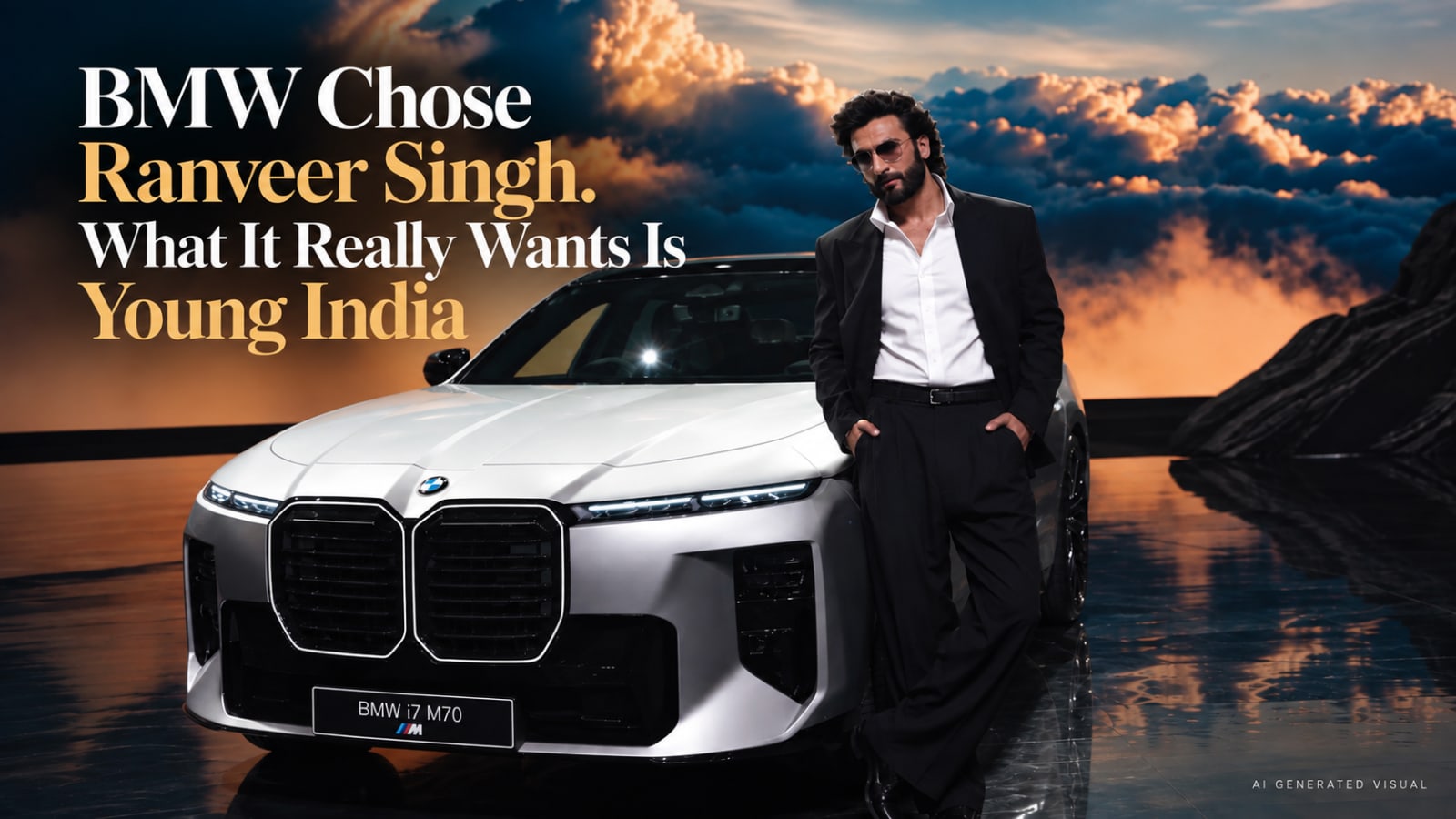
BMW India has made Ranveer Singh its new Brand Voice at a moment when the Indian luxury buyer is becoming younger, more expressive and more willing to spend. The partnership is not just about celebrity reach. It reveals how one of the world's most established luxury car brands is repositioning itself for a new generation of Indian wealth.
Ranveer Singh arriving in a BMW i7 M70 to unveil the new 7 Series looked, at first glance, like a familiar luxury launch formula. Big star. Big car. Big room. Plenty of cameras. But BMW's choice of Ranveer is more interesting than the event photographs suggest.
BMW India did not simply announce another celebrity endorsement. In its own communication, the company introduced Singh as its Brand Voice, describing the association as a way to bring contemporary resonance to the brand through individuality, dedication and a personal passion for driving. That wording matters. BMW is not only borrowing fame. It is borrowing personality.
And the personality it chose is almost impossible to describe as quiet. Ranveer's public image is expressive, theatrical, fashion conscious, energetic and highly individual. He has spent years making visibility part of his identity. That makes him an intriguing choice for a category that once treated restraint as one of luxury's defining virtues.
The real story, then, is not why BMW wanted a film star. Luxury brands have wanted film stars forever. The real story is why this BMW, in this India, wanted this film star now.
Old luxury whispered. New luxury wants a personality.
For an earlier generation of affluent Indians, luxury often came with a particular code. Success was formal. Wealth was discreet. The expensive sedan was usually black, the watch was recognisable to the right people and the person in the rear seat did not necessarily need to explain what any of it cost.
That version of luxury has not disappeared, but it is no longer the only version that matters. A younger generation of Indian wealth is much more comfortable with visibility. Founders talk publicly about exits. Creators turn personal identity into businesses. Professionals post holidays, watches, sneakers, restaurants and cars. A premium purchase is not merely proof that someone has arrived. It is increasingly part of how that person expresses who they are.
BMW itself has been preparing for this shift. Its 2026 Drive Your Match campaign moved the conversation from simply owning a BMW to finding a car that reflects an individual's personality, aspirations and lifestyle. The company described its idea of progressive luxury through choice, recognition and self expression. Ranveer Singh fits that language almost too neatly.
He does not make luxury look inherited. He makes it look performed, enjoyed and personalised. For a brand trying to connect with younger Indian affluence, that distinction is valuable.
BMW's customer is already getting younger
This is not merely a creative interpretation of an advertising campaign. BMW's own customer data points in the same direction. BMW Group India President and CEO Hardeep Singh Brar has said the luxury market is seeing younger professionals, startup founders and first time luxury buyers enter the category in increasing numbers. In an August 2026 conversation with The Economic Times, he identified this younger customer base as an important part of the changing Indian luxury market.
The average BMW buyer in India is around 42 years old, among the youngest for the brand globally. In a separate Financial Express interview, BMW said younger professionals are emerging not only in the major metros but increasingly in Tier 2 and Tier 3 cities. Nearly half of its 2025 demand came from what the company described as aspirational buyers.
First time luxury ownership is especially important. BMW's record 2025 sales of 18,001 cars were increasingly powered by customers entering the luxury segment for the first time. The share of first time luxury buyers rose from roughly 43 percent in 2024 to nearly 49 percent in 2025, according to reporting on BMW's customer mix. On the X1, the gateway into the BMW range for many customers, the company says around half of buyers are first time luxury customers.
That changes the marketing problem completely. A brand speaking to someone buying their third luxury car can rely heavily on heritage, engineering and product superiority. A brand trying to recruit someone's first luxury purchase has to do something else as well. It has to make the category feel culturally desirable.
Ranveer is not young. His idea of success is.
There is an obvious point worth making. Ranveer Singh is not Gen Z. BMW has not chosen a twenty something creator to speak literally for twenty something buyers. The more useful way to understand the association is psychographic rather than demographic.
Ranveer represents a particular idea of modern Indian success. It is ambitious without being apologetic. It is Indian but globally fluent. It mixes cinema, sport, fashion, social media and entrepreneurship. It is comfortable being photographed. It treats clothing, cars and experiences as extensions of personality. Most importantly, it does not subscribe to the old belief that sophistication requires disappearing into beige.
That makes him relevant to a much broader audience than people his own age. A 30 year old startup founder, a 35 year old technology executive and a 40 year old second generation business owner may have very different lives, but all can recognise the same cultural permission: success is allowed to be enjoyed visibly.
BMW's official language around the partnership repeatedly emphasises individuality and distinctive character. That is precisely where Ranveer's value lies. He makes the brand feel less like an institution awarding membership to the successful and more like a tool through which successful people can express themselves.
The bigger battle is not BMW versus Mercedes. It is luxury versus waiting.
India's luxury car market is still remarkably small relative to the size of the country's overall automobile market. Luxury vehicles account for only around 1 percent of more than four million annual passenger vehicle sales. That means the long term opportunity for BMW is not limited to stealing customers from Mercedes Benz or Audi. It is expanding the number of Indians who believe a luxury car belongs in their lives at all.
BMW has already shown how aggressively it thinks that opportunity can grow. The company has argued that the luxury share of India's car market could rise substantially by the end of the decade as affluence, infrastructure and premiumisation deepen. Industry reporting in 2026 also noted BMW's view that Gen Z shows a stronger propensity for premium consumption than previous generations. The important word here is not luxury. It is premiumisation.
Young India is moving up the price ladder across categories. Coffee became speciality coffee. Sneakers became collectible. Phones crossed the one lakh mark. Weddings became destination experiences. Homes acquired branded residences, imported kitchens and hotel style amenities. Travel moved from sightseeing to experiences. Cars are part of the same cultural movement.
The new luxury customer is therefore not necessarily someone born into a family that always bought German cars. Increasingly, it can be someone whose parents considered a luxury car unnecessary, but whose own income, exposure and spending philosophy are completely different.
The first luxury car may now arrive before the traditional milestones
This is where the generational shift becomes especially interesting. Traditional Indian wealth often followed a sequence. Build the business, buy the house, accumulate assets, secure the family and then spend visibly. The new professional and entrepreneurial class is more willing to compress that timeline.
That does not necessarily mean financial irresponsibility. It means the role of consumption has changed. Younger affluent Indians have grown up in an economy where global brands are immediately visible, financing is more sophisticated, incomes in technology and entrepreneurship can rise quickly and social media continuously exposes people to how peers live.
Luxury becomes less of a retirement gift to oneself and more of an experience purchased during the journey. A BMW at 35 is not only a symbol that the buyer has arrived. It can be a reward for the company they just built, the promotion they just earned or the life they believe they are creating.
That is why Ranveer works better for this story than a more conventionally restrained celebrity might. His image does not say wait quietly until success is complete. It says enjoy the moment loudly.
Even the flagship 7 Series is being asked to feel younger
The fact that BMW introduced the association alongside the 7 Series makes the choice even more revealing. The 7 Series is not the obvious entry point for Young India. It is BMW's flagship sedan, a car historically associated with boardrooms, industrialists, senior executives and the established elite.
Yet the new range is being presented through a vocabulary of technology, choice and modern luxury. Petrol sits alongside electric. The i7 is now locally produced in India, making India the only country outside Germany producing the model locally, according to BMW's launch announcement. The cabin is built around screens, digital interfaces, entertainment and personalisation as much as traditional craftsmanship.
Putting Ranveer next to the flagship therefore does more than give the launch star power. It helps reposition the top of the BMW hierarchy itself. The message is that the pinnacle of luxury does not have to feel old.
India is becoming too important for global luxury brands to speak in a global accent
There is another layer to BMW's choice. India is becoming a more important luxury market at the same time that global luxury growth is becoming harder to take for granted elsewhere. BMW sold a record 18,001 cars in India in 2025, up 14 percent. Reuters reported that the company planned further launches and greater local sourcing as it pursued growth in a market where luxury penetration remains low.
The momentum continued in 2026. BMW reported more than 9,000 vehicles in the first half, with growth of 17 percent, while electric vehicle sales rose sharply. The company is also expanding beyond the biggest cities and increasing localisation. This is what brands do when they stop treating a country as a satellite market and start treating it as a long term growth engine.
The marketing has to localise too. A global campaign can explain BMW's engineering. A culturally specific personality can explain what BMW means in India now.
Ranveer gives the brand access to Bollywood scale, but scale alone is not the most interesting benefit. He gives BMW an Indian vocabulary for confidence, individuality and visible ambition.
Luxury is moving from possession to identity
The most important shift may be philosophical. Luxury used to be defined largely by scarcity and possession. You owned the thing other people could not afford. For younger consumers, the object still matters, but the story around it matters too. What does the brand say about me? Does it fit my personality? Is it technologically current? Does it feel culturally alive? Can I personalise it? Does it belong in the life I imagine for myself?
BMW appears to understand that engineering excellence alone cannot answer all of those questions. The company still has to sell performance, quality and driving pleasure. But it also has to sell relevance.
That is why celebrity choices matter more than the old endorsement model suggests. The right person does not merely transfer fame to a logo. They help translate a brand from one generation's definition of status into another's.
So why Ranveer?
Because BMW is trying to protect what made it desirable while changing who gets to see themselves inside the brand.
Ranveer can stand next to a two crore rupee flagship without making it feel like an old establishment object. He can speak to ambition without pretending ambition must be discreet. He can make a century old German marque participate in Indian popular culture without stripping it of premium status.
There is risk in that strategy. Ranveer's maximalism will not appeal to every traditional luxury customer, and BMW still has to preserve the engineering credibility and sophistication that justify its prices. But that tension may be exactly why the choice is strategically useful. The brand does not need Ranveer to make BMW famous. BMW is already famous. It needs him to help make BMW feel current.
For an earlier generation of Indians, buying a BMW meant you had arrived. For the generation BMW is chasing now, the car may be part of announcing where you are going.
That is a much bigger shift than a new Brand Voice. It is the sound of Indian luxury changing generations.
Tags
Read Next
More stories
Have a person, achievement or story our editors should know about?
Submit a Story
Stories worth telling, in your inbox.
Get the latest People Who Matter features delivered weekly.
Subscribe NowDiscussion
No comments yet. Be the first to share your thoughts.