How the 80s Photo Trend Became a Free Product Demo for ChatGPT
The 80s photo trend was fun, nostalgic and remarkably effective at showing what ChatGPT could do. Here is how it spread, why it worked like free marketing, and what the privacy, energy and water questions actually mean.
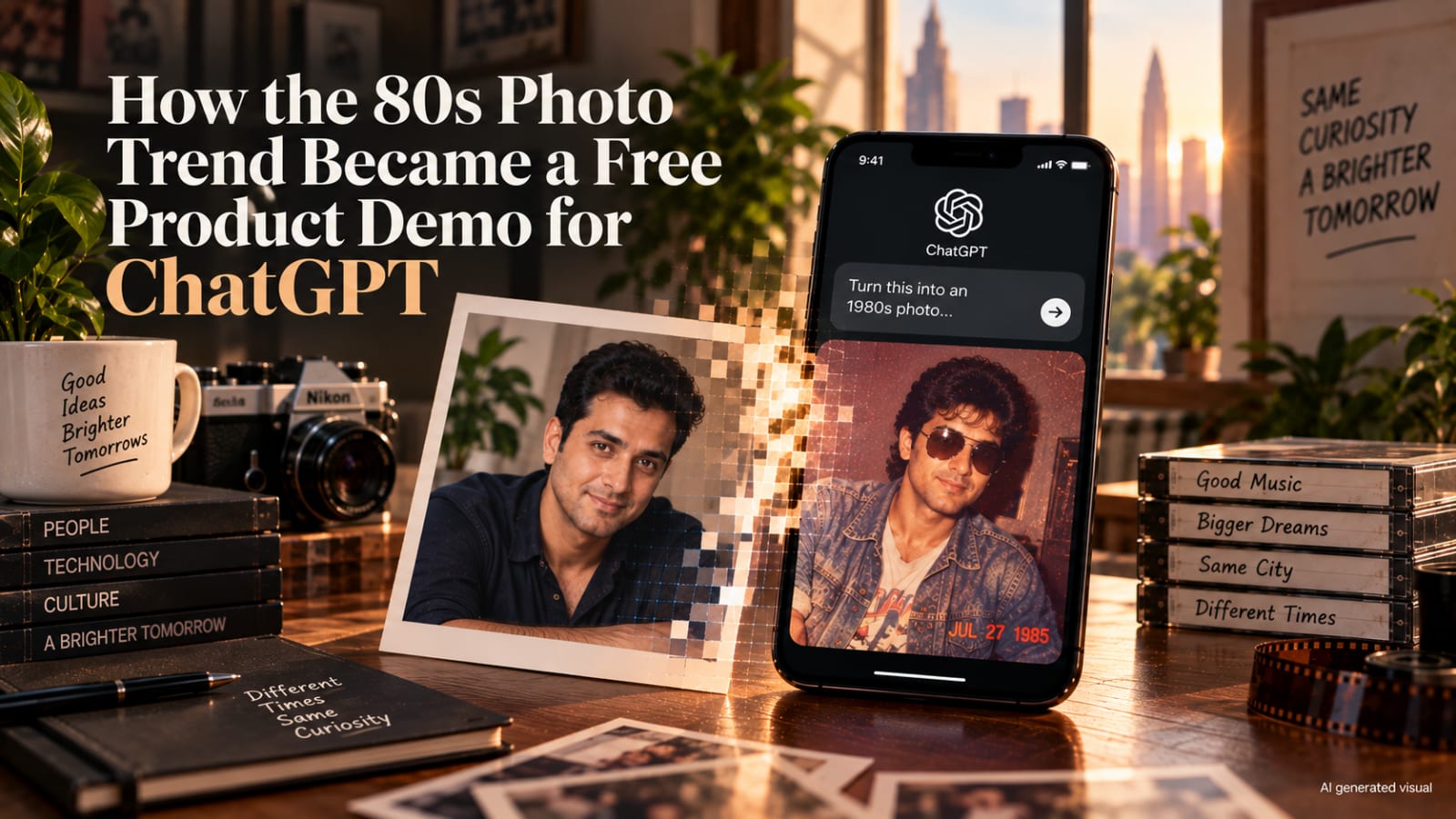
A wave of retro portraits did more than revive big hair and film grain. It showed how a viral visual format can turn users into a technology company’s distribution network while renewing questions about privacy and the physical cost of AI creativity.
Your feed has apparently been cast in a 1985 film. The hair has volume. The shirts have opinions. Somewhere in the corner, an orange date stamp is doing a suspicious amount of work.
For a few days in September, India’s social feeds appeared to move backwards in time. Contemporary selfies returned as 1980s studio portraits: big hair, warm flash, silk saris, patterned shirts, film grain and the soft colour of a family album. Politicians, actors and ordinary users joined in. Each finished image was personal content. It was also a demonstration of what ChatGPT could do.
And that is where this stops being just another internet trend.
A conventional advertisement can tell you that an AI product is easy, creative or surprisingly capable. The retro portraits showed all three in public. Users supplied the faces, copied or tweaked the prompts, generated the results and distributed them across Instagram, X and WhatsApp. The product demo travelled because people wanted to share themselves, not because they wanted to promote an AI company.
First, who sent the internet back to 1985?
The public trail shows the format gathering prominent Indian participants in early September 2026. Piyush Goyal posted his version on 8 September; Kiren Rijiju followed with a vintage-car image on 9 September. Star Sports Kannada also shared AI images of cricketers including Virat Kohli and KL Rahul. Those broadcaster posts should not be read as evidence that the players themselves joined the trend. Indian Express
By 14 September, coverage included Keerthy Suresh sharing retro images featuring herself and her husband, Antony Thattil, while Kajal Aggarwal appeared in denim and hoop earrings. The format had moved comfortably between politics, entertainment and everyday feeds. Indian Express
What the reporting does not establish is a single person who invented the trend. There is no credible public evidence that OpenAI planned it, paid people to participate or secretly seeded it as a campaign. Giving the story a neat mastermind would make it more dramatic, but less accurate.
Its appeal is easier to explain. You recognise the person, then notice everything that has changed. A friend’s transformation makes you wonder what yours would look like. The joke arrives with its own invitation to participate.
Then curiosity started moving towards the product
The strongest public signal comes from Google search behaviour. Financial Express reported that Indian interest in the search term “ChatGPT download” rose sharply as the trend spread, reaching the top of Google Trends’ relative-interest scale on 10 September. Searches for “1980s AI photo prompt ChatGPT” reportedly rose by 700%, while “prompt seen ChatGPT” increased by 500%.
Those numbers need to be read correctly. A Google Trends score of 100 means peak relative interest; it is not a download count. And correlation does not prove that every search became a new ChatGPT user. But the timing supports a reasonable conclusion: the pictures were making people curious enough to look for the product and the instructions needed to join in.
There was already evidence that socially contagious image formats could create enormous behaviour around ChatGPT. After native image generation arrived in ChatGPT in March 2025, OpenAI said more than 130 million users generated over 700 million images in the first week. That figure is about the broader image-generation launch, not this 2026 trend, but it shows the scale a shareable visual feature can unlock.
Was this an AI marketing move?
There is evidence of company encouragement. Mint reported on 11 September that OpenAI had shared a prompt for recreating a person’s appearance around 1985 while retaining recognisable features. That is a reported promotional contribution, although the original company post should still be independently verified before publication.
What it does not prove is that OpenAI invented the trend, paid the people posting it or coordinated its spread. There is no verified evidence for those claims in the sources reviewed for this article.
The more interesting possibility is simpler: a trend can be organic and still become extraordinary marketing.
A portrait makes an image tool’s capabilities personal. Nobody needs to sit through a presentation about visual consistency, editing or prompt adherence when they can upload a selfie and inspect the result on their own face. The company gets millions of public examples of what its tool can do. Participants get something entertaining to share. No secret master plan is required.
Why it worked better than an ordinary technology campaign
The output explained the product. No tutorial was necessary. Viewers could immediately see that ChatGPT could take a recognisable face and place it inside a coherent new visual world.
Participation was the reward. The user did not have to care about artificial intelligence. The incentive was simply seeing a more glamorous, cinematic or ridiculous version of themselves.
Every share carried an unspoken instruction. A retro portrait made friends ask how it was created. The answer was often a product name and a prompt. Distribution and user education happened in the same conversation.
The prompt lowered the creative barrier. Copy-and-paste instructions circulated beside the images. You did not need to understand models, editing software or photographic terminology before trying it.
And familiar faces supplied social proof. Once politicians, actors and other recognisable people appeared in the format, it stopped looking like a niche AI experiment and started looking like a mainstream cultural activity that happened to require an AI tool.
For OpenAI, that is close to the ideal product loop: someone creates something personally meaningful, publishes the result somewhere else and causes the next person to return to the original tool. The marketing asset is not the slogan. It is the output.
Before the makeover, there is an upload
The picture may look like 1985. The infrastructure and data questions behind it very much belong to 2026.
Before the big hair appears, you send a photograph to a service. A convincing result tells you almost nothing about what happens to the original image after you upload it.
For ChatGPT, OpenAI says users can switch off “Improve the model for everyone” to prevent their conversations from being used to improve its models. Temporary Chats are not used for training and are deleted from OpenAI systems after 30 days, although they may still be reviewed for abuse. A training opt-out is therefore not the same thing as instant deletion.
Those are ChatGPT’s controls. A random retro-photo app may operate under completely different terms. Check the service you are actually using, crop out information it does not need and ask before uploading someone else’s picture. Your friend agreeing to a photograph is not automatically agreement to an AI makeover.
It is also worth looking closely at what comes back. Did the tool lighten or darken skin, reshape a face, change body proportions or quietly turn an entire decade into a beauty filter? Nostalgia can carry old stereotypes as easily as old hairstyles. And if you share the image publicly, label it as AI-generated. A fake date stamp should not become a fake family record.
Does one retro picture really cost a bottle of water?
This is where the viral conversation becomes much messier. AI does have a physical footprint. Images that feel weightless on a phone screen are produced by servers consuming electricity, while data centres may use water directly for cooling and indirectly through electricity generation. A single social-media-ready portrait may also come after several discarded attempts.
But research does not support one universal number for “the water used by an AI image”. The much-repeated bottle comparison comes from research first released in 2023. Its revised paper estimated roughly 500 millilitres of water consumption for 10 to 50 medium-length GPT-3 text responses, depending on where and when the model ran. That was a modelled estimate for an older text system. It was not a measurement of one image made by today’s retro-photo tools.
The terminology matters too. Water withdrawal is the amount taken from a source. Water consumption is the portion not returned to the immediate water environment, for example because it evaporates. Treating those numbers as interchangeable can make an already complicated claim sound far more dramatic.
Energy use varies just as widely. A 2025 study, The Hidden Cost of an Image, reported a roughly 46-fold spread among the image-generation systems it tested, with measured consumption ranging from about 0.086 to 4.08 watt-hours per image depending on the model, hardware, resolution and settings. Those figures should not be presented as the footprint of a ChatGPT retro portrait: the study did not establish a product-specific number for this trend.
The broader infrastructure direction is clearer. The International Energy Agency projects global data-centre electricity consumption to reach around 945 terawatt-hours by 2030, roughly double its 2024 level, with AI an important driver of the increase. That is not electricity attributable to retro photographs. It simply reminds us that apparently effortless digital creation sits inside a very physical and rapidly expanding system.
So is the environmental concern real? Yes. Is “one retro selfie equals one bottle of water” a reliable fact? No. Not on the evidence currently available. If a dramatic number does not tell you the model, data centre, cooling system, location and method behind it, treat it as a conversation starter rather than a universal measurement.
The real lesson is bigger than nostalgia
The 1980s aesthetic will disappear from feeds, as viral formats always do. What happened around it is likely to last.
The trend showed that the most effective consumer-facing use of AI may not begin with explaining artificial intelligence at all. It may begin by giving someone a result they understand instantly and want to show another person.
For OpenAI, the portraits turned capability into culture. They reached people who might never read a model announcement, compare technical benchmarks or watch a product demonstration. The route to the technology was simply a familiar face in a decade it may never have occupied.
It also exposed the bargain underneath generative creativity. The user receives an instant personalised fantasy. The platform receives attention, product discovery and demonstrations circulating at effectively no media cost. Behind both sits infrastructure whose energy, cooling and resource use remains largely invisible to the person tapping “generate”.
That makes the 80s photo trend more than a nostalgic internet diversion. It is a compact illustration of how modern AI products can grow: users become creators, creations become advertisements, and participation itself becomes distribution.
Tags
Read Next
More stories
Have a person, achievement or story our editors should know about?
Submit a Story
Stories worth telling, in your inbox.
Get the latest People Who Matter features delivered weekly.
Subscribe NowDiscussion
No comments yet. Be the first to share your thoughts.