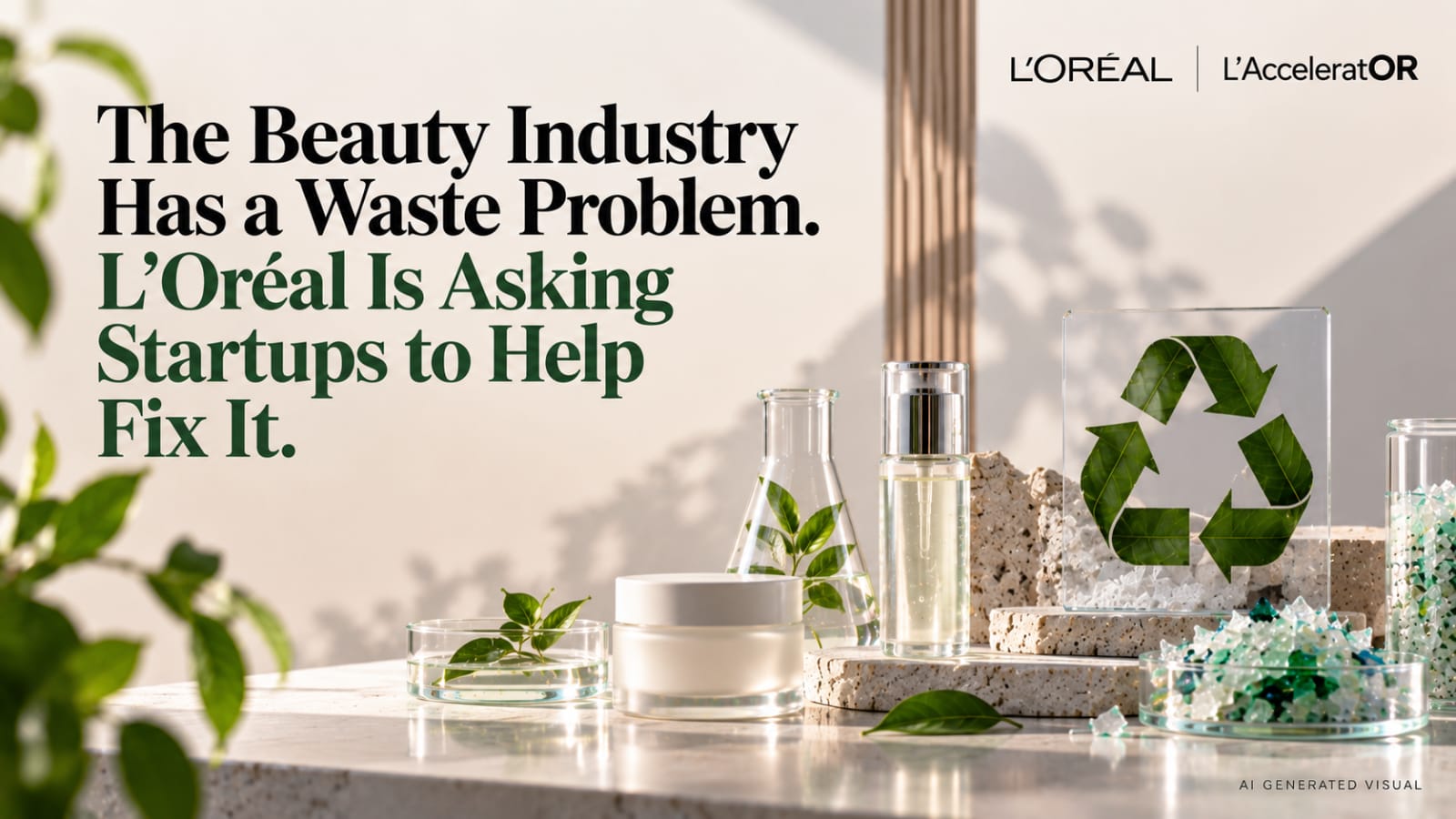
The Beauty Industry Has a Waste Problem. L’Oréal Is Asking Startups to Help Fix It.
L’Oréal has selected 13 companies for the second cohort of its €100 million sustainability accelerator, including two Indian innovators. The bigger story is how a global beauty group is looking outside its own laboratories for solutions to waste, water use and circular manufacturing.
The second L’AcceleratOR cohort brings 13 companies from eight countries into L’Oréal’s sustainability programme. Two are from India. What matters now is not who made the list, but whether their ideas can make the difficult leap from promising technology to industrial reality.
Beauty has always sold transformation. The industry itself is now being asked to transform.
A shampoo bottle, lipstick tube or jar of moisturiser may look small on a bathroom shelf, but producing beauty at global scale creates a complicated environmental footprint. There is packaging to redesign, virgin plastic to reduce, water to conserve, industrial heat to decarbonise, ingredients to rethink and waste streams that conventional recycling systems often struggle to handle.
That is the problem L’Oréal is trying to address through L’AcceleratOR, its sustainability innovation programme backed by €100 million over five years. On September 17, the group announced the programme’s second cohort: 13 companies from eight countries working across packaging, materials, ingredients, industrial processes, water and data intelligence. Two of them are Indian.
The announcement is easy to read as another corporate accelerator. The more interesting question is what happens after the announcement.
Can a global beauty company take technologies being built by relatively small innovators, test them inside a vast industrial system and eventually deploy the ones that work across factories, products and supply chains around the world? If it can, the accelerator becomes more than a sustainability programme. It becomes a different model for corporate innovation.
Two Indian ideas, two very different waste problems
India’s representation in the new cohort comes from Without and Nexus.
Without is working on one of recycling’s most stubborn problems: flexible, multilayer packaging. Think chip packets and similar wrappers made from several materials fused together. They are light, cheap and effective at protecting products, but their mixed composition makes them difficult and often uneconomical to recycle.
Founded by Anish Malpani, Without says it is developing technology to turn this low value waste into usable materials. The company began by demonstrating what could be made from discarded packets, including recycled sunglasses, but its larger ambition is material recovery at scale. Its own description of the problem is refreshingly direct: multilayer plastic is precisely the kind of waste that frequently ends up in landfills because existing systems struggle to extract enough value from it.
The second Indian company, Nexus, legally Felis Leo Widgets, approaches circularity from a different direction. Founded by sisters Nikita and Nishita Baliarsingh, the company has been developing rechargeable battery technology using agricultural residue. Earlier technical descriptions of its work have focused on extracting materials from crop waste to create biodegradable or lower impact energy storage systems.
That creates an unusual circular proposition. Agricultural residue that might otherwise be discarded or burned becomes an input for energy storage. The challenge, of course, is proving that the technology can move beyond prototypes and field trials into safe, repeatable and economically competitive manufacturing.
Why L’Oréal is looking outside L’Oréal
Large companies traditionally built innovation through their own research departments. L’Oréal still does that at enormous scale. The group says it has more than 4,000 scientists and 22 research centres across seven regional hubs.
But sustainability problems do not necessarily respect the boundaries of an industry. A company developing chemical recycling may know little about lipstick. A startup designing industrial heat pumps may never have considered a cosmetics factory. A water technology company may have been built for an entirely different sector.
That is precisely why external innovation can matter.
The 13 companies in this cohort range from a British venture developing plant based alternatives to leather and an Italian glassmaker working on lighter packaging, to a US company converting methane into packaging material, a Finnish industrial heat pump company and an AI native platform focused on water and biodiversity risk. For the first time, the accelerator has also selected dedicated water technology.
Instead of asking every solution to originate inside the beauty industry, L’Oréal is effectively asking a broader question: what technology already exists somewhere else that could solve a problem beauty has not solved on its own?
The difficult part begins after selection
Accelerators are good at producing cohorts. Industrial transformation is much harder.
The selected companies will enter an acceleration phase led by the innovation team at the University of Cambridge Institute for Sustainability Leadership. They may then gain access to L’Oréal resources for pilot projects lasting roughly six to nine months. Successful technologies could ultimately be scaled across the group’s international operations.
The word that matters there is could.
A technology can work in a laboratory and still fail in a factory. A recycled material can perform beautifully in a prototype and become too expensive at millions of units. A new process can reduce emissions but create reliability problems. A packaging innovation can be technically recyclable while entering markets where the collection infrastructure required to recycle it barely exists.
That gap between invention and adoption is where many climate technologies struggle. L’AcceleratOR becomes meaningful only if it can help companies cross it.
L’Oréal has given itself numbers to answer to
The programme also sits inside measurable environmental commitments. Under its updated L’Oréal for the Future framework, the company says that by 2030 it aims to reduce its absolute use of virgin plastic for product packaging by 50 per cent compared with 2019, source half of all packaging materials from recycled or bio based sources, and reduce packaging intensity by 20 per cent.
It says virgin plastic use for product packaging has already fallen 37 per cent from the 2019 baseline. On water, the group aims to use recycled or reused water for all industrial purposes in its factories by 2030; it reported 56 per cent in 2025.
Those numbers matter because they turn sustainability from an abstract ambition into something that can eventually be checked.
They also explain why a company such as L’Oréal needs more than one breakthrough. Packaging, water, ingredients, industrial processes and emissions are interconnected problems. There is unlikely to be a single technology that fixes all of them.
India’s role is worth watching
The presence of Without and Nexus is significant for another reason. Indian climate technology is often discussed through the country’s own environmental challenges: waste, crop burning, energy transition and rapidly expanding cities.
But technologies created in response to those constraints may have applications far beyond India.
Without’s flexible packaging problem is global. Nexus is attempting to connect agricultural waste with energy storage, two challenges that matter across markets. If either company progresses from accelerator pilot to deployment inside L’Oréal’s international operations, the story changes from Indian startups participating in a global programme to Indian technology being tested as part of a global industrial solution.
That distinction matters.
The beauty industry’s next innovation may not look like beauty
For decades, innovation in cosmetics was easy for consumers to recognise: a new shade, a new formula, a longer lasting product, a better applicator.
The next generation of innovation may be almost invisible.
It could be the material inside the bottle, the process that recycled the wrapper, the heat pump running inside the factory, the sensor reducing water consumption or the waste stream that became a new raw material.
Consumers may never know the names of the companies responsible.
But if programmes such as L’AcceleratOR work as intended, some of the most important technologies shaping the future of beauty may come from entrepreneurs who never started out trying to build a beauty company at all.
Tags
Read Next
More stories

Have a person, achievement or story our editors should know about?
Submit a Story
Stories worth telling, in your inbox.
Get the latest People Who Matter features delivered weekly.
Subscribe NowDiscussion
No comments yet. Be the first to share your thoughts.