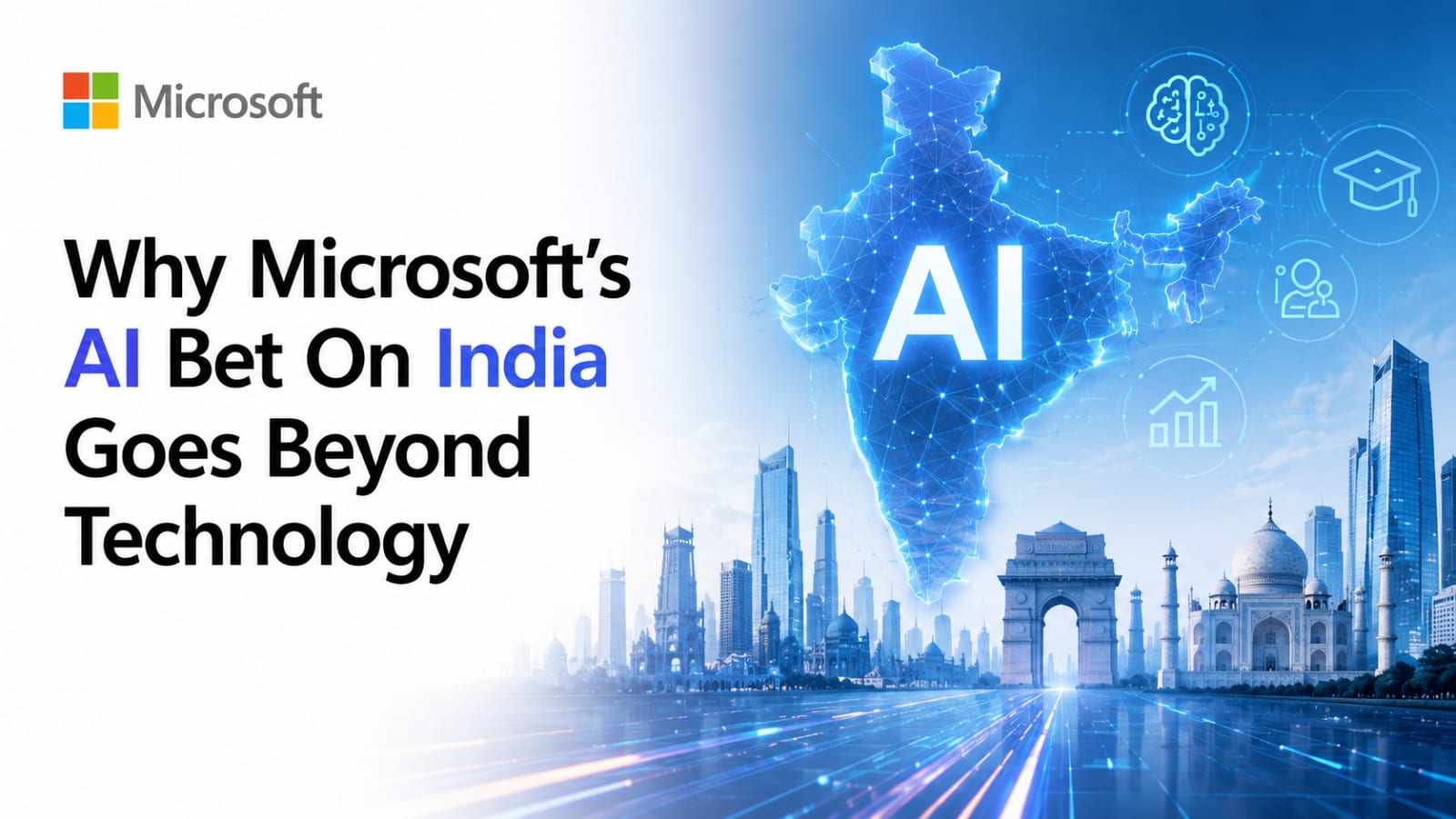
Why Microsoft's AI Bet On India Goes Beyond Technology
Microsoft's AI skilling initiative seeks to bridge opportunity gaps by bringing AI education to underserved regions and equipping millions of Indians for the future of work.
Artificial intelligence (AI) is no longer a skill of the future. Having AI skills is the need of the hour. Earlier, AI was largely confined to sectors such as technology, IT and manufacturing. Today, it empowers almost every industry in some way.
However, not every student, professional or educator has had the opportunity to develop AI capabilities. This created a growing gap between the demands of the job market and the skills available in the workforce.
For a country like India, which has one of the world's largest young workforces, the challenge is not whether AI will transform jobs but whether enough people will be prepared for that transformation.
Against this backdrop, Microsoft stepped in with a $3 Bn investment. In January last year, the tech major announced that by 2030, it would partner with ministries, state governments and NGOs to train 10 million Indians in AI skills under its ADVANTA(I)GE INDIA initiative. This move, according to Microsoft, was aimed at fueling productivity and opening doors to jobs and other such uses.
The announcement stated that under this programme, the company would train about 10 million Indians. The first phase of this initiative upskilled 2.4 million people. By extending AI education to underserved regions and underrepresented groups, Microsoft is seeking to ensure that the benefits of the AI economy are not concentrated in a handful of technology hubs.
Appreciating the company, Jui Shrikant Bidaye, who studied in a rural school in Devgad, in Maharashtra, said that she underwent such training while graduating from NBN Sinhgad School of Engineering. On completion, she did a six-month internship working on creating a secure file storage application, using AI tools to help. She hoped that such an experience would translate to employment and she would be able to support her younger brother’s education.
Meanwhile, Venkatesh Deshpande, who was born blind, used to keep currency notes in different pouches, which made it easier for him to identify the notes. But today, he just points the notes at the rear camera of his phone, and the Microsoft Seeing AI app tells him what denomination it is. He learnt to use the app from Vidhya Y., who was also a research fellow at Microsoft Research India.
He now uses AI to help develop lesson plans for teachers in more than 140 schools serving students with disabilities in 14 states across India.
Speaking about India’s AI ecosystem, Satya Nadella, chairman and CEO, Microsoft said, “India is rapidly becoming a leader in AI innovation, unlocking new opportunity across the country. The investments in infrastructure and skilling we are announcing today reaffirm our commitment to making India AI-first, and will help ensure people and organisations across the country benefit broadly.”
As this aligns with the Indian Government’s ‘AI for India’ mission, MoS for Skill Development and Entrepreneurship, Jayant Chaudhary said, “By equipping our workforce, especially women and youth, with advanced skills, we are building an AI-ready India, poised for digital leadership and sustainable economic growth.”
Notably, this comes at a time when AWS asked employees to treat AI as teammates and not as merely workplace tools, and LTIMindtree announced the deployment of 1,500 AI-powered ‘digital employees’ or agents across multiple functions.
This shift is already visible. Technology firms are building AI agents that can perform tasks once handled by humans, while organisations are redesigning workflows around AI-powered systems. The conversation is actually about the transformation that AI can bring to the Indian workforce.
AI For All
The company announced that it aims to make AI education accessible beyond metropolitan cities of India, focusing on women and learners from Tier-II and Tier-III regions. In fact, according to the official statement, of the 2.4 million people trained under the first phase of ADVANTA(I)GE INDIA, 65% were women and 74% came from smaller cities. And on this success, the tech major built the second phase of the programme.
On this, Puneet Chandok, President of Microsoft India and South Asia, said, “We aim to not only enhance employability but also bridge the digital divide and create a more inclusive future for every Indian.”
If successful, the initiative could help create a workforce that is not only equipped to use AI tools but also capable of building AI-powered products, services and businesses, strengthening India's position in the global digital economy.
Aligned with this, Microsoft has already partnered with SaaSBoomi, the premier community for B2B startups in India. Under this collaboration, the two sides aim to foster innovation and entrepreneurship, especially in tier II cities.
The partnership is aimed at impacting over 5,000 startups and over 10,000 entrepreneurs. To achieve the goal, Microsoft and SaaSBhoomi will upskill more than 150,000 startup employees through focused workshops and foster regional development in over 20 tier II cities. The two sides also plan to create over 200,000 new job opportunities and help attract an additional $1.5 Bn in venture capital funding for the Indian AI and SaaS ecosystem.
Strengthening India’s Youth
What makes Microsoft’s initiative noteworthy is that it addresses a challenge that extends beyond technology. Looking forward, it is evident that to prepare the youth for employment in future, imparting AI skills is no longer just an option.
Thus, by focusing on students, educators, entrepreneurs and professionals, the company is attempting to build a talent pipeline that can participate in, and potentially lead, the next wave of digital innovation.
Opportunity Divide
As observed, Microsoft’s AI training programme is built on the principles of empowering people with AI. The tech giant is on a journey to bridge the gap between people and AI across every level of the socio-economic pyramid.
By taking AI education beyond metropolitan India and into smaller cities and underserved communities, Microsoft is betting that the country's next generation of innovators will not emerge from a few technology hubs alone. They will come from classrooms in rural Maharashtra, aspiring entrepreneurs in Tier-II cities and professionals looking to reinvent themselves for a changing world.
In that sense, Microsoft's investment is not simply about building AI talent. It is about expanding access to opportunity. And in a country as young and ambitious as India, that may prove to be its most important contribution.
Read Next
More stories


Have a person, achievement or story our editors should know about?
Submit a Story
Stories worth telling, in your inbox.
Get the latest People Who Matter features delivered weekly.
Subscribe NowDiscussion
No comments yet. Be the first to share your thoughts.