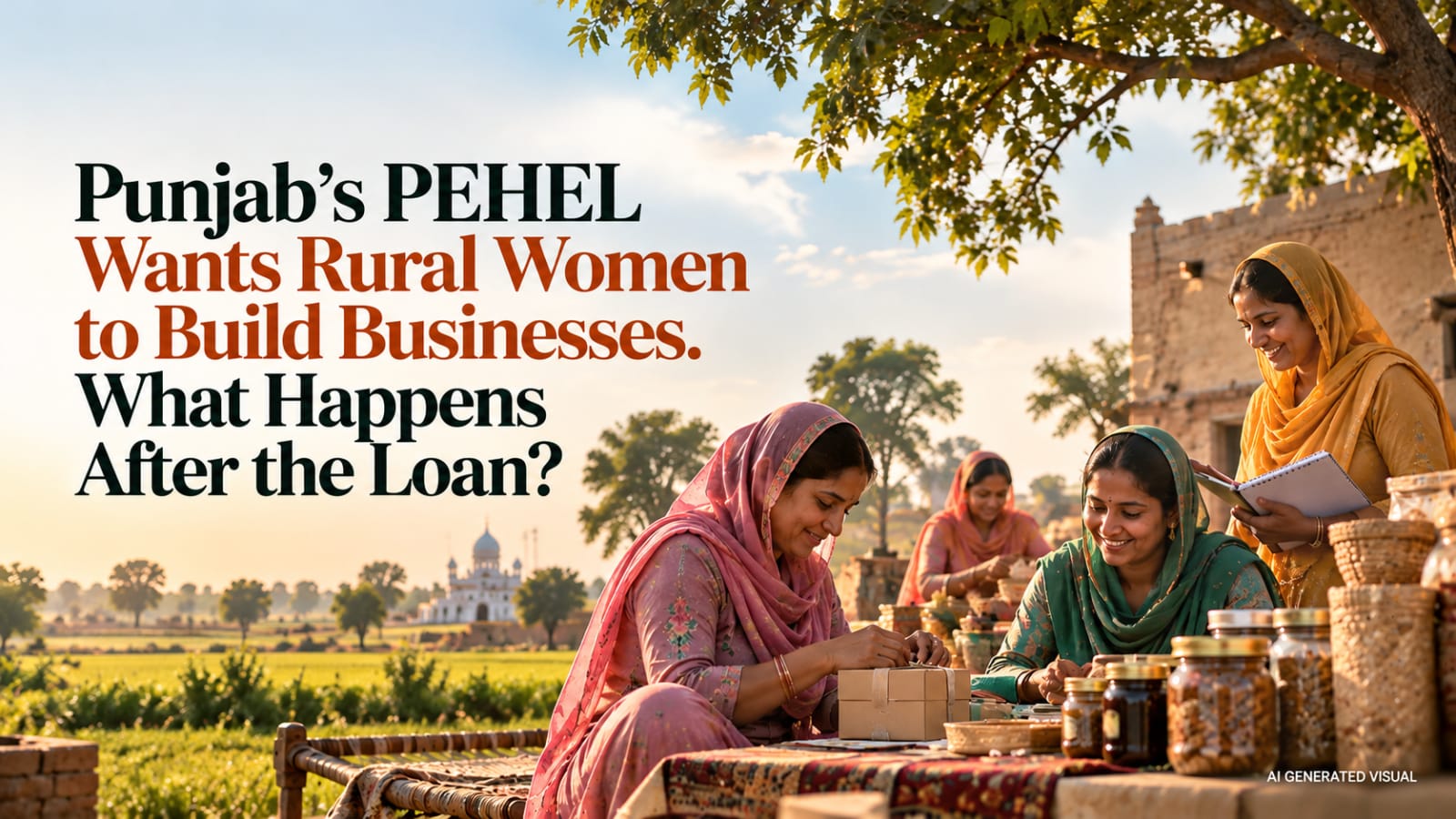
Punjab’s PEHEL Wants Rural Women to Build Businesses. What Happens After the Loan?
The initiative pairs credit with practical business support. Its early results are promising, but the true measure will be whether women can build lasting incomes.
The initiative pairs credit with practical business support. Its early results are promising, but the true measure will be whether women can build lasting incomes.
The difference between receiving money and making a living
A loan can help someone start a business. It cannot tell them which business their village needs, how to price a service or what to do when sales are slow. Those decisions often determine whether access to finance becomes a livelihood or another financial obligation.
Punjab’s PEHEL initiative is trying to address that gap for women in self-help groups. Led by the Punjab Development Commission and implemented through the state’s rural development system, it combines credit with structured enterprise support and local guidance. [India Today report on PEHEL]
A small business changes a household
Programme reporting describes Manjeet Kaur in Sangrur district, whose household previously relied largely on her husband’s factory income. She now runs a beauty parlour while her husband operates a kulcha cart. The programme says the combination has nearly doubled the household’s earlier income.
This is a reported programme example, not independently verified evidence of average impact. Still, it illustrates the economic logic: a second earning stream can change how a family handles everyday expenses, risk and future choices. [CSR Universe programme report]
What PEHEL is actually doing
PEHEL works with partners including the Gates Foundation, Leap 300 and RoundGlass Foundation. Leap 300’s model adds a structured 300-day journey around existing self-help-group credit. Women receive help selecting businesses, preparing before funding arrives and managing early operations. Local Sakhis and digital support are part of that approach.
Technology, including an AI-enabled assistant called Vyapar Mitra, appears in the delivery model. But the story is not really about AI. It is about whether advice, mentoring and accountability can make small loans more productive. [The Good initiative report]
Promising figures need careful reading
Reports published on 8 October say 237 women across 50 villages received ₹1.1 crore in credit, with full repayment reported to date. They also cite an increase in first-time entrepreneurs from 15% to 45%, and business launches across 51 categories.
Those numbers describe early programme reporting. They do not yet prove long-term profitability, sustained household income growth or outcomes at statewide scale. A reported fall in business launch time from about three months to 12 days is encouraging, but speed is not the same as survival.
The questions that will determine success
Can participants earn enough after costs and loan repayments? Do they control the income they generate? Are businesses still operating after one or two years? Does local demand support dozens of similar enterprises? And can the model work without intensive support from external partners?
PEHEL has set ambitious expansion goals, with reporting describing plans to create more than 1.5 lakh women entrepreneurs over five years. Ambition matters, but independent evaluation will matter more.
The strongest version of this initiative would not simply produce more borrowers. It would produce more women with viable businesses, greater financial choice and a stronger say in their households and communities.
Tags
Read Next
More stories

Have a person, achievement or story our editors should know about?
Submit a Story
Stories worth telling, in your inbox.
Get the latest People Who Matter features delivered weekly.
Subscribe NowDiscussion
No comments yet. Be the first to share your thoughts.