
Sridhar Vembu: Building Global Tech From Rural India
The Zoho co-founder challenges the idea that world-class technology companies must be built in big cities.
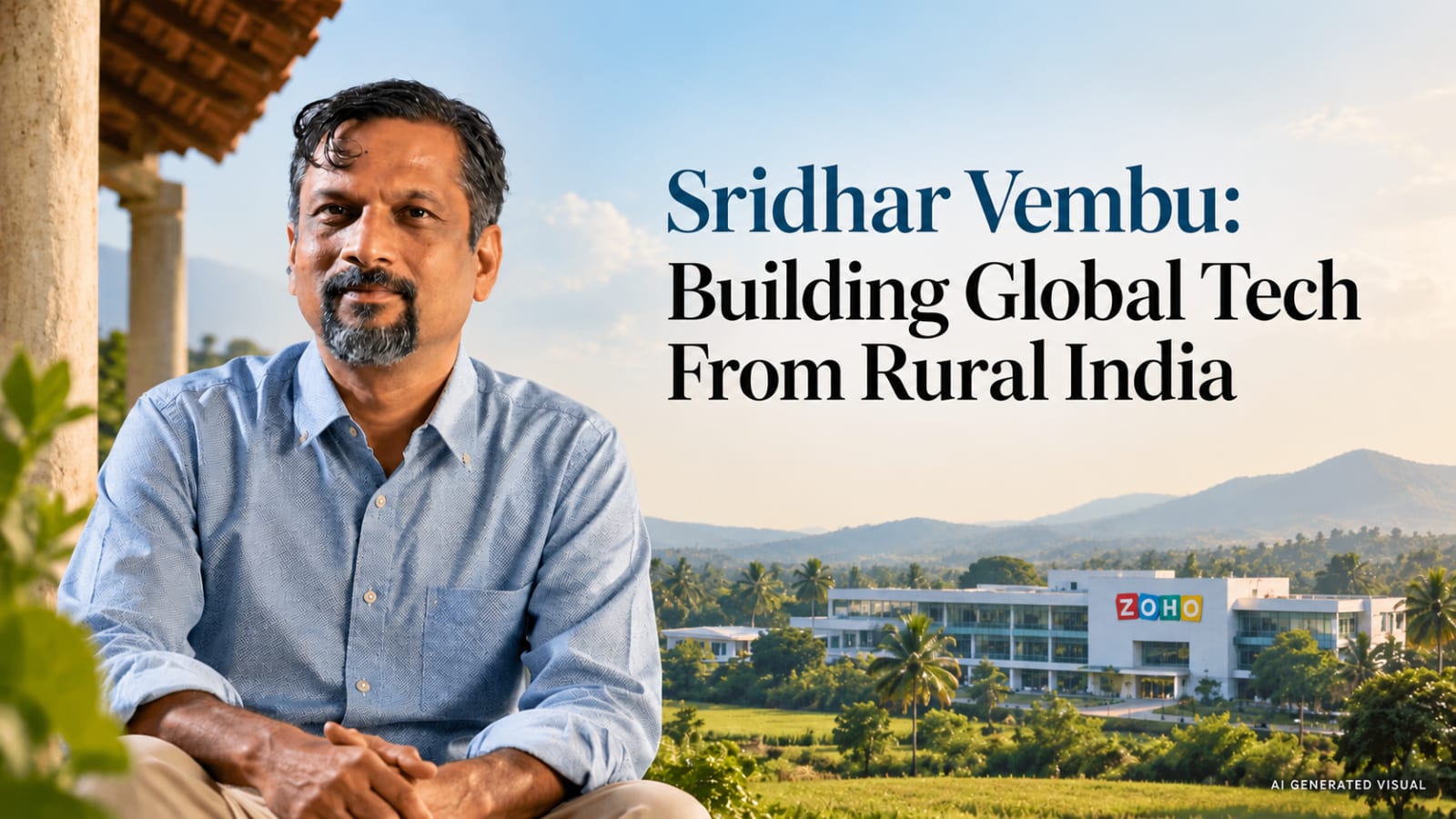
The Zoho co-founder challenges the idea that world-class technology companies must be built in big cities.
The address is part of the argument
For decades, the geography of Indian technology appeared settled. Ambitious software firms gravitated towards major cities, where engineers, investors and international connections were concentrated. Sridhar Vembu has spent years questioning whether that concentration is inevitable. His rural workplace experiment is not a retreat from technology. It is a different proposal for where technological opportunity can live.
Zoho describes a network of smaller distributed offices intended to let employees work closer to home, reduce the pressure to migrate and keep more economic activity within local communities. The model asks a simple question: why should a talented engineer have to leave a town before being taken seriously? [Zoho rural revival]
An independent company can make unusual choices
Zoho has described itself as privately held, profitable and committed to funding growth through its own business rather than venture capital. That matters because the rural experiment is easier to pursue when a company does not have to justify every decision against the next funding round.
Independence does not guarantee better decisions. It creates room for different decisions. Small offices, patient hiring and long-term product investment can appear inefficient in a culture that rewards immediate scale. Vembu has made the case that these choices can support durable capability and customer value.[Zoho company story]
Talent does not begin with a degree
The challenge goes beyond opening an office in a village. A distributed technology company still needs a way to discover and develop people. Zoho Schools of Learning offers one answer: an alternative training pathway linked to work, rather than treating a conventional university credential as the only gateway into a technology career.
Such programmes deserve scrutiny as well as admiration. Their impact depends on student outcomes, mobility, teaching quality and whether graduates gain transferable skills. A powerful idea should be measured by what happens to learners after the first job, not only by the number admitted. [Zoho rural and education initiatives]
What a rural technology model cannot solve alone
A company can bring jobs, but it cannot single-handedly provide reliable transport, housing, public healthcare, strong schools or high-quality internet everywhere. Local ecosystems also need other employers, so workers are not dependent on a single institution.
That is the useful tension in Vembu’s approach. Zoho can demonstrate that sophisticated work need not be confined to a metro. Replicating the model at national scale will require businesses, educators and governments to make opportunity genuinely portable.
The bigger measure of success
Vembu’s legacy will not be determined only by Zoho’s software portfolio. It will also be shaped by whether more people can build serious careers without surrendering their connection to home.
The enduring question is not whether every company should move to a village. It is whether India can stop treating migration as a prerequisite for ambition.
Tags
Read Next
More stories

Have a person, achievement or story our editors should know about?
Submit a Story
Stories worth telling, in your inbox.
Get the latest People Who Matter features delivered weekly.
Subscribe NowDiscussion
No comments yet. Be the first to share your thoughts.