
What Truly Makes Amul The Taste of India?
From Gujarat’s milk cooperatives to becoming one of India’s most trusted household names, Amul’s success story is a story of rural empowerment, economic inclusion and a revolution that reshaped the nation’s dairy industry.
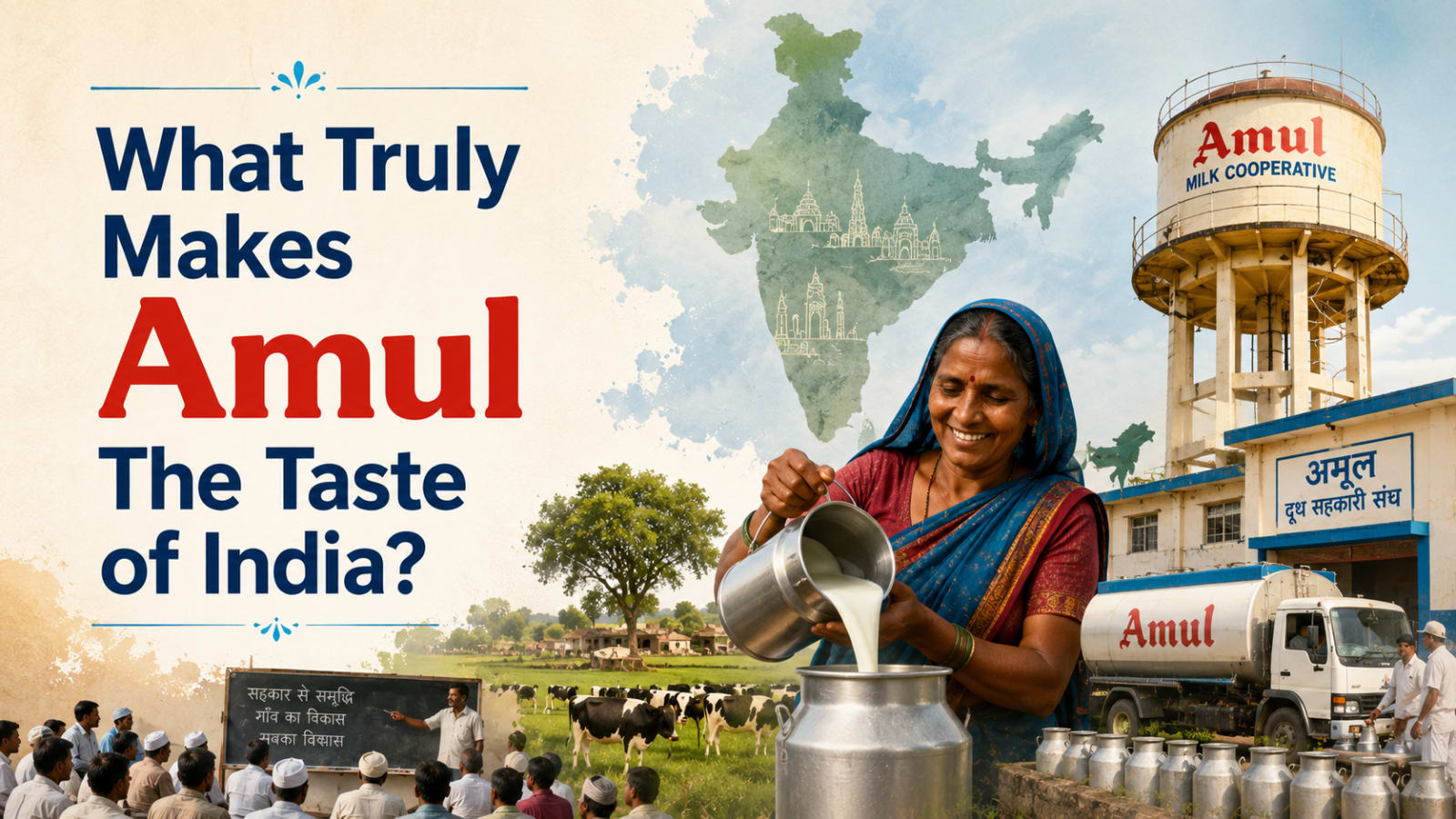
Some brands dominate the market, while some shape an industry not just economically but also socially. Dairy giant Amul belongs to the second category. The brand itself tells the story of a revolution closely associated with figures such as Sardar Vallabhbhai Patel, Dr Verghese Kurien, the Government of New Zealand, and UNICEF, among others.
Notably, the stature of the dairy brand is such that, despite facing multiple challenges ranging from internal cooperative structure disputes to recent backlash over quality and adulteration concerns, Amul has continued to stand strong as a household name that still dominates Indian kitchens.
The Revolution
In 1946, in the Kheda (formerly Kaira) district near Anand town in Gujarat, local milk farmers decided to rebel against the middlemen. The system kept them underpaid and dependent on private contractors who controlled the dairy trade.
Led by Tribhuvandas Patel and supported by Sardar Vallabhbhai Patel, the farmers formed a cooperative that allowed them to sell milk directly, eliminating exploitative middlemen. What began as a grassroots protest soon evolved into a nationwide movement when the Father of India’s White Revolution, Verghese Kurien, joined the initiative and transformed it into a modern dairy ecosystem.
Amul started by the name of Kaira District Co-operative Milk Producers Union Ltd. But it eventually became a brand, proving that rural farmers, many of them women, could collectively build one of the country’s most powerful and trusted institutions.
Amul is way beyond just a dairy brand. What truly distinguishes the cooperative is its distribution model. According to Amul, even today, nearly 80–85% of the money consumers spend on its products reaches the farmers directly.
In an era marked by conversations around sustainable development, rural entrepreneurship and women-led growth, Amul stands as one of India’s earliest and most successful grassroots economic models.
Today, it is safe to say that Amul lives up to its tagline ‘Taste of India’.
Social Upliftment
Today, the company has over 3.6 lakh women farmers. Over the decades, this structure has emerged as a major force in women’s economic empowerment, enabling women in villages to transition from informal dairy workers into financially independent contributors within their households and communities.
It also conducts special programmes to push women's welfare further. An initiative titled Mahila Pashupalan Talim Karyakram helps women to identify the key issues in the milk business and get them resolved during this one-day programme. They communicate directly with the Chairman and respective Board members of the union to solve the challenges.
In addition, they also have gender-agnostic programmes like Dudh Utpadak Mandli Sanklit Vikas Aayojan. It is a 3-day programme designed to help milk producers increase profitability through scientific animal husbandry. Under this programme, milk farmers go through training in animal breeding, nutrition and health, calf rearing and record keeping.
But to know more about Amul’s legacy, it is important to take a look at Dr Kurien’s association with the cooperative. It is a strong determinant of how the brand shaped many lives across the country.
As a part of the White Revolution, Dr. Kurien launched Operation Flood in 1970. Under this operation, a National Milk Grid was established, which helped the Indian milk producers connect with consumers across 700+ towns and cities. This was aimed at reducing seasonal and regional price variations while ensuring that the producer transparently gets fair market prices on a regular basis.
During its first phase, Operation Flood linked 18 of India’s premier milksheds with consumers in India’s four major metropolitan cities, which are Delhi, Mumbai, Kolkata and Chennai.
The operation was segregated into three phases. By the time it reached the third and final phase between 1988-89, the number of milksheds peaked at 173. It is pertinent to note that the number of women members and Women’s Dairy Cooperative Societies also increased significantly.
Amul’s official website claims that more than 3.6 million dairy farmers across 18,600 village dairy cooperatives are associated with Amul today. It procures about 35 million litres of milk per day.
In 1976, India Today published a report which stated that at the grassroots level, Amul welcomed buffalo owners at a nominal fee of Rs. 10. Amul did not stop at the generation of employment opportunities for the rural people and women. It also kept planning how to help them manage the surplus.
Buffaloes yielded two and a half times more milk in winter than in summer. To help the farmers manage that, a plant worth Rs. 50 lakh was set up in 1951 to manufacture butter and milk powder. Notably, financial assistance was received from UNICEF and New Zealand for this. The technical aid was provided by the United Nations' Food and Agriculture Organization.
Later, in 1960, the cooperative expanded its operations by setting up a new manufacturing wing capable of producing 2,500 tonnes of roller-dried baby food and 600 tonnes of cheese annually.
Over the years, the Amul cooperative model expanded far beyond Gujarat and has now been adopted across 28 Indian states. Today, more than 18 million milk producers are connected through over 1.96 lakh dairy cooperative societies nationwide.
The milk collected through these networks is processed by 245 district cooperative unions and distributed through 28 state marketing federations, creating a vast ecosystem that continues to support and improve the livelihoods of millions of rural families across the country.
From Milkshed-To-Silver Screen-To-Cannes
The impact of Amul and India’s White Revolution was so profound that it eventually inspired cinema as well. In 1976, filmmaker Shyam Benegal directed Manthan, a film based on the cooperative milk movement led by Verghese Kurien.
What made the project historic was the association of the milk producers with their own story. Nearly five lakh dairy farmers from Gujarat reportedly contributed Rs. 2 each to finance the movie, making Manthan India’s first crowdfunded film.
Starring actors like Smita Patil, Naseeruddin Shah and Girish Karnad, the film portrayed the struggles of rural farmers, caste dynamics, exploitation by middlemen and the rise of the cooperative movement. According to the Economic Times, it was the first crowdfunded film of India to have received a special screening at the 77th Cannes Film Festival.
This shows that even decades after the White Revolution, Amul continues to remain relevant in an increasingly corporate and startup-driven economy because its core philosophy of collective growth has remained unchanged.
The Taste of India
Far beyond its business success, Amul today represents one of India’s largest grassroots economic networks. More importantly, Amul’s journey demonstrates how a brand can evolve into an institution.
Its story is not merely about dairy production or market dominance, but about how cooperative ownership, rural participation and inclusive growth can collectively reshape an industry. Long before terms like “social impact” became part of corporate vocabulary, Amul had already embedded the idea into its foundation.
At a time when conversations around inclusive growth and women-led development dominate policy and corporate narratives, Amul stands as one of India’s earliest and most successful examples of both. Decades after the White Revolution transformed the country’s dairy landscape, the cooperative continues to remain deeply embedded in India’s social, cultural and economic fabric, proving that some brands do far more than sell products. They shape nations.
Read Next
More stories
From A Single Terrace To Global Kitchens: Lijjat Papad Legacy Lives On
Aug 7, 2026

Khadi India: Inspired By Swadeshi Movement, Embraced By Youth, Livelihood For Many
Aug 7, 2026

Mission4Million: Axis Bank Foundation's Initiative To Transform 4 Million Rural Lives By 2030
Aug 7, 2026
Have a person, achievement or story our editors should know about?
Submit a Story
Stories worth telling, in your inbox.
Get the latest People Who Matter features delivered weekly.
Subscribe NowDiscussion
No comments yet. Be the first to share your thoughts.