
Radhakishan Damani Built DMart Without the Hype. Why Does His Retail Formula Still Work?
Excerpt As DMart expands beyond 500 stores, its founder’s quiet philosophy faces a louder, faster and increasingly digital retail market.
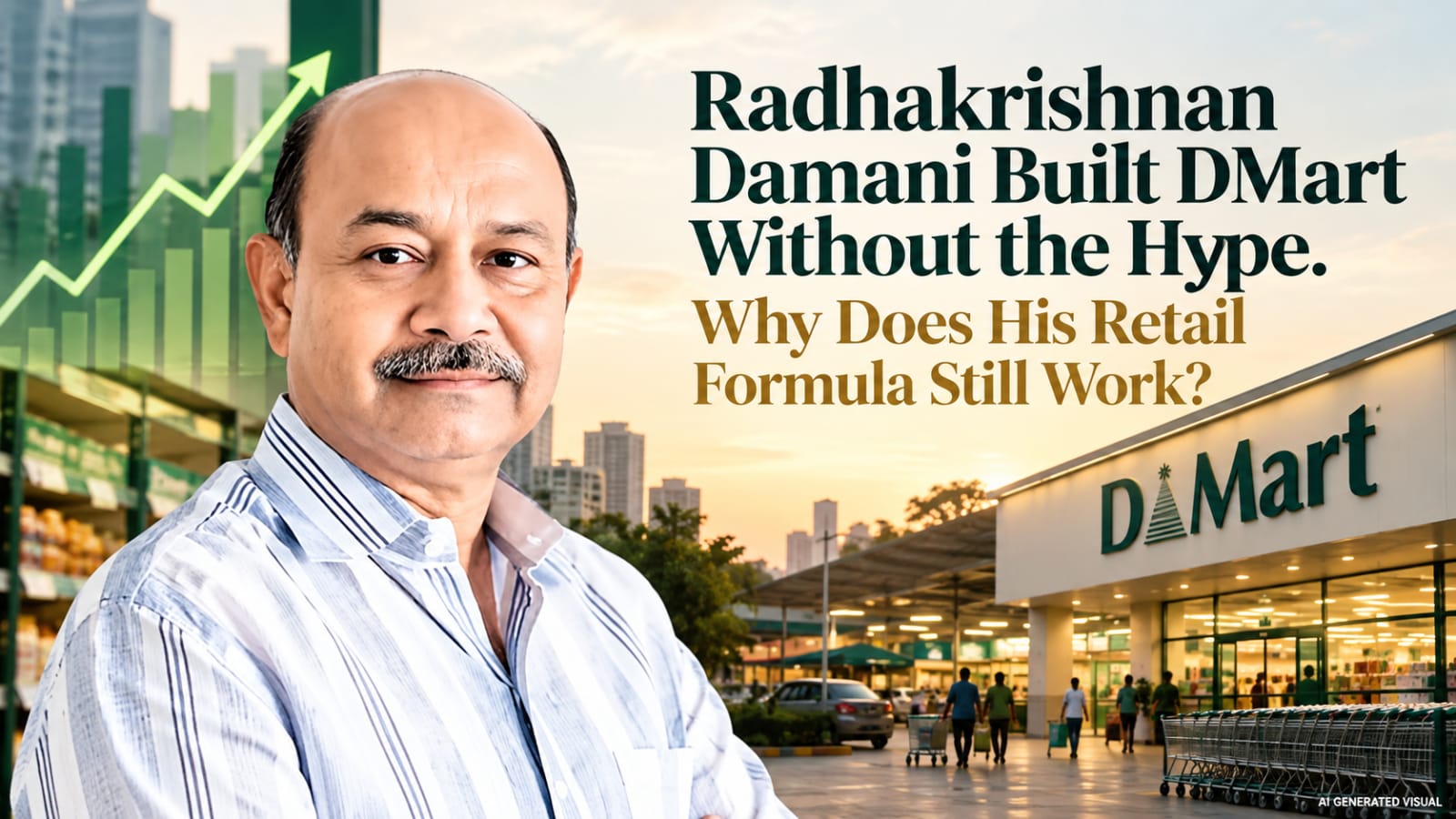
As DMart expands beyond 500 stores, its founder’s quiet philosophy faces a louder, faster and increasingly digital retail market.
The business that refuses to perform for attention
There is a particular kind of modern business success that arrives with a constant stream of announcements. New markets, new celebrity campaigns, new app features, new promises about changing everything. DMart became one of India’s most consequential retailers through a less theatrical proposition: sell everyday essentials at prices people trust, and make the operation work repeatedly.
That discipline is closely associated with founder Radhakishan Damani. Yet the interesting question in 2026 is not whether the approach has worked. It is whether the same philosophy can keep working as India’s retail market becomes more impatient.
What the numbers actually say
Avenue Supermarts’ FY2025 to 26 annual report records 500 stores at year end, after 85 additions, and revenue from operations of ₹66,968 crore. Its store footprint extended across 15 states, one Union Territory and the National Capital Region. These are substantial numbers for a format built around physical shopping and everyday value.
The company’s October 2026 second-quarter update was reported to show 18.4% year-on-year standalone revenue growth and 518 stores. The share price nevertheless fell after the update. That contrast is worth noticing: sales growth and investor expectations are not the same thing. [Avenue Supermarts FY2025 to 26 annual report]
The secret is not a secret
DMart’s own annual report describes a cluster-based expansion strategy. It deepens its presence in existing markets before spreading into new ones. The operating logic is familiar but demanding: manage inventory, choose products carefully, understand local shoppers and keep the cost of serving them low.
Low prices alone are not a moat. Plenty of retailers can advertise discounts. The harder advantage is the operational ability to offer value consistently while maintaining enough margin to keep opening stores. That is a system, not a slogan. [Avenue Supermarts quarterly company update]
Why the new retail race is different
India’s urban shopper now has more options than a neighbourhood supermarket. Quick commerce can make waiting feel old-fashioned. Online marketplaces can expand assortment almost endlessly. Premium stores can make shopping itself an experience.
DMart does not need to copy every competitor to remain relevant. But it does need to answer a practical question: which shopping missions still justify a deliberate visit to a large-format store? For a family buying a substantial basket of household essentials, price certainty may still matter more than instant delivery. For a forgotten ingredient at 9 pm, convenience may win. [Economic Times Q2 FY27 update]
What Damani’s example teaches founders
The temptation for ambitious businesses is to confuse visibility with durability. DMart offers a different lesson: a customer promise becomes powerful when the supply chain, real estate choices, working capital and store teams all support it.
The limits matter too. Physical expansion ties up capital, location choices can go wrong, and value-conscious customers are unforgiving when prices slip. A disciplined model is not a risk-free model.
The larger story is that Radhakishan Damani built an institution around an ordinary human desire: making household money go further. In an economy obsessed with disruption, that may remain a surprisingly durable idea.
Tags
Read Next
More stories

Have a person, achievement or story our editors should know about?
Submit a Story
Stories worth telling, in your inbox.
Get the latest People Who Matter features delivered weekly.
Subscribe NowDiscussion
No comments yet. Be the first to share your thoughts.