
India Is Getting Older. Max India and ISB Want to Rethink How the Country Cares for Its Seniors
Max India Foundation and ISB have launched SCALE to build evidence around senior care. The initiative arrives as India faces a demographic shift that will reshape healthcare, finance, technology, work and family life.
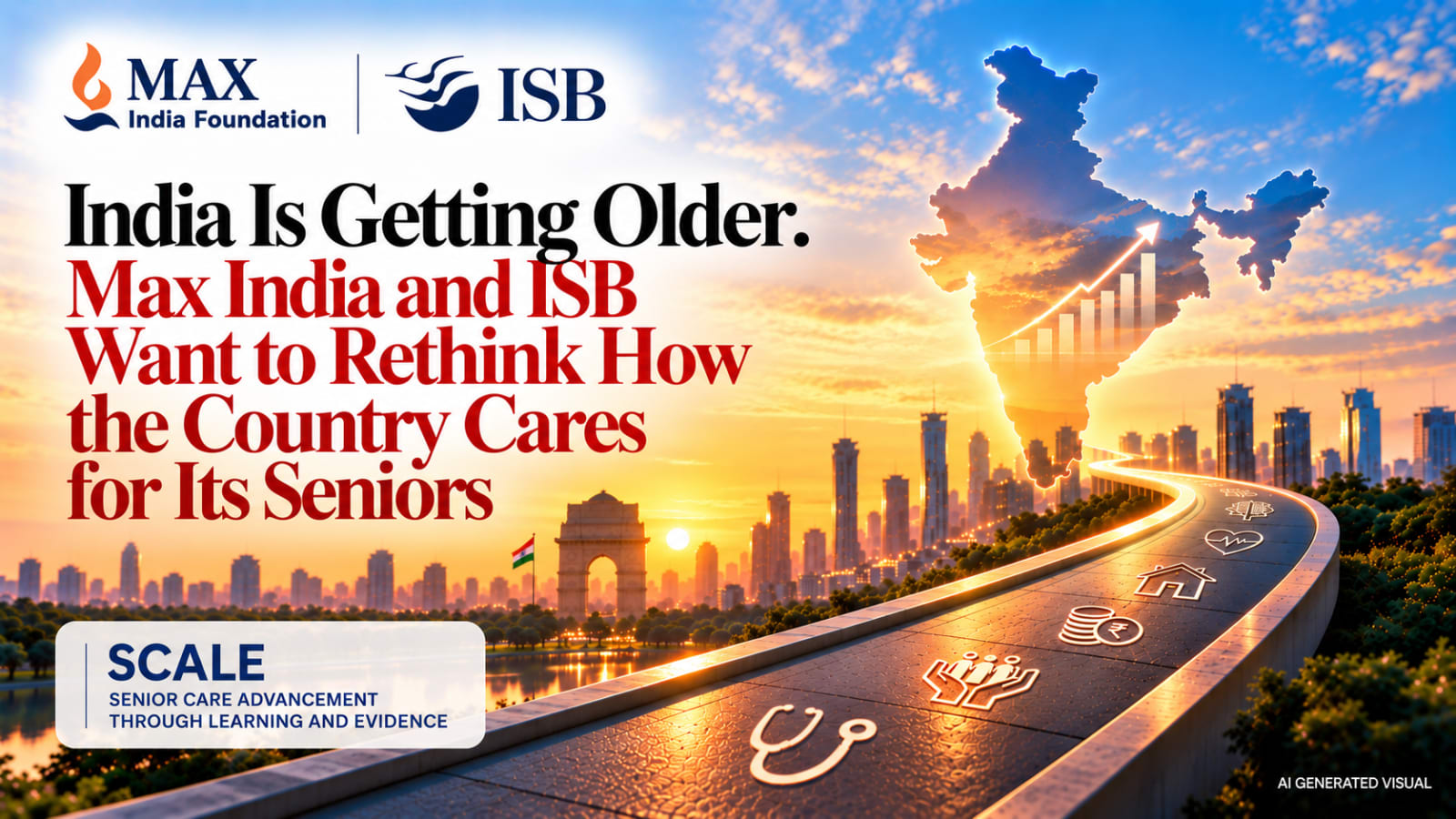
Max India Foundation and the Indian School of Business have launched SCALE, a research initiative focused on senior care. Behind the programme sits a much larger question: India has spent decades preparing for the opportunities of a young population. Is it equally prepared for what happens when that population grows old?
India likes to describe itself as young. For good reason. A large working age population has shaped the country’s economic story, its consumer markets and its sense of future possibility.
But demographic stories do not stop moving. The young population that creates a dividend eventually becomes an older population that needs a different kind of economy around it.
That is the context in which Max India Foundation and the Max Institute of Healthcare Management at the Indian School of Business have launched SCALE, or Senior Care Advancement Through Learning and Evidence.
ISB says the initiative will build evidence across five broad areas: healthcare delivery and care models; financing, insurance and economic security; consumer behaviour and markets; work and economic participation; and technology, digital inclusion and innovation.
The list is revealing. Senior care is no longer only a healthcare question. It is becoming a design question for almost every part of modern Indian life.
India’s demographic dividend has an expiry date
UNFPA India projects that by 2050 around 346 million Indians, close to 21 per cent of the population, will be over 60. It says India could add nearly 200 million older people over roughly a quarter century.
Numbers that large change the meaning of ageing. This is not a niche population requiring a few specialist services. It is a major consumer group, a healthcare population, a voting population, a workforce question and a family question.
The challenge is that many of the systems older people will depend on were designed when India was younger, families were structured differently and digital services did not mediate so much of everyday life.
The family cannot be India’s entire senior care system
Indian elder care has traditionally rested heavily on families. That remains culturally important, but family structure is changing. Children move cities and countries for work. Households are smaller. Women, who historically carried a disproportionate share of unpaid care, participate more actively in paid work. People also live longer with chronic conditions that require sustained support rather than occasional help.
This does not mean the family disappears. It means the family increasingly needs an ecosystem around it.
The SCALE announcement says the initiative is intended to connect researchers, clinicians and industry stakeholders, support data sharing and pilot projects, and translate evidence into insights for policy and private sector practice. Antara Senior Care is a founding partner.
That emphasis on evidence matters because senior care is expanding quickly, but the category is fragmented. Senior living, home healthcare, insurance, AgeTech, assisted care and financial products often develop in separate lanes even though an older person experiences them as one life.
Ageing is also a financial design problem
Living longer is good news. Financing longer lives is more complicated.
ISB’s SCALE framework explicitly highlights pensions, insurance, risk pooling and economic security. It notes that many older Indians lack adequate pension and insurance protection.
That raises uncomfortable questions. What happens when retirement lasts twenty or thirty years? How should health insurance work when the probability of needing care rises with age? How should families plan for long term care that may not resemble a conventional hospital expense?
The senior economy will require products built around these realities rather than simply adapting products designed for younger consumers.
Digital India has an ageing problem too
India has rapidly moved banking, payments, travel, healthcare, government services and communication onto screens. For many younger users, that shift has been liberating. For some older users, it can create a new form of dependence.
SCALE identifies digital inclusion and technology as a dedicated research theme. That is important because accessibility is not achieved by adding a larger font after a product has already been designed. It requires understanding how ageing affects vision, hearing, dexterity, memory, confidence and vulnerability to fraud.
The opportunity is equally large. Remote monitoring, telemedicine, AI assisted care, simpler interfaces and better emergency systems could allow more people to remain independent for longer. But technology only becomes useful when it is designed around the person using it.
Older Indians are not only patients
One of the more interesting parts of SCALE is its focus on work, productivity and economic participation. That pushes against the lazy assumption that ageing is simply a transition from worker to dependent.
Many people want to continue working, advising, teaching, building businesses, volunteering or contributing to family enterprises after conventional retirement age. A country with hundreds of millions of older citizens cannot afford to treat all of that accumulated knowledge as economically irrelevant.
The same is true of consumption. Older Indians are not one homogeneous market. Their health, wealth, family structures, ambitions and digital comfort vary enormously. Designing for them requires segmentation rather than stereotypes.
SCALE is useful because India still has time to prepare
The demographic shift is large, but it is not arriving overnight. That creates something valuable: planning time.
Research initiatives do not solve senior care by themselves. SCALE will ultimately need to demonstrate that evidence can influence products, care models, investment and policy. Its value today is that it frames ageing as a system that needs to be understood before it can be redesigned.
India’s demographic dividend has encouraged the country to think constantly about what its young people might build. The next question is just as important.
What kind of country will those same people grow old in?
Tags
Read Next
More stories
Have a person, achievement or story our editors should know about?
Submit a Story
Stories worth telling, in your inbox.
Get the latest People Who Matter features delivered weekly.
Subscribe NowDiscussion
No comments yet. Be the first to share your thoughts.