
How the Kamath Brothers Kept Building Even After Zerodha
The Kamath brothers built one of India's most successful bootstrapped companies. Their greater contribution, however, may lie in how they have used that success to inspire founders, shape conversations and strengthen India's innovation ecosystem.
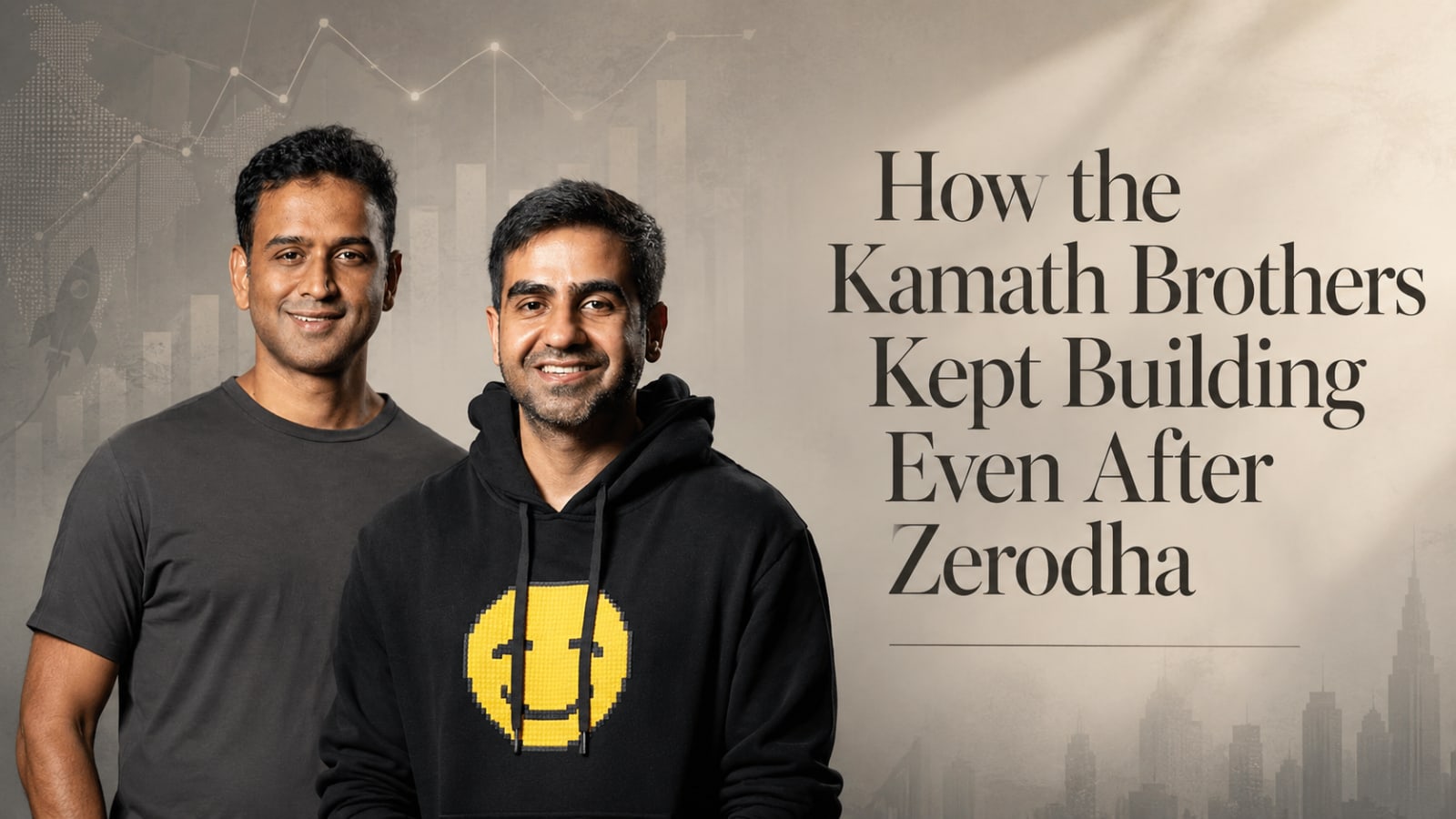
For decades, India’s relationship with the stock market was built on caution. Investing belonged to a select club of seasoned traders, wealthy families, and financial advisors. They often spoke a language that felt inaccessible to the average Indian. Brokerage fees were high, and participation in capital markets remained limited despite India's growing economy.
Then came a quiet disruption.
It didn’t begin with billion-dollar funding rounds, celebrity endorsements, or aggressive advertising campaigns. Instead, it started with the question, “What if investing could become as accessible as opening a bank account?” One of the few people to have asked this question was Nikhil Kamath.
That question translated into a whole new industry of fintech startups, of which a significant one is Zerodha.
Nithin Kamath and Nikhil Kamath looked at this as an opportunity. Thus, the Kamath brothers founded the stock investing app Zerodha in 2010. Today, Zerodha is India’s largest stockbroker by active clients, serving millions of investors and handling a significant share of the country’s retail trading activity.
This transformation wasn't driven by technology alone. It required trust, affordability, and a willingness to challenge decades-old business models.
Over the last decade, the brothers have evolved from entrepreneurs to investors and ecosystem builders. Today, they are two of India’s most influential voices on entrepreneurship and capital allocation.
While they have backed startups through the venture capital firm Rainmatter, Nikhil has turned complex topics into interesting discussions through his podcast ‘WTF is with Nikhil Kamath’.
The Zerodha Revolution
When the Kamath brothers entered the stock broking market in 2010, the industry was already crowded. Thus, they named the company ‘Zerodha’. It reflected their ambition. According to them, “We named the company Zerodha, a combination of Zero and ‘Rodha’, the Sanskrit word for barrier.”
Unlike many fintech startups that relied heavily on venture capital, Zerodha took a different route. The company was entirely bootstrapped. It did not raise institutional funding, allowing its founders to prioritise long-term sustainability over short-term growth metrics. In an ecosystem increasingly obsessed with valuations and fundraising announcements, this approach stood out. It also proved remarkably successful.
By introducing a flat-fee brokerage model, Zerodha fundamentally altered how brokerage services were priced in India. Instead of charging commissions based on transaction size, it simplified pricing and dramatically reduced trading costs for retail investors. Yet the real innovation wasn’t pricing alone.
Zerodha invested heavily in building technology that simplified investing for first-time users. Its flagship trading platform, Kite, replaced cluttered interfaces with a cleaner, more intuitive experience. Together, these innovations lowered both financial and psychological barriers to investing.
Its success inspired an entirely new generation of fintech entrepreneurs. Discount brokerage became an accepted category. Product-first financial technology companies gained greater credibility. Bootstrapped businesses received renewed attention in a startup ecosystem that often equated success with fundraising.
Capital With A Purpose
The Kamath brothers have never viewed wealth as an end in itself. Rather than stepping away after building one of India’s most profitable startups, the Kamaths chose to become active participants in shaping the country’s startup ecosystem.
Their investments over the years reveal a clear pattern. They have consistently backed startups from climate resilience and sustainable mobility to healthcare innovation, agriculture and frontier technologies.
According to a blog by Rainmatter, some of the key investments are Cred, Castler, The Ken, Galaxeye, among others.
It is safe to say that their investments have rarely chased headlines or speculative trends. Instead, it has sought to enable entrepreneurs building solutions with the potential to create lasting economic and social value. In doing so, the brothers have quietly demonstrated that investing can be more than a financial exercise. It can be a means of strengthening the country’s innovation ecosystem.
Recently, in a blog, Nithin Kamath wrote, “So far, we’ve invested over ₹1,500 crore across 160+ startups spanning fintech, climate, health, media, and deep tech. We’ve also earmarked 10% of everything Zerodha earns to invest in startups, and another 10% for the social sector through the Rainmatter Foundation.”
He further added that Rainmatter doesn’t want to take board seats and that they are not in this for quick exits.
According to him, “The simple reality is that building a good business is hard. Building one that is genuinely useful, scalable, and profitable is even harder when investors are pushing you to speedrun success and sustainability. That kind of pressure usually leads to shortcuts. And shortcuts, more often than not, come at the consumer’s expense.”
“Ultimately, businesses that don’t consider their broader impact will be left behind, not just by consumers, but by the market itself,” Nikhil Kamath said in an interaction with UNDP.
Thus, Rainmatter’s approach is to be patient, back founders for the long term, and help them build the business the right way.
More Than Investors, Builders of Possibility
For the Kamath brothers, investing has never been merely about deploying capital. It is about extending the entrepreneurial journey beyond their own success and into the ambitions of others.
They proved that a bootstrap startup could be a profitable, customer-centric company and could challenge an established industry.
That shift is significant. It moves the Kamath brothers beyond the role of entrepreneurs and into that of ecosystem builders. Their influence is no longer defined solely by what they have created themselves, but by the opportunities they have opened for others.
In backing founders tackling climate resilience, healthcare, financial inclusion and frontier technologies, they are helping shape ideas that could impact India’s economic and social future.
Read Next
More stories


Have a person, achievement or story our editors should know about?
Submit a Story
Stories worth telling, in your inbox.
Get the latest People Who Matter features delivered weekly.
Subscribe NowDiscussion
No comments yet. Be the first to share your thoughts.