The Man Tata Wasn’t Ready to Let Go: N. Chandrasekaran’s Long Game
N. Chandrasekaran spent nearly four decades inside Tata and was preparing to leave. Then the Tata Sons board asked him to stay. His reversal says as much about the unfinished transformation of the group as it does about the man leading it.
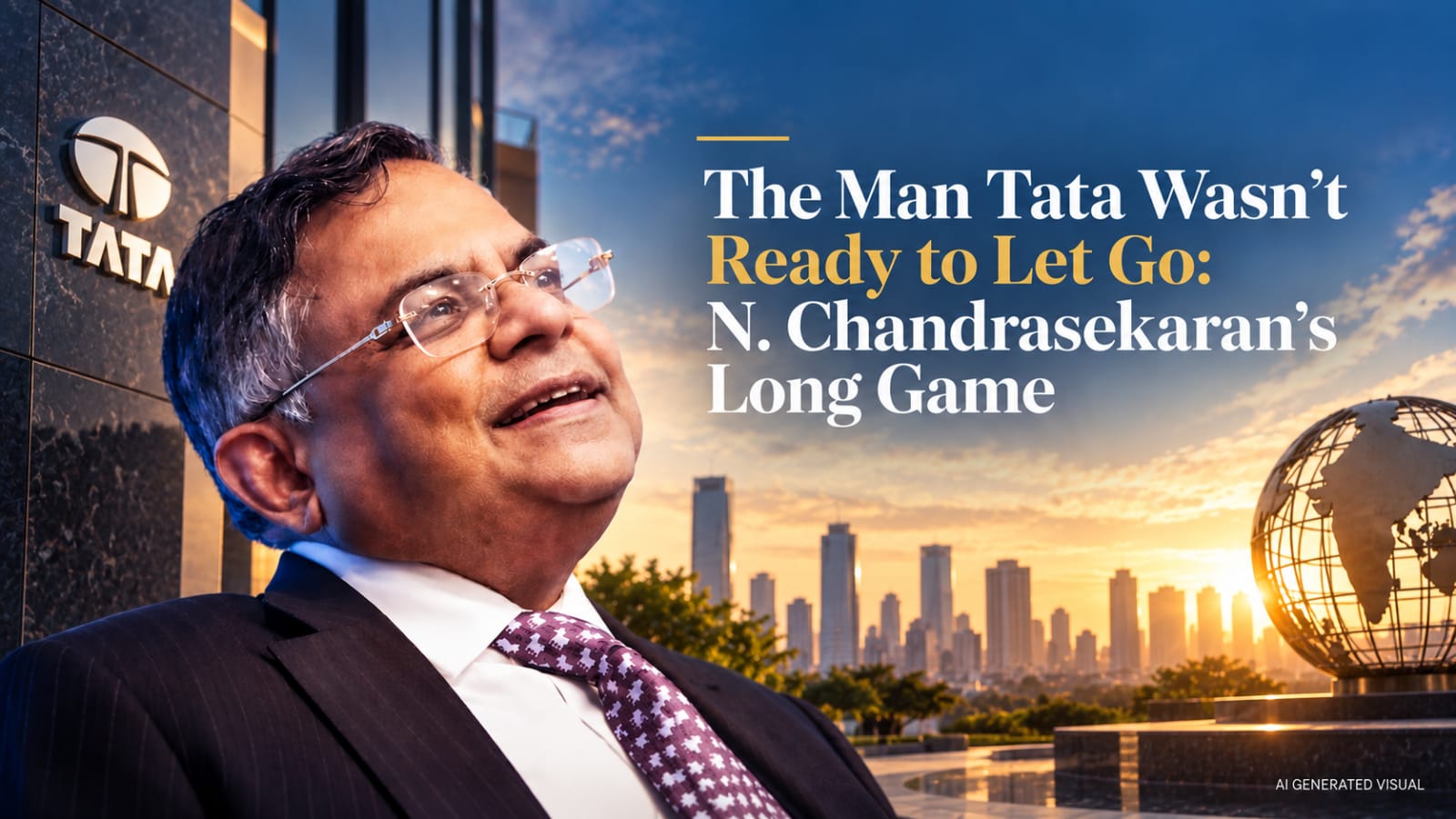
He joined TCS as a young engineer in 1987 and eventually became chairman of Tata Sons. Nearly four decades later, N. Chandrasekaran was preparing to end that journey. Then came an extraordinary reversal. What made the quiet operator at the centre of one of India’s biggest business houses so difficult to replace at precisely the moment Tata became hardest to run?
There is something unusually revealing about the fact that N. Chandrasekaran almost left Tata.
Not retired quietly. Not eased himself into a ceremonial role after decades inside the group. In August 2026, the man who had spent his entire corporate career within Tata said he would not seek another term as chairman of Tata Sons when his tenure ended in February 2027.
Then, five weeks later, he agreed to stay.
On 17 September, the Tata Sons board approved another five year term for Chandrasekaran, reversing what had briefly looked like the closing chapter of one of corporate India’s most remarkable careers. Reuters reported that the decision came amid a wider dispute involving Tata Sons, Tata Trusts and the future structure of the holding company. Tata Trusts has challenged the validity of the reappointment, so the governance position remains contested and should be rechecked before publication.
But look beyond the boardroom drama and there is a more interesting People Who Matter story.
Why, after nearly four decades at Tata, does so much of the group’s future still appear to run through one man? And why did Chandrasekaran choose to stay when leaving might have been considerably easier?
The chairman of Tata started as a programmer
Long before semiconductors, Air India, electric vehicles and multibillion dollar factories, there was a young engineer joining TCS.
Chandrasekaran joined Tata Consultancy Services in 1987 after completing his master’s in computer applications at Regional Engineering College, Trichy. Tata’s official profile records a 30 year career at TCS, including eight years as chief executive, before he became chairman of Tata Sons in 2017.
That detail matters because Chandrasekaran is not an outsider brought in to modernise an old institution. He is a product of the institution who eventually became responsible for reinventing it.
There is an almost old fashioned quality to that career trajectory. One company. One group. Nearly four decades. At a time when executive careers are increasingly built through movement, Chandrasekaran built his through accumulation: more businesses, more responsibility and a progressively larger view of the same institution.
He inherited Tata. Then he started changing what Tata could be.
When Chandrasekaran became chairman in 2017, Tata was already one of India’s most important business institutions. His challenge was not to make Tata famous. It was to make something enormous move faster.
His answer was organised around what Tata describes as the “One Tata” strategy, built on simplification, scale and synergy. The group’s profile of Chandrasekaran says that approach has accompanied Tata’s expansion into semiconductors, electronics manufacturing, consumer internet, mobile technology and battery gigafactories.
You can see the logic in electric mobility. Tata Motors can make the vehicle. Tata Power can build charging infrastructure. Tata AutoComp can work on components. Tata Technologies and TCS can contribute engineering and technology. Put them together and the group is not simply selling a car. It is trying to create an ecosystem.
That way of thinking increasingly became Chandrasekaran’s signature. Not another Tata company. Another Tata system.
Then his bets became much bigger
The Tata Group Chandrasekaran is running today looks strikingly different from the one he inherited. It owns Air India again. It is manufacturing electronics. It is building semiconductor capability. It is investing in batteries, electric mobility, renewable energy and digital infrastructure.
These are not lightweight businesses. They consume capital. They take years to build. They involve governments, regulators, global technology partners and complicated supply chains. Several can take years before anyone knows whether the original bet was right.
That may be the defining difference between the first half of Chandrasekaran’s Tata tenure and what comes next. The first was partly about fixing, simplifying and integrating Tata. The second is about building things that do not yet fully exist.
Dholera may tell us more about Chandrasekaran than another annual report
Look at what is happening in semiconductors. Tata Electronics is building a semiconductor fab in Dholera and an assembly and testing facility in Assam, while simultaneously building relationships across equipment, technology, packaging and global customers.
The partnership with Nexperia announced in September 2026 is an early example of what the strategy is trying to become. Reuters reported that Nexperia plans to manufacture power control chips at Tata’s Dholera facility and use Tata’s Assam operation for assembly and testing, while the companies also collaborate on future technologies.
That requires a different kind of corporate patience. A software company can scale extraordinarily quickly. A semiconductor ecosystem cannot.
Perhaps that is one reason Chandrasekaran’s background is so interesting. The man who spent most of his career in one of India’s greatest asset light success stories is now placing some of Tata’s biggest bets on deeply physical businesses: factories, aircraft, batteries, chips, cars and power.
But this is not a victory lap
It would be easy to tell Chandrasekaran’s story as a neat progression from TCS programmer to Tata chairman, followed by a collection of increasingly impressive investments. Reality is much messier.
Air India remains a huge transformation project. Jaguar Land Rover operates in a difficult global automotive environment. Several newer Tata businesses require substantial capital before their economics are fully proven. And above all of it sits an unresolved debate about Tata Sons itself.
The Reserve Bank of India’s regulatory treatment of Tata Sons has kept the question of a potential listing alive, while the disagreement between Tata Sons and Tata Trusts has become a major governance issue. Reuters’ September 17 report described the reappointment and listing question as part of the same widening rift.
Chandrasekaran is therefore not staying because everything worked. He is staying while several of the biggest things are still unfinished. That makes the decision considerably more interesting.
The quiet operator now has the loudest problems
Chandrasekaran has never fitted the stereotype of the celebrity Indian billionaire. He does not own Tata. His surname is not Tata. He has not built a public persona that competes with the businesses he runs. His authority has largely come from operating inside the institution.
That style matters now because the problems in front of him are anything but quiet. Tata is simultaneously dealing with capital intensive new businesses, the long repair of Air India, global automotive volatility, the future of Tata Sons and an unusually public disagreement over governance.
The paradox is that the more complicated Tata becomes, the more valuable institutional memory becomes. Chandrasekaran knows the group not only as its chairman, but as somebody who spent decades moving through it before reaching the top.
His greatest strength may also create Tata’s biggest question
There is a danger whenever too much strategic continuity becomes associated with one executive. The stronger Chandrasekaran’s influence becomes, the more important succession becomes too.
That is not an argument against his leadership. It is an institutional question created by it. Tata is much larger than any chairman. That is part of what has allowed the group to survive generations of leadership, economic cycles and enormous changes in India itself.
Yet the reaction to his reappointment showed how much continuity had become associated with him personally. Reuters reported that Tata Sons controls more than 30 group companies, while another Reuters report put the combined market capitalisation of listed Tata companies at about $277 billion as of March 31, 2026.
For a man whose strategy has emphasised One Tata, Chandrasekaran has himself become one of the things holding the many Tatas together.
The next five years will probably define the first ten
Chandrasekaran became Tata Sons chairman in 2017. It is tempting to judge those years through market value, acquisitions or the number of new businesses launched. But those may ultimately be less interesting measures of his tenure than what happens to the bets that are still being built.
Can Tata create a globally competitive semiconductor business? Can Air India become the airline Tata imagined when it brought the carrier home? Can its battery, electronics, electric mobility, energy and digital investments become coherent businesses rather than an expensive collection of ambitions? And can Tata Sons navigate its internal governance disagreements without weakening the institution Chandrasekaran has spent his entire working life serving?
Those answers will take years. Which makes the reversal of the past five weeks feel strangely appropriate.
N. Chandrasekaran spent almost four decades climbing through Tata and, briefly, appeared ready to walk away. Instead, at 63, he has chosen another lap.
His legacy will probably not be decided by how high he climbed inside Tata. It will be decided by whether the businesses he chose to build are strong enough to keep growing after he eventually leaves.
Tags
Read Next
More stories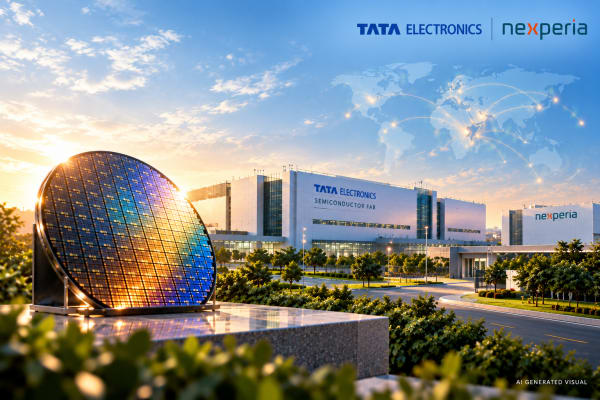

Have a person, achievement or story our editors should know about?
Submit a Story
Stories worth telling, in your inbox.
Get the latest People Who Matter features delivered weekly.
Subscribe NowDiscussion
No comments yet. Be the first to share your thoughts.