
CMF Is Becoming an Indian Smartphone Brand. Can India Finally Build a Global Phone Brand?
CMF is moving towards majority Indian ownership and deeper local engineering. Its transformation reveals the next challenge for India's electronics industry: moving from making global phones to building global phone brands.
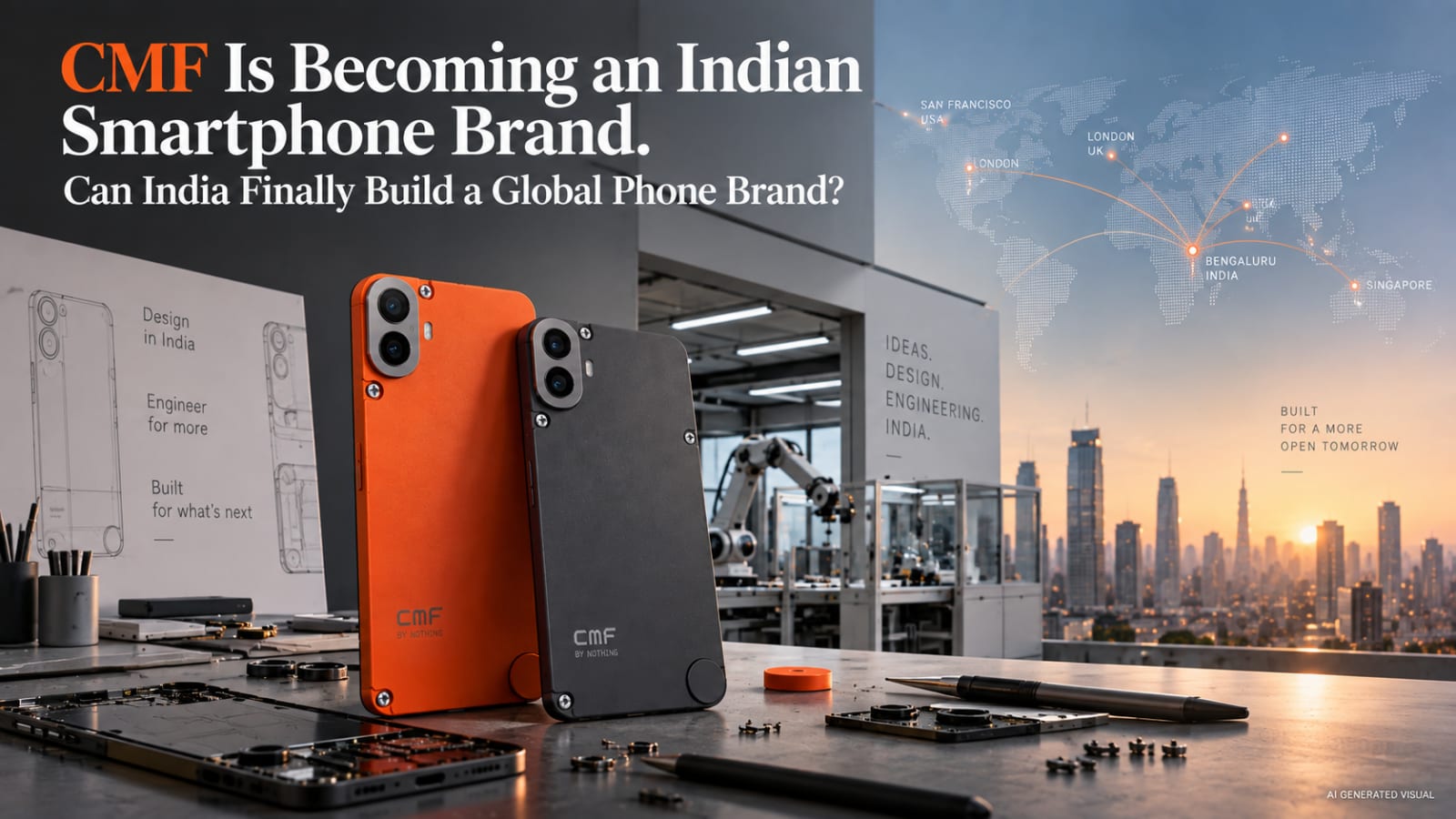
Nothing is turning CMF into a standalone, majority Indian owned smartphone company with manufacturing, engineering and intellectual property increasingly rooted in India. The move raises a bigger question for a country that already makes most of the phones it buys: when does manufacturing become ownership, and when does ownership become a global technology brand?
For years, the phrase Made in India solved one part of India's smartphone problem. Factories arrived. Assembly moved closer to the customer. Supply chains deepened. Phones that once came into the country in finished boxes increasingly began leaving Indian production lines instead.
But making a phone and building a phone company are not the same thing.
That distinction is what makes the latest chapter in CMF interesting. Nothing is moving its value focused CMF brand into a standalone India based company, with Optiemus Group set to hold a majority stake. The structure is designed to bring ownership, manufacturing and research and development under an Indian entity while Nothing remains a partner. The Economic Times reported that the plan goes beyond assembly towards end to end smartphone engineering and local intellectual property.
On paper, this is a corporate restructuring. In reality, it asks a much more interesting question: what would it actually take for India to produce a consumer technology brand that the rest of the world wants to buy?
India learned how to make phones. Building brands is the harder exam.
India's electronics manufacturing story has changed dramatically in little more than a decade. The country has become a major smartphone production base, helped by scale, incentives, contract manufacturers and a vast domestic market. Yet the logos on the devices remain overwhelmingly foreign. Manufacturing success has not automatically produced an Indian equivalent of Samsung, Xiaomi or Apple.
That is not a contradiction. Manufacturing is a capability. Brand building is another. Product architecture, industrial design, software, camera tuning, thermal engineering, supply chain control, patents, retail, service and the ability to keep consumers returning all have to work together. A global consumer technology brand is not simply a factory with a logo attached.
CMF's proposed structure appears designed around precisely that gap. Mint reported that Optiemus Infracom will hold 51.1 percent in the proposed venture, with Nothing continuing as a partner. The stated ambition is to combine Indian manufacturing with deeper product development rather than treating localisation as the final step.
The most important shift is from assembly to authorship
For consumers, the back of a phone saying Made in India can feel like the end of the localisation story. For the industry, it may only be the beginning.
The higher value question is who decides what the product is. Who designs the antenna? Who tunes the camera? Who owns the industrial design? Who writes the software experience? Who controls the intellectual property? Who chooses the components and makes the trade offs between price, battery, heat, weight and performance?
Carl Pei has framed the CMF plan around developing those capabilities in India. The Indian Express described the strategy as an attempt to use India's manufacturing base, consumer scale and local research capabilities to build a global brand rather than merely a locally assembled device.
That word, global, matters. India does not need another phone brand whose only advantage is being Indian. National identity may create curiosity, but consumers stay for product quality, price, software, service and desirability. The harder ambition is to build something in India that succeeds even where being Indian provides no automatic advantage.
CMF is an unusual candidate for the job
CMF did not begin as a patriotic challenger brand. It began inside Nothing, the London based consumer technology company founded by Carl Pei, as a more accessible product line. Its visual language, playful industrial design and connection to Nothing gave it an identity before the Indian ownership question became central.
That may actually help. One weakness of earlier attempts to build Indian smartphone brands was that many competed primarily on price and distribution while relying heavily on external design and manufacturing ecosystems. When Chinese brands arrived with faster product cycles, deeper supply chains and aggressive pricing, much of that advantage disappeared.
CMF starts from a different place. It already has a recognisable design vocabulary and access to Nothing's product experience. The new structure is trying to add Indian ownership and engineering depth without throwing away the brand equity that already exists.
The challenge will be proving that the combination is more than a clever corporate arrangement. Majority ownership does not automatically create technical independence. Local R&D does not instantly create globally competitive intellectual property. And a distinctive design language does not guarantee scale.
The real opportunity is India's enormous home market
Global consumer technology brands rarely become global by ignoring their home market. They learn at scale somewhere first. India offers CMF something unusually valuable: hundreds of millions of demanding smartphone users across wildly different price points, climates, languages, connectivity conditions and usage patterns.
A product engineered seriously for India has to solve difficult problems. Battery life matters because usage is intense. Thermal performance matters because temperatures are high. Cameras have to work across skin tones and lighting conditions. Service networks matter beyond the largest metros. Pricing has to survive extraordinary comparison shopping. Software has to feel fast even when hardware budgets are constrained.
If those constraints produce better engineering rather than merely cheaper engineering, India can become a product laboratory rather than only a manufacturing destination.
Being Indian cannot be the product proposition
There is an obvious temptation in a story like this to make nationality the selling point. That would undersell the opportunity.
Consumers may like the idea of an Indian owned smartphone brand. They will still compare its camera with a Vivo, its battery with a OnePlus, its software with a Pixel, its ecosystem with Samsung and its price with everything else on Flipkart and Amazon. National pride can get a brand into the consideration set. It cannot protect a mediocre product.
That is why CMF's next phase will be more revealing than the ownership announcement itself. The meaningful evidence will arrive in products: whether more engineering genuinely moves to India, whether local teams own important technical decisions, whether intellectual property accumulates here, and whether CMF can sell outside India without depending on the story of where it comes from.
The next Make in India story may be about who owns the idea
India's first electronics manufacturing victory was getting more devices made locally. The second is likely to be harder: creating companies that own more of the design, technology, brand and margin behind those devices.
CMF is now volunteering itself as a test case.
If it works, the significance will not be that India finally has another smartphone logo. It will be that a country which spent years becoming indispensable to the production of consumer electronics has begun to claim a larger role in deciding what those electronics should be.
The difference between Made in India and built by an Indian company may sound semantic. In technology, it is the difference between participating in somebody else's value chain and trying to create one of your own.
Tags
Read Next
More stories


Have a person, achievement or story our editors should know about?
Submit a Story
Stories worth telling, in your inbox.
Get the latest People Who Matter features delivered weekly.
Subscribe NowDiscussion
No comments yet. Be the first to share your thoughts.