
Titan: The Timeless Masterpiece By The Tata Group
From a factory in Hosur to the acquisition of a 300-year-old Swiss watchmaker, Titan's journey reflects the power of conviction, innovation and an unwavering belief that India could build brands the world would admire.
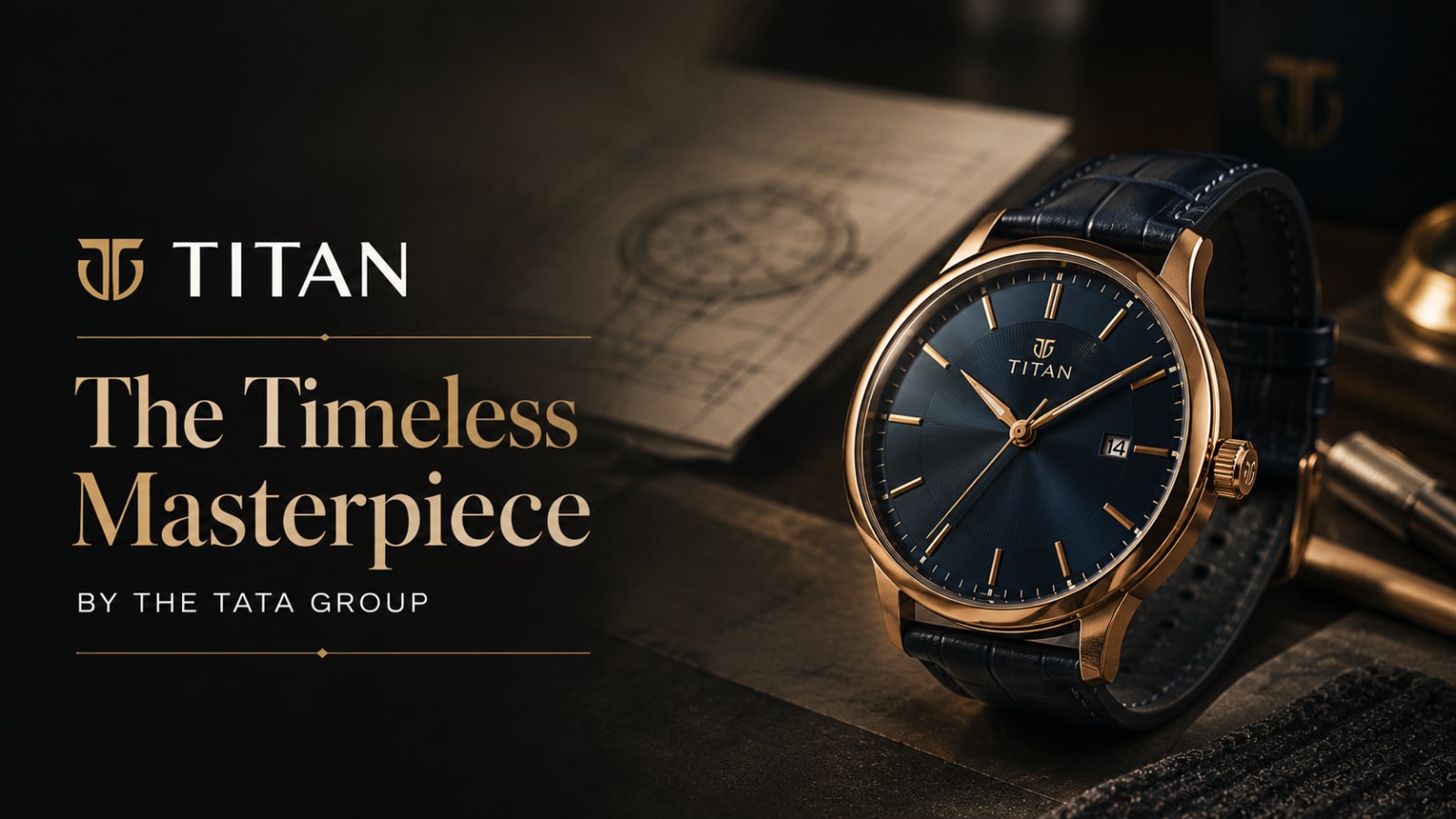
Decades before “Make in India” was a thing, the Tatas believed in it. Whether it’s The Taj Mahal Hotel, Tata Steel, Tata Power or anything else, the Tata Group has been at the forefront of making the world believe that India can, when nobody else could even imagine it. That’s how India’s own Titan was also born.
Titan was founded in 1984. It was a time when Indians either wore HMT or imported Swiss watches. The market was dominated by mechanical timepieces and limited choices. Few imagined that an Indian brand could redefine the category through design, precision engineering and world-class manufacturing.
But the story of Titan isn’t limited to the Tata Group launching a watch brand. It was building something from scratch, starting right from training an entire workforce to manufacturing a watch which was entirely made in India.
In the decades that followed, Titan didn’t simply build successful brands but also changed how Indians measured quality, trusted retailers and celebrated life’s milestones. More importantly, it demonstrated that an Indian company could shape consumer culture rather than merely participate in it.
Titan's story, therefore, is not merely about a watchmaker. It is about a company that arrived at a time when Indian consumers instinctively equated foreign labels with superior quality. Titan wasn't simply asking Indians to buy an Indian watch. It was asking them to believe that an Indian brand could belong among the world's finest.
From Hosur To The World “Of Titan”
While J.R.D. Tata encouraged the making of Titan; Xerxes Desai gave it a soul. Desai wasn’t interested in creating just another Indian watch company. He wanted to build a brand that could stand shoulder to shoulder with the best in the world.
Manufacturing was the easy part. Building confidence was considerably harder. Titan had to convince consumers that precision engineering, thoughtful design and reliability didn't have to come from Switzerland or Japan. That belief had to be created long before it could be sold.
The journey itself demanded unusual conviction. It took nearly a decade of navigating bureaucracy, securing technology partnerships and convincing stakeholders before Titan’s first watches reached consumers.
Competing with HMT’s mechanical pieces wasn’t easy. Quartz technology, which offered greater accuracy, lower maintenance and slimmer designs, was still largely unfamiliar to Indian consumers. Titan realised that if it wanted consumers to experience the difference, it needed to reinvent how watches were sold.
That’s how the World of Titan was born.
Its first exclusive showroom opened in Bengaluru, giving customers an experience that was rare in India at the time. Instead of buying a watch from a crowded multi-brand counter, shoppers could browse collections, compare designs, understand new technologies and receive after-sales service under one roof. Today, exclusive brand stores have become commonplace across retail categories, but in the late 1980s, Titan helped pioneer the concept for watches in India.
Looking back, the World of Titan was far more than a retail innovation. Instead of simply placing products on shelves, Titan built environments where trust could be experienced. In hindsight, the store became as important a product as the watch itself.
Building A Legitimate Watch Market
The struggle for Titan didn’t end with the launch of an official store. It also had to fight the black market for watches to make a statement.
In the 1970s and early 1980s, foreign watches, particularly Japanese and Swiss brands, were highly aspirational but difficult to import because of India's restrictive trade policies. As a result, a thriving smuggling network emerged, flooding the market with foreign watches and counterfeit models. Quartz watches, which were largely unavailable from Indian manufacturers, became especially popular among consumers.
The impact was visible across the market. An India Today report published in 1990 noted that the value of seized smuggled watches had fallen sharply from INR 135 Cr to INR 42.75 Cr in a year. The report attributed much of the change to the growing availability of Indian-made quartz watches.
Responding to this, Titan’s MD Xerxes Desai said, “Smugglers too are vacating the price range we work from - they're now downmarket.”
The episode illustrates something larger about Titan’s approach to competition. Rather than attempting to win through price alone or relying on regulation to curb illegal imports, it expanded the legitimate market by giving consumers a better product. In doing so, it proved that innovation can often achieve what enforcement alone cannot.
Blending Culture With Precision
Interestingly, though during the initial months Titan found it tough to push its mechanical watches through the market, people soon began to resonate with the products through endorsements.
Gradually, Mozart’s Symphony No. 25 became synonymous with Titan. Even decades later, Indians instantly associate the melody with the brand, making it one of the most recognisable sonic identities in Indian advertising history.
Few companies become part of a nation’s cultural memory. Titan did. The melody became shorthand for celebration, achievement and gifting, demonstrating that the company's greatest success lay not in selling watches but in embedding itself into everyday Indian life.
But Titan’s goal was bigger. Xerxes Desai and his team wanted to compete with the global brands. And soon, they realised that for this they needed variety in designs. This wouldn’t just help them compete with the global brands but also help them expand the Indian customer base.
Thus, the team launched Raga for women, Fastrack for young consumers, Nebula as the luxury category, and many such categories.
But Titan turned heads by launching Titan Edge in 2002, branding it as the slimmest watch in the universe. This demonstrated that an Indian company could compete with the finest names in global watchmaking not only on affordability but also on engineering excellence.
An Indian Watchmaker That Outgrew Expectations
It is safe to say that Titan is a timeless masterpiece by the Tata Group. It is a legacy built on conviction, craftsmanship and innovation. With those principles and ideas, the Indian watchmaker entered the European market in 1993, along with the Middle East and Asia Pacific regions. But a crucial landmark was the acquisition of Favre-Leuba in 2011.
Under the deal, the company acquired the global rights to the Swiss watchmaker, founded in 1737. This reflects the journey of a brand as an Indian challenger to a globally respected watchmaker.
For a company that began by convincing Indians to believe in domestically manufactured watches, acquiring a historic Swiss brand was a huge step towards the global market. It underscored how far Titan had travelled from aspiring to global standards to becoming a steward of one of Switzerland's oldest names in horology.
According to Titan, in 2024, Edge became the first Indian brand to compete at the Grand Prix D’Horlogerie de Genève in the Time Only and Challenge category with the Titan Edge Squircle Matte Black and Titan Edge UltraSlim.
Today, Titan is present across 40+ countries through more than 3,300 stores. It sells products across multiple categories
Yet numbers alone don't explain Titan’s influence. Store count, revenue and international presence tell only a part of the story. Titan’s larger contribution lies in how it reshaped consumer behaviour. It normalised branded jewellery, elevated watches from utility to aspiration and showed that Indian manufacturing could compete on design rather than just cost.
Today, Titan’s portfolio spans watches, jewellery, eyewear, wearables, fragrances, handbags and Indian dress wear. The brands under Titan are Sonata, Fastrack, Tanishq, Mia, Zoya, CaratLane, Titan Eye+, Skinn and Taneira, among others. The company operates 16 brands across multiple lifestyle categories.
A Legacy Beyond Time
The true measure of an institution is when its story is no longer confined to annual reports or business schools. Titan’s journey is now being retold on screen through the web series Made in India: A Titan Story.
This reflects how the brand has become part of India’s entrepreneurial folklore as much as its industrial history.
It is pertinent to note that such an honour is reserved for companies whose stories transcend business success to become part of a nation’s collective memory. Most brands are remembered for the products they sell. But only a handful are remembered for the industries they reshape. Titan’s story has endured because it isn't merely about watches or jewellery. It is about ambition, craftsmanship and the conviction that an Indian company could build products capable of standing alongside the world's finest. That is what makes Titan not just a successful brand but a timeless masterpiece.
Read Next
More stories

Have a person, achievement or story our editors should know about?
Submit a Story
Stories worth telling, in your inbox.
Get the latest People Who Matter features delivered weekly.
Subscribe NowDiscussion
No comments yet. Be the first to share your thoughts.