
Gig Work, Food Delivery, Q-Commerce, Ambulance: How Zomato Built An Ecosystem
What started as a restaurant menu website eventually transformed into one of India’s biggest consumer-tech companies. From food delivery and Blinkit to gig employment and quick commerce, Zomato reshaped how urban India eats, shops, works, and experiences convenience.
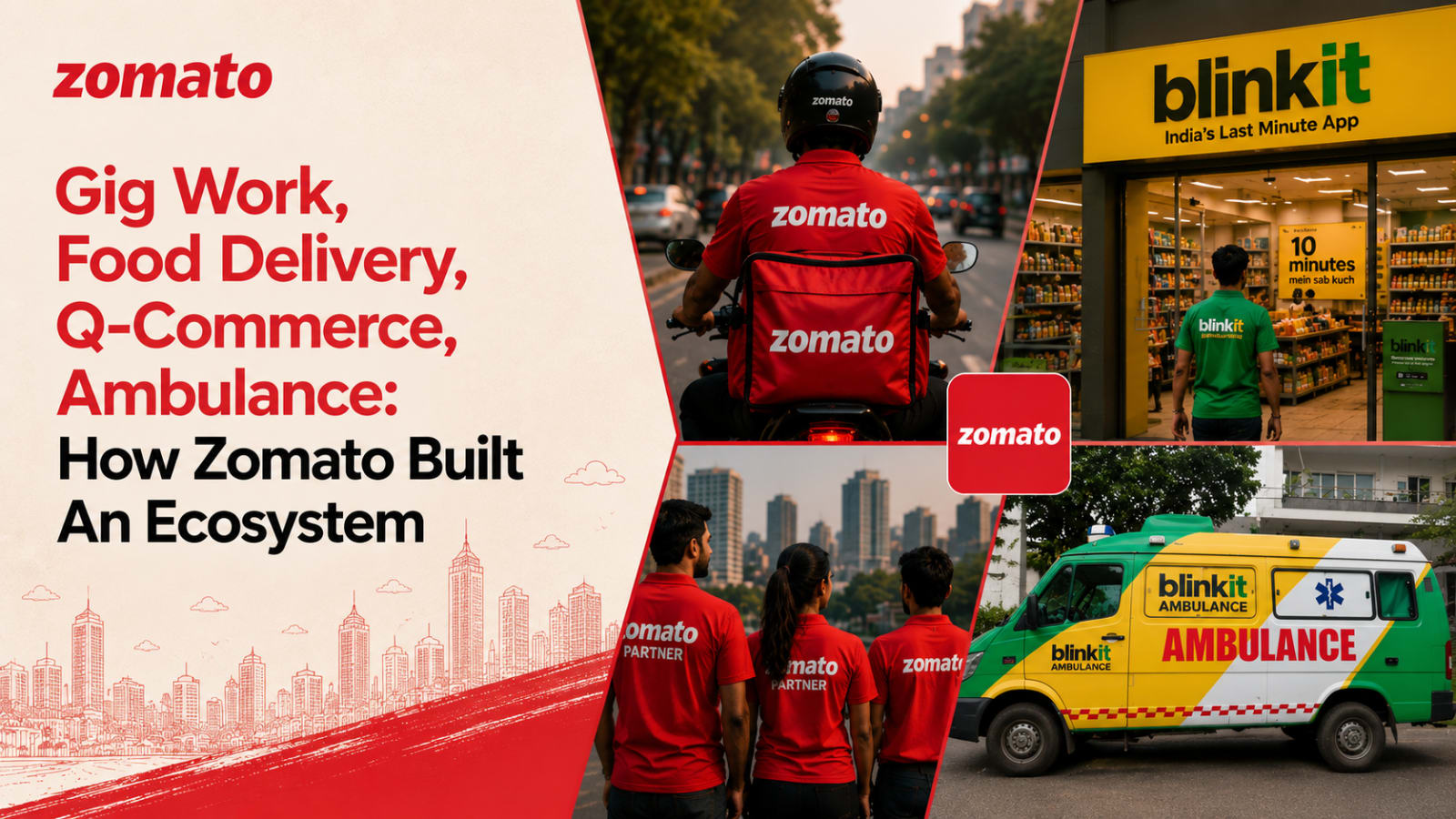
India, being a country with endless choices when it comes to food, online ordering was never just about taste. It was always about convenience and time. And Zomato turned that convenience into a daily habit for millions of Indians across cities, age groups, and lifestyles.
What started as a platform to browse restaurant menus slowly changed how urban India eats, shops, works, and even plans its day. Ordering Biryani at 1 AM after work, groceries during traffic jams, or ice cream during late-night cricket matches slowly became part of the urban routine. For many urban Indians, Zomato became a survival app during exhausting workweeks.
At a time when India’s startup ecosystem was still trying to prove itself globally, Deepinder Goyal built a company that survived brutal competition, public criticism, funding winters, and doubts over profitability. More importantly, he kept reinventing it. From restaurant discovery to food delivery, from quick commerce to medicines and ambulance, Zomato noticed how quickly Indian consumers were getting used to speed and doorstep delivery.
Today, the company is a part of the urban infrastructure of India. It hasn't just shaped how people look at food, but also how restaurants operate. From bringing street-side vendors to cloud kitchens on the ecommerce map, Zomato has given a new shape to the Indian food industry.
Zomato also built a social footprint that often goes unnoticed in conversations around startups and valuations. As the company grew, it gradually became a key flagbearer of gig employment in India. According to company statements shared in 2025, Zomato operated with an average of more than 5 lakh monthly active delivery partners across the country.
Also, aligning with the Indian government’s push to formalise labour, it partnered with HDFC Pension to introduce the National Pension Scheme for the delivery partners. As of October 2025, more than 30,000 delivery partners onboarded on Zomato generated their PRANs (Permanent Retirement Account Numbers) within 72 hours of this integration. Back then, Zomato committed to enabling over 1 lakh delivery partners with their NPS retirement accounts by the end of the year.
However, around the end of 2025, the company faced massive criticism about the 10-minute delivery model followed for Zomato’s quick-commerce vertical, Blinkit. Social media was flooded with opinions for and against the model, especially following the workers’ strike. But the company said that on New Year’s Eve 2025, more than 4.5 lakh delivery partners helped complete nearly 7.5 million orders across Zomato and Blinkit during this period.
But the debates indirectly reveal how deeply platforms like Zomato are now connected to employment, mobility, and everyday urban life in India.
Shaping Dreams
The company’s impact extends beyond workers and consumers. For thousands of small restaurants, street-side eateries, and cloud kitchens, Zomato opened access to a much larger customer base without requiring heavy investment in physical expansion.
Jashn The Restaurant is one of such success stories. Based in Ranchi, Jharkhand, brothers Nishant Ranjan and Vikash Ranjan wanted to start a restaurant business. They started the business in 2017. According to their experience shared with Zomato, the first few months were challenging as Ranchi was already home to established food giants. But by 2018, the brothers noticed that people were more interested in convenience. Online ordering gained pace. That’s when they onboarded Jashn on Zomato.
Nishant told Zomato, “Our first big breakthrough came when we crossed 1,000 online orders in the very first month after onboarding.”
Growth skyrocketed during the COVID-19 pandemic as people avoided stepping out for meals. Positive reviews boosted their online visibility, while regular feedback led to continuous improvements in their menu and service.
But while Zomato was changing the dynamics of the restaurant business in India, many restaurant owners also raised concerns around commissions, discounts, and increasing dependence on aggregator platforms. But interestingly, the discussion just reflects whether one likes it or not, Zomato has positioned itself as a crucial part of the larger picture of food businesses in India.
The History
Zomato was initially named Foodiebay and was founded by Deepinder Goyal and Pankaj Chaddah in 2008. It started as a website to help people scan restaurant menus for faster home delivery by calling the phone numbers listed for each restaurant. They changed the name to Zomato after the first round of funding.
Back then, it was just a website for looking up nearby restaurant options. It entered the food delivery segment in 2015. What started with no revenue model and four employees is a Rs. 2.5 Lakh Cr company with more than 2000 employees.
However, the acquisition of Blinkit (formerly Grofers) was one of the biggest turning points. Zomato acquired Blinkit in an all-stock deal worth Rs. 4,447 Cr (around $568 Mn), according to the company’s stock exchange filing reported by The Economic Times.
Over time, these quick commerce apps shaped modern consumer behaviour. Rapid delivery became a practice. With that thought, Zomato entered the rapid food delivery segment with the launch of Bistro in 2024. The move reflected the larger industry shift toward ultra-fast food delivery and competition in the quick-service ecosystem.
More recently, the company has also explored emergency and hyperlocal utility services, including ambulance support initiatives in select cities. These experiments indicate how Zomato and Blinkit are increasingly positioning themselves not just as food-delivery platforms, but as part of India’s broader convenience and urban logistics infrastructure.
Today, what began as a digital menu directory has evolved into a multi-layered ecosystem spanning food delivery, quick commerce, restaurant supply chains, event ticketing, and hyperlocal services. In many ways, Zomato’s journey mirrors the evolution of India’s own startup economy over the last decade.
The Founder’s Journey
Before building Zomato, Deepinder Goyal was working as a management consultant at Bain & Company. At the time, few could have imagined that a small menu-listing website would evolve into one of India’s biggest consumer-tech companies.
But Deepinder’s journey was never linear. Over the years, he navigated intense competition, failed experiments, profitability concerns, layoffs, and constant scrutiny around the sustainability of the quick-commerce model. Yet, instead of remaining confined to one category, he repeatedly repositioned the company around changing consumer behaviour.
Recently, he stepped down as the CEO of the parent company Eternal for Blinkit’s CEO, Albinder Dhindsa, to take over.
With his love for experimentation, Deepinder recently announced a new wearable device called Temple, marking his entry into the health-tech space. Zomato and its founder have evolved hand-in-hand. From solving everyday problems to constantly redefining what convenience-driven businesses in India can look like, Deepinder and his ideas have changed how an entire generation thinks.
Why Zomato Will Be Relevant 10 Years Later
Zomato’s story is not just about food delivery. It is about how technology reshaped everyday life in urban India. It changed how people consume, how restaurants survive, how gig workers earn, and how convenience became deeply embedded in modern lifestyles.
Not every startup changes behaviour permanently. Zomato arguably did. And that is what makes it more than a company. It became a reflection of a rapidly changing India.
Earlier, eating out was once seen as an occasional indulgence, but food delivery apps have slowly normalised restaurant food as an everyday habit. Competitors such as Swiggy, Uber Eats, and more arrived. But Zomato’s rocket-speed growth made it challenging to catch up in the race.
For millions of Indians, Zomato and the ecosystem around it is no longer just a few apps on a phone screen. Those are late-night meals after work, the emergency grocery order during rain, the livelihood of a delivery worker, and the survival of a small restaurant trying to stay visible in the digital economy.
And perhaps that is why Zomato matters. Because somewhere along the way, it stopped becoming merely a company and quietly became part of everyday urban life in India.
Read Next
More stories


Have a person, achievement or story our editors should know about?
Submit a Story
Stories worth telling, in your inbox.
Get the latest People Who Matter features delivered weekly.
Subscribe NowDiscussion
No comments yet. Be the first to share your thoughts.