
Amazon vs Flipkart: India’s Festive Sale War Is No Longer Just About Discounts
Amazon and Flipkart’s 2026 festive sales reveal a larger battle over Indian shopping habits, fast delivery, AI discovery and what a discount really means.
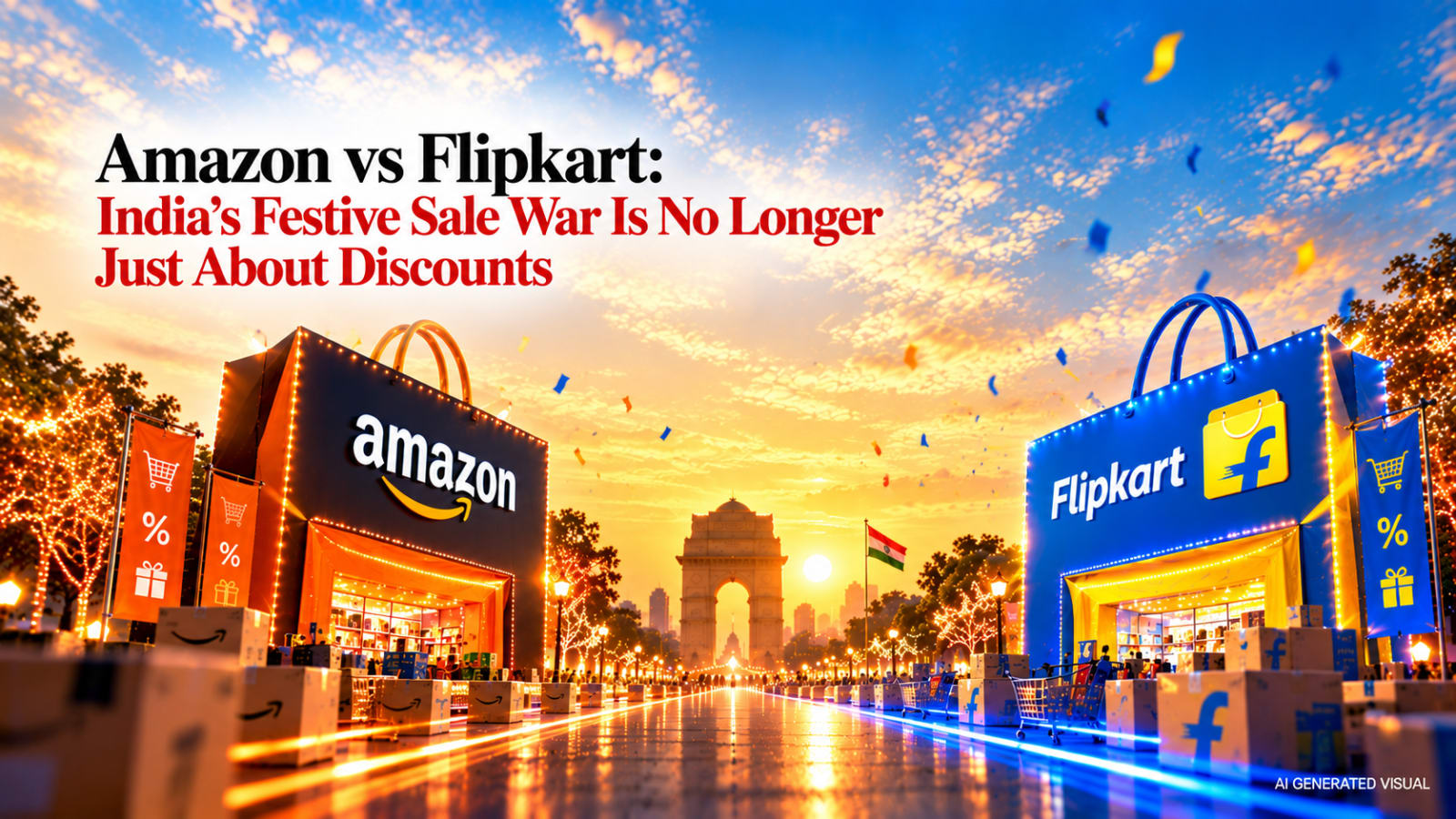
The Great Indian Festival and Big Billion Days are competing for more than shopping carts. They are trying to shape how India discovers products, judges value and expects everything to arrive.
There is a familiar ritual in Indian households when the festive sales arrive. A phone sits in a wishlist for weeks. Someone checks whether the television is finally affordable. Family WhatsApp groups fill with screenshots, bank card suggestions and urgent questions about whether a deal is actually a deal.
This year, the ritual has a new dimension. Amazon’s Great Indian Festival opened to all shoppers on October 8. Flipkart’s Big Billion Days opens to everyone on October 9, after early access for eligible customers. The timing puts two of India’s most recognisable retail events almost directly against one another. [Source]
The visible contest is about prices. The more consequential contest is about habits: where people begin searching, which offers they trust, how they finance purchases and how quickly they expect an order to reach their door.
The discount is only the opening move
Both platforms know the power of a spectacular number. Amazon advertises festive savings across phones, electronics, fashion, beauty and household categories, with SBI-linked offers and other benefits for eligible shoppers. Flipkart promotes bank offers, exchange options, special launches and a vast assortment. Those claims are useful starting points, not proof that every item is cheapest on either platform. [Source]
The real price is the amount that appears at checkout after the eligible card discount, exchange value, delivery charge and any financing costs. A headline percentage can be calculated against a reference price that is not what most shoppers would otherwise have paid. Comparing the exact model and its recent selling price remains more meaningful than comparing promotional banners.
Even the window for the most aggressive discounts may be changing. An October 8 Economic Times report says brands facing rising input costs are concentrating their steepest festive offers in a shorter initial period. That makes the opening days more important, but it also raises the pressure on shoppers to make decisions quickly. [Source]
The biggest prize is becoming the place where shopping starts
An ecommerce platform wins more than a transaction when a customer opens its app before considering alternatives. It gets the first opportunity to influence the shortlist, the product comparison and ultimately the purchase.
Flipkart’s October 6 announcement describes AI-powered shopping, including discovery experiences, alongside record seller participation and an expanded fulfilment network. Amazon’s festival communication similarly emphasises assortment, deals and delivery options measured in minutes, hours, same-day and next-day windows. These are company descriptions of their own capabilities, not independently verified measures of who performs better. [Source]
The shift matters because discovery is no longer a simple search box. A shopper can arrive with a photograph, a broad need or a question rather than a product name. The platform that reduces the work of deciding what to buy can become influential long before the payment page.
That convenience has a trade-off. Recommendations and promoted placements can help shoppers find relevant products, but they also shape what is visible. The question is not only whether AI makes shopping faster. It is whether shoppers can tell why a particular product is being shown to them.
Fast delivery is changing what a festive sale promises
For years, online festive sales were associated with waiting: placing an order during a promotional rush and tracking a parcel over the following days. Quick commerce is challenging that expectation.
Amazon Now has expanded to more than 120 Indian cities, according to a Financial Express report published in early October. Flipkart says its Minutes service will offer more than 77,000 products across over 150 cities during Big Billion Days. The breadth and availability of those services still depend on location and the individual product. [Source]
The strategic implication is bigger than festive shopping. If consumers become accustomed to ordering everyday items almost immediately, they may carry that expectation into categories once associated with slower deliveries. Speed becomes part of perceived value, not merely an extra service.
Yet the faster the promise, the more important the underlying economics become. Warehouses, inventory, delivery partners and returns all cost money. The question for both companies is how much speed shoppers will value after promotional incentives fade.
The Indian seller is part of this story too
The sale is often told as a rivalry between two giant apps. Behind each listing is a network of brands, marketplace sellers, delivery partners and small businesses whose fortunes can depend on visibility during a few high-traffic days.
Flipkart says the 2026 event includes record participation from sellers and MSMEs and a network of more than 8,200 fulfilment and delivery facilities. Amazon says it created more than 160,000 seasonal work opportunities across its India operations ahead of the festival. These are company-reported figures and describe different measures, so they should not be treated as a head-to-head comparison. [Source]
For a small seller, a surge in orders can mean reaching customers far beyond a local market. It can also mean greater pressure to fund promotions, maintain inventory, handle returns and compete for attention. A record-breaking sale for a platform does not automatically mean an equally successful season for every business using it.
Are shoppers saving more, or simply buying more?
This is the uncomfortable question at the centre of every festive sale. A lower price on something a household genuinely planned to buy is a saving. A tempting discount on something it never needed is still spending.
Bank offers, exchange deals, loyalty privileges and no-cost EMI can make a purchase more accessible. They can also make the final comparison harder. A shopper may need to weigh eligibility rules, processing fees, exchange assessments and delivery timelines before knowing the real cost.
A 2026 Datum Intelligence festive advertising report suggests that purchase research is beginning well before sale day and that AI-assisted product research is becoming common. Its figures are survey and forecast findings rather than a count of completed festive purchases, but they point toward a shopping journey that begins weeks before checkout. [Source]
That makes the sale less of a single event and more of a season-long contest for attention. The wishlist, the recommendation, the advertisement and the payment offer all become part of the same decision.
The next winner may not be the platform with the loudest sale
Amazon and Flipkart will both have compelling deals, and neither will necessarily be cheapest for every customer or category. The winner for a particular shopper may depend on a bank card, a postcode, a product model or whether an order is needed tomorrow rather than next week.
But the larger winner in India’s ecommerce race will be the platform that earns a more durable habit. It will be the one customers trust to show a fair choice, make the actual cost clear, deliver reliably and resolve problems after the purchase.
That is what makes the 2026 festive season worth watching beyond its discount banners. Amazon and Flipkart are not simply asking India to shop this week. They are competing to decide what shopping will feel like the rest of the year.
Tags
Read Next
More stories
Have a person, achievement or story our editors should know about?
Submit a Story
Stories worth telling, in your inbox.
Get the latest People Who Matter features delivered weekly.
Subscribe NowDiscussion
No comments yet. Be the first to share your thoughts.