
The World Came to Delhi. India Is Becoming the Centre of the New Global Order
The BRICS Summit brought Vladimir Putin, Xi Jinping and leaders from across the emerging world to New Delhi. The summit itself mattered, but so did what it revealed: India is growing rapidly, becoming easier to build and do business in, and gaining the economic and diplomatic gravity to sit closer to the centre of world affairs.
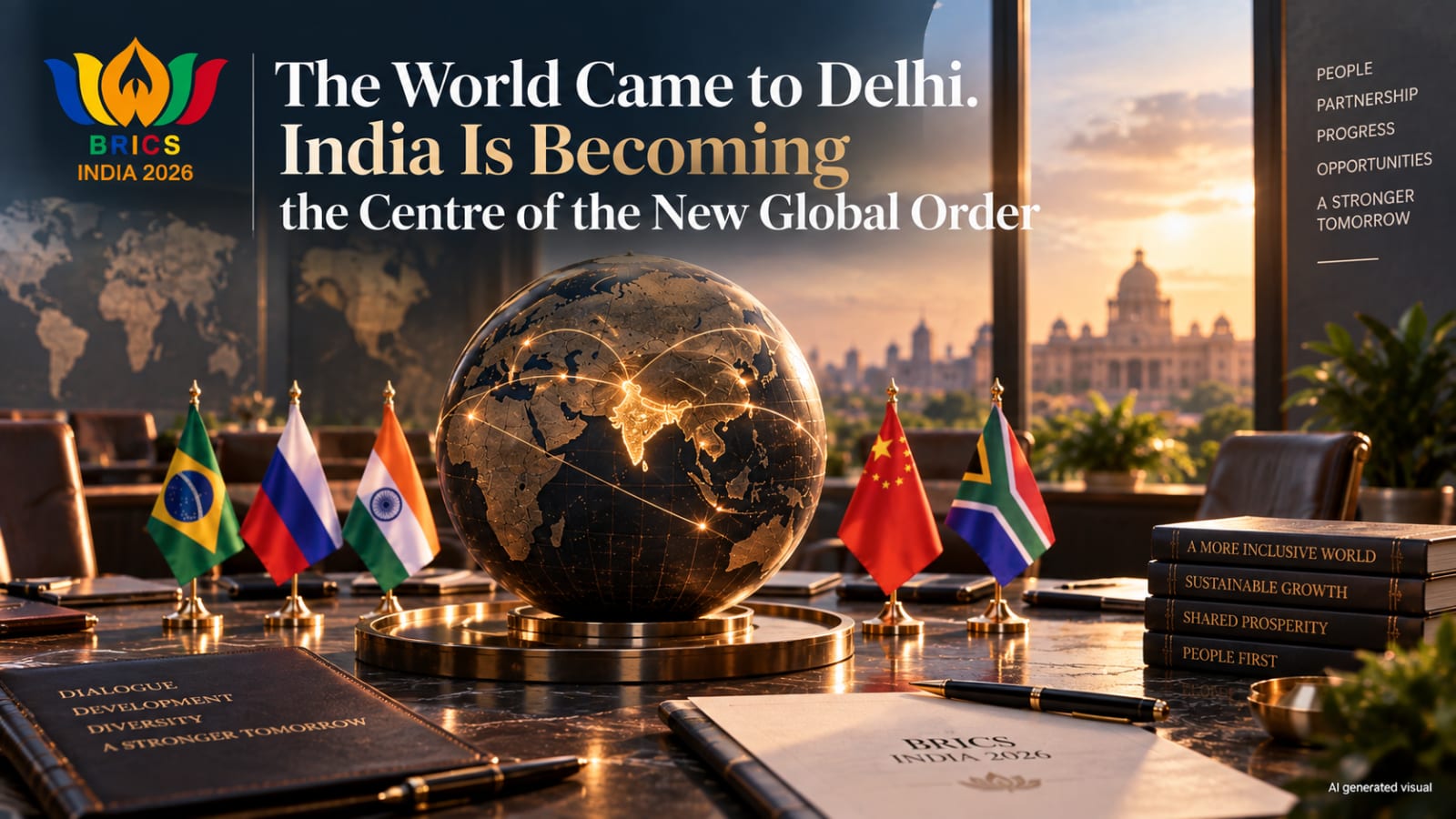
The BRICS Summit brought Vladimir Putin, Xi Jinping and leaders from across the emerging world to New Delhi. But the bigger story is the country hosting them: an India growing faster than most major economies, building better systems for business and everyday life, and gaining the economic weight to match its diplomatic ambition.
For two days in September, New Delhi became one of the most consequential rooms in world politics. Russian President Vladimir Putin was there. Chinese President Xi Jinping returned to India for the first time since 2019. Prime Minister Narendra Modi hosted leaders from an expanded BRICS that now stretches across Asia, Africa, Latin America and the Middle East. Iran and the UAE sat within the same grouping despite the war in West Asia. Brazil, South Africa, Indonesia, Egypt and Ethiopia were part of the conversation. The summit was important in its own right, but the more interesting question is what it said about India.
For decades, India's global story was told in the future tense. It was the economy that would become enormous, the market that would one day be impossible to ignore and the country that deserved a larger voice in institutions designed for another era. That language is beginning to feel dated. India still has serious challenges to solve, but the case for its rise increasingly rests on what is already happening: faster growth than most major economies, infrastructure being built at scale, digital systems that make everyday transactions dramatically easier, a deeper manufacturing ambition and a foreign policy confident enough to engage rival power centres without permanently joining any one camp.
What actually happened at the BRICS Summit?
The 18th BRICS Summit was held in New Delhi on September 12 and 13 under India's chairship and concluded with the New Delhi Declaration, a 140 paragraph consensus document covering global governance, trade, terrorism, conflicts, finance, technology, health, agriculture, climate and development. The official declaration described the summit theme as “Building for Resilience, Innovation, Cooperation and Sustainability” and reiterated the group's push for a more representative international order. The New Delhi Declaration also carried a visible Indian imprint, including initiatives around digital public infrastructure, industrial capabilities, health and development cooperation.
Consensus itself was one of the summit's achievements. BRICS includes countries with very different interests and relationships, and the meeting took place amid wars, sanctions, tariffs and serious geopolitical tension. Yet the members agreed on language urging restraint and diplomacy in West Asia, opposed unilateral trade restrictions, backed greater use of local currencies and cross border payment cooperation, and renewed demands for reform of global institutions. The declaration also condemned terrorism and specifically referenced the Pahalgam attack. The Indian Express noted that the final text included several India led priorities and that achieving consensus was significant after BRICS foreign ministers had failed to produce a joint statement earlier in the year.
The summit also produced the photographs and bilateral conversations that naturally travelled further than the declaration. Modi met Putin, Xi and Iranian President Masoud Pezeshkian. India and Russia discussed their strategic relationship and a goal of taking bilateral trade towards $100 billion by 2030. Modi and Xi used Xi's first India visit in seven years to discuss the boundary, trade imbalances, market access, business exchanges and a cautious stabilisation of ties. Associated Press described the Modi Xi meeting as another step in an effort to repair relations damaged by the 2020 border clash.
Those meetings matter for search headlines, but they also matter to the larger India story. Putin coming to Delhi is important. Xi returning to Delhi is important. Iran and the UAE accepting a common declaration in Delhi is important. Together, they show that New Delhi is becoming a place where countries with competing interests are still willing to show up, talk and negotiate.
The summit was the backdrop. India was the bigger story.
India's diplomatic position is unusual. It can deepen defence and technology ties with the United States while maintaining a strategic relationship with Russia. It can participate in the Quad while helping lead BRICS. It can work closely with the Gulf and Israel. It can compete with China while still sitting across the table from Xi Jinping and discussing trade, connectivity and regional stability. In an older geopolitical order built around rigid blocs, these relationships might have looked contradictory. In a fragmented and increasingly multipolar world, they are becoming an advantage.
The Indian model is not to be equidistant from everyone. It is to preserve enough strategic autonomy that relationships can be judged on Indian interests rather than inherited alliances. That makes India useful to countries that do not necessarily trust one another. The ability to speak to Washington, Moscow, Beijing, Abu Dhabi, Riyadh, Paris and Tokyo while retaining credibility across much of the Global South is a form of leverage that few countries of comparable size possess.
The economic numbers are beginning to justify the confidence
Diplomatic ambition carries far more weight when it is backed by economic momentum. India grew 7.6 percent in FY26, up from 7.1 percent the year before, and the World Bank described it as the fastest growing major economy despite global trade tensions. The first quarter of FY27 was stronger still: official data showed real GDP expanding 7.8 percent, with investment up 11.9 percent, household consumption up 7.1 percent and exports up 12 percent. The IMF has called India one of the world's fastest growing economies and a key engine of global growth.
The comparison matters. Many advanced economies are struggling to produce even modest growth, while China, although still vastly larger, is expanding at a slower pace than it did during its own high growth decades. India is not the fastest growing country of every size, nor has it solved the development problems that come with its scale. But among the world's biggest economies, the combination of size, population, domestic demand and sustained growth above 6 percent is unusual. It creates economic gravity.
That gravity is changing how companies think about India. The country is no longer simply a low cost operating base or a market to enter eventually. It is increasingly a place where global companies want to manufacture, build technology teams, sell to a rapidly expanding consumer base and position themselves for the next decade of growth. India's advantage is that much of this story is still early. The country is still urbanising, formalising, digitising and moving households into higher levels of consumption.
Doing business and everyday life increasingly work better
Perhaps the most persuasive version of the India story is the one people experience rather than read about. Moving money is easier. Paying a merchant is easier. Selling across states is more integrated. Company filings, tax systems, procurement and a growing number of approvals are digital. GST created a more unified national market, while digital banking and payments have reduced friction in transactions that once depended heavily on cash and paperwork. None of this makes Indian business frictionless, but it does make the India of 2026 structurally different from the India of a decade ago.
UPI is the clearest symbol of that change. A QR code at a roadside stall and the same payment infrastructure inside a large corporate ecosystem are part of the same network. The significance is not simply that digital payments are convenient. It is that India has demonstrated an ability to build public digital infrastructure for a population scale that very few countries have attempted. Identity, bank accounts, instant payments, digital documents and direct transfers increasingly form an operating layer underneath economic life.
The physical economy is changing alongside the digital one. Roads, airports, metro systems, railways, freight corridors, ports, logistics networks, power infrastructure and mobile connectivity have expanded significantly. There are still congested cities, uneven infrastructure and regulatory frustrations, but the direction matters. For businesses, time lost to logistics, payments, paperwork and fragmented markets is a real economic cost. Every improvement makes India not only larger, but more usable.
Manufacturing is becoming part of the proposition
India's global strength has traditionally rested heavily on services, but the next phase of growth depends partly on making more of what the world buys. Production Linked Incentive programmes, electronics manufacturing, mobile phone production and supply chain diversification are all attempts to create that capability. India does not need to become another China to succeed. Its more interesting opportunity is to combine manufacturing with software, engineering, design, a huge domestic market and digital distribution inside the same economy.
This is why the phrase “China plus one” only captures part of the opportunity. Companies may initially look at India because they want supply chain alternatives, but the deeper reason to stay is the market itself. A factory in India can potentially serve both global exports and one of the world's largest future consumer economies. That combination is difficult to replicate.
India has something many mature economies cannot recreate: runway
India is already one of the world's largest economies, yet it is still building much of the infrastructure, urban capacity and consumer wealth that mature economies built decades ago. Its population is younger than many major economic powers, creating the possibility of a long cycle of workers, entrepreneurs, engineers, creators and consumers. Demography is not destiny, and India will need better education, skills and millions of productive jobs for that advantage to translate fully into prosperity. But the strategic opportunity is enormous.
Most established global powers became rich before the digital age. India is attempting to become richer inside it. That means its growth can be layered on systems that are mobile first, data enabled and capable of scaling nationally much faster than older physical networks. The same country can simultaneously build highways, semiconductor capacity, digital payments, startups, metro systems, global capability centres and new consumer categories. That overlap is part of what makes the current moment unusual.
Putin and Xi matter because India now has something they need too
It is easy to view the presence of Vladimir Putin and Xi Jinping purely through the lens of diplomatic symbolism. But relationships between major powers ultimately rest on interests. Russia sees India as an important strategic and economic partner. China cannot construct a credible Asian or multipolar order while ignoring India. The United States and Europe see India as a major market, technology partner and increasingly important part of Asian strategy. Gulf economies see a vast consumer market, investment destination and long term energy relationship.
That is the shift worth noticing. India is no longer important merely because of where it sits on the map or because other powers want it on their side. It is increasingly important because access to Indian growth, consumers, talent, capital opportunities and diplomatic cooperation has value in its own right. The world is not coming to Delhi out of courtesy. It is coming because India increasingly matters to other countries' own economic and strategic calculations.
India positive does not have to mean India perfect
There is no need to turn this into chest beating. India still has substantial work ahead on per capita income, jobs, education, healthcare, air quality, urban planning, judicial speed, regulatory consistency and inequality. China remains a much larger economy. The United States retains enormous advantages in capital, technology, military reach and institutional power. Calling India a finished superpower would therefore be premature.
But acknowledging those gaps does not weaken the India story. It makes it more credible. The compelling argument is not that India has arrived at the end of its journey. It is that the direction and velocity have changed. Growth is strong, the operating environment is improving, infrastructure is being built, digital systems work at extraordinary scale, manufacturing ambitions are becoming tangible and the country's foreign policy has become more confident. The question is increasingly shifting from whether India will matter to how much it will matter.
The old world had power centres. The new one will need connectors.
Washington, Moscow and Beijing represented different centres of power in different eras. A genuinely multipolar world will still have powerful capitals, but it will also need countries capable of moving between them. India has the opportunity to become precisely that kind of power: large enough to matter on its own, independent enough to retain options and connected enough to speak to countries that do not always speak comfortably to one another.
That is why the BRICS Summit in New Delhi deserves to be remembered as more than a two day diplomatic event. The New Delhi Declaration, the Modi Putin engagement, Xi Jinping's return to India, the consensus among an increasingly diverse BRICS and the emphasis on the Global South all mattered. But together they pointed to something larger: India looked less like a country asking for a place in the global order and more like a country around which parts of that order are beginning to organise.
For decades, India wanted a bigger seat at the world's most important tables. Now it is doing something more ambitious. It is building the table, growing the economy around it and giving the world more reasons to take a seat. The world is not coming to India because India says it is the next great power. Increasingly, the numbers, the opportunity, the relationships and the direction of travel are making that argument for it.
Tags
Read Next
More stories

Have a person, achievement or story our editors should know about?
Submit a Story
Stories worth telling, in your inbox.
Get the latest People Who Matter features delivered weekly.
Subscribe NowDiscussion
No comments yet. Be the first to share your thoughts.